
Transcript
Announcer:
You’re listening to Project Oncology on ReachMD, and this episode is sponsored by Incyte. Here’s your host, Dr. Brian McDonough.
Dr. McDonough:
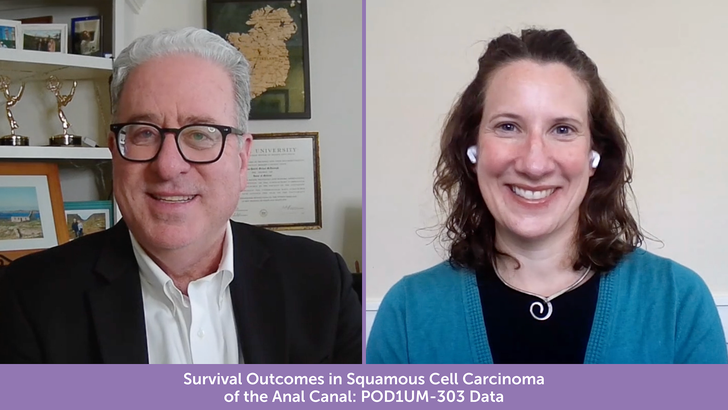
This is Project Oncology on ReachMD. I'm Dr. Brian McDonough, and joining me today to review the survival outcomes from the POD1UM-303 study, which evaluated retifanlimab in first-line advanced squamous cell carcinoma of the anal canal, is Dr. Stacey Cohen. Not only is she a Professor in the Clinical Research Division at Fred Hutch Cancer Center, but she's also a Professor in the Division of Hematology and Oncology at the University of Washington School of Medicine. Dr. Cohen, welcome to the program.
Dr. Cohen:
Thank you so much for having me today.
Dr. McDonough:
So let's begin with the trial itself, Dr. Cohen. POD1UM-303 was a randomized phase 3 study evaluating a checkpoint inhibitor in first-line advanced squamous cell carcinoma of the anal canal. With that context in mind, what aspects of the study's design are most important for clinicians to understand when interpreting these results?
Dr. Cohen:
Here we have the opportunity to review a randomized trial that was for metastatic anal squamous cell carcinoma patients. And this is great because a lot of our data is extrapolated from more common cancers or is based on earlier-phase small studies. So the fact that this was done really helps us ask and answer questions about the treatment of anal cancer and makes the interpretation of this really practice-changing.
So InterAACT-2 or POD1UM-303 was a randomized controlled trial that was done in over 300 patients with metastatic anal cancer, and it had a randomized double-blind fashion. So patients either had carboplatin-paclitaxel with placebo, or they had carboplatin-paclitaxel with retifanlimab, a PD-1 inhibitor.
And so this was exciting both for the evaluation of chemoimmunotherapy but also because they allowed for crossover; the patients in the placebo arm were able to cross over and receive retifanlimab in the second line. And I think that's a really important point because we've seen other immunotherapy trials where overall survival was heavily influenced by second-line therapy, but also by access to immunotherapy.
And so I think that makes it even more interesting to be able to interpret this data, both for progression-free and overall survival data.
Dr. McDonough:
Now, if we turn our attention to the findings, the study met its primary endpoint, with a median progression-free survival of 9.3 months versus 7.4 months at a hazard ratio of 0.63. From a clinical perspective, how meaningful is that degree of separation in the first-line advanced setting?
Dr. Cohen:
I think that that's a really huge benefit that we're seeing here, and I think that's very exciting. As we think about outcomes, often we only see small amounts of difference. And so even two months of survival improvement from a therapy really can add, in accumulation, meaningful overall survival. And so I think that is, in my mind, a really meaningful clinical benefit because if we think about it, we're typically scanning patients every two months or so. For us to be able to add another scan interval timing, I think that really adds true benefit. So this was a robust primary endpoint. We saw good risk reduction, but I think the fact that we are seeing that difference in benefit is exciting.
I do want to give the caveat, though, that when this trial data was first presented, it was interesting because they contrasted this phase three study, which was one of the later InterAACT studies, with the original InterAACT study that established carboplatin-paclitaxel as the standard of care. And actually, the control arm here did not do quite as well as had been shown before. So as we look for incremental benefit from adding retifanlimab, it's, of course, in contrast to what the control arm is, but I think that based on, as we'll talk about, some of the overall survival data, truly this is adding to what we see for patients being a beneficial treatment.
Dr. McDonough:
When it came to overall survival, retifanlimab was associated with a median overall survival of 32.8 months versus 22.2 months with chemotherapy alone. So how should we interpret that finding, especially considering that nearly half of the control arm crossed over to immunotherapy?
Dr. Cohen:
I think that's a really important point because as we look at overall survival data, that of course encapsulates the entire patient journey, not just the first-line therapy or the therapy in the trial. So I do think it's really important to look at the degree of benefit, both from the original intervention, but also from subsequent lines of therapy.
But thankfully because they had retifanlimab crossover as part of the study, they were able to do some of that analysis, and as expected, when patients get immunotherapy in later lines, we dilute some of that overall survival benefit. But really, if we're asking the question whether immunotherapy early on matters or could it be given at any time, we can use that crossover data to our benefit.
And I think what the trial shows is that getting retifanlimab as part of chemoimmunotherapy in the first line is still more beneficial than getting chemotherapy first and then getting immunotherapy in a later line. So we've seen that in colorectal cancer. We've seen that in other GI cancers. So I think that this really compounds what we know, which is that first-line therapy is critically important, that we give the best optimal therapy for the patient, and that we are doing that, in this case, with a combination of chemotherapy and immunotherapy.
Dr. McDonough:
For those just tuning in, you're listening to Project Oncology on ReachMD. I'm Dr. Brian McDonough, and I'm speaking with Dr. Stacey Cohen about survival outcomes from the POD1UM-303 study.
Now, in addition to the survival endpoints, the trial demonstrated an objective response rate of over 50 percent with retifanlimab and a median duration of response of nearly 15 months. So, Dr. Cohen, what do these secondary efficacy findings add to your interpretation of the overall results?
Dr. Cohen:
When we see progression-free and overall survival suggesting benefit, we expect to see that the other survival endpoints also show benefit as well. I think overall response rate is interesting because what that's capturing is complete responses and partial responses. It's not necessarily capturing the full benefit that we would say clinically because that doesn't include stable disease.
However, it's very exciting that over half of patients had actual shrinkage—at least 30 percent of their disease burden was reduced by the combination and that it was more durable. 15 months is an incredibly long time when we think about that. Before these data, we would quote an overall survival of about one year for metastatic anal cancer. So the fact that we are having prolonged progression-free survival with a durable response in patients is very exciting because that means that they're getting to live longer just on their first-line therapy, let alone on subsequent lines.
So I think that really helps us understand that the benefit from the overall survival that we're seeing is really probably being driven by this first-line therapy, especially given the paucity of later-line treatment options for this disease.
Dr. McDonough:
And from a safety standpoint, the addition of retifanlimab was generally well tolerated, and there were no new safety concerns with extended follow-up. Additionally, delivery of carboplatin-paclitaxel was not compromised. With all that being said, how should we think about these findings in the context of combination therapy?
Dr. Cohen:
I think that's a good point because there's always a concern that more is better, but more is also more toxic. And so I think as we look at these data, we want to make sure that we're not compromising the chemotherapy backbone because that still is critically important in the treatment of this cancer type.
And so I thought it was great that as we looked at the trial data, generally speaking, patients were still able to get the same dose intensity of chemotherapy in the two arms, meaning that we saw some expected toxicities from retifanlimab—the typical immune-related adverse events that we would expect to see with any PD-1 inhibitor—but that those toxicities did not preclude patients from getting the chemotherapy that they needed.
So this is really an additive or synergistic benefit for patients without the detriment of one of the therapies having to be dose reduced. And I hope that that means that as we start to treat patients off study, we're really going to be able to see that this is still feasible because I think that providers are very comfortable giving carboplatin-paclitaxel. That is sort of a regimen that has been around for many years. We're getting more and more comfortable with giving PD-1 inhibitors. And so now knowing that we can give these in combination without undue harm, I think that's very encouraging for implementation, even in practices that might not see this disease very often.
Dr. McDonough:
So if we consider all this data together before we close, Dr. Cohen, what do these findings mean for first-line decision-making in advanced squamous cell carcinoma of the anal canal?
Dr. Cohen:
Well, I think we can say that standard practice has changed. We have been under the paradigm that it was chemotherapy first, immunotherapy considered in the second- or later-lines, and trying other regimens as much as possible. But now, I think we know that the best first-line regimen, if we believe all of these data, is a combination of chemotherapy and immunotherapy.
The problem is it does not answer the question of what do we do next? Because if someone was able to get carboplatin-paclitaxel plus retifanlimab, we don't know that they would get the same benefit of going on single-agent immunotherapy. In fact, they probably wouldn't. We know that our chemotherapy options and second- and later-lines are not that robust.
And so I think at the same time of improving our standard of care, it also adds some questions because we have to figure out: How do we sequence therapies? How do we continue to improve overall survival statistics? So those will be questions that I'm sure will emerge in later analyses of the data as they look at exploratory analyses of hopefully, you know, if they know what patients got in the future after the original therapy, these will be really important. Maybe there'll be more biomarker data, but we know that, for example, PD-L1 is not an indicative biomarker in this disease in terms of choosing therapy.
So I hope that as we continue to be comfortable with this data, we can push the envelope a little bit more and learn about who are the patients that benefit the most and how do we plan subsequent lines of therapy? So these will be factors that I imagine will come about in the coming years, and hopefully even more so, we'll have more randomized controlled data for anal cancer because it's a population that truly needs it.
Dr. McDonough:
As those final comments bring us to the end of today's program, I want to thank my guest, Dr. Stacey Cohen, for joining me to review the survival outcomes from the POD1UM-303 study and how they're impacting our approach to first-line advanced squamous cell carcinoma of the anal canal. Dr. Cohen, it was great speaking with you today.
Dr. Cohen:
Thank you so much.
Announcer:
This episode of Project Oncology was sponsored by Incyte. To access this and other episodes in our series, visit Project Oncology on ReachMD.com, where you can Be Part of the Knowledge. Thanks for listening!

