Transcript
Announcer:
You’re listening to Project Oncology on ReachMD, and this episode is sponsored by Incyte. Here’s your host, Dr. Brian McDonough.
Dr. McDonough:
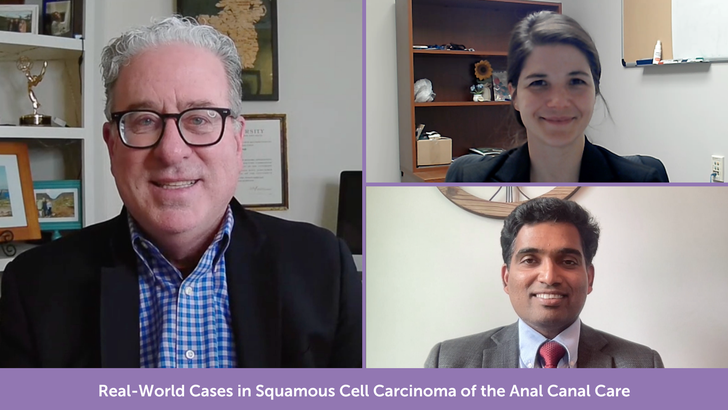
This is Project Oncology on ReachMD, and I'm Dr. Brian McDonough. Joining me to share real-world cases that demonstrate how we can personalize treatment and coordinate care for patients with squamous cell carcinoma of the anal canal are Drs. Madison Conces and Midhun Malla. Dr. Conces is a Clinical Assistant Professor at Case Western University School of Medicine in Cleveland, Ohio, and University Hospitals Seidman Cancer Center. Dr. Conces, welcome to the program.
Dr. Conces:
Thanks so much for having me. I'm excited to be here today.
Dr. McDonough:
And Dr. Malla is an Associate Professor of Medicine at the University of Alabama at Birmingham. Dr. Malla, it's great to have you with us as well.
Dr. Malla:
Likewise. Thanks for having me.
Dr. McDonough:
So let's begin with you, Dr. Conces. Could you briefly share two patient cases that illustrate how squamous cell carcinoma of the anal canal can present differently and explain what factors shaped your initial treatment approach?
Dr. Conces:
Yes, so there are two possible cases I can review just briefly. One is a patient comes in with severe pain. Maybe they're not able to sit because they're so uncomfortable, but of course, in the office, we make them feel comfortable; they can stand or position themselves however they need to. That's a very common presentation and probably one of the most frequent ways we see patients presenting. Another way is patients really struggling with their bowel movements; maybe they have obstructive symptoms. And those both play into how we maybe initially approach a patient. Now I'll compare apples to apples in presentations.
So for locally advanced disease in both of those situations, the priority may be, can that patient even have a bowel movement? If they can, then maybe we need to have a colorectal surgeon have a conversation about whether or not an ostomy is needed so that we can move forward with treatment. We obviously don't want someone having an obstruction from an anal mass. So even with locally advanced disease in the anal canal, you may have to start with a diversion or an ostomy just to even start treatment from a safety standpoint and from a patient's care point of view. So I'd say that's how they present differently and how you may even approach them.
But really the approach to treating cancer starts with the stage. And I think regardless of the staging, if someone presents with obstructive symptoms, they may need a diversion. But really, the stage matters and then the patient matters, right? So patients who are younger and healthy, you may have a different conversation about what your goals of therapy are compared to someone who's much older. That being said, while age matters for a lot of patients, especially with localized disease, we spend a lot of time trying to be as aggressive as we can, understanding that the cure rate of this cancer in the localized setting is very high at over 80 percent.
Dr. McDonough:
Thanks for sharing those cases with us, Dr. Conces. And if we turn to you now, Dr. Malla, is there a recent patient case of de novo metastatic disease that you've managed? And if so, how did you approach their first-line systemic therapy?
Dr. Malla:
The incidence of de novo metastatic squamous cell anal carcinoma is quite rare. I may even think of a handful of patients, if not less, that are diagnosed with this de novo metastatic squamous cell anal carcinoma. The majority of patients are diagnosed with localized disease or locally advanced perhaps because of the location of the disease leading to the symptom burden, as Dr. Conces has alluded to.
However, in my practice, I can recollect one of the patients that I'm currently managing who presented with de novo metastatic squamous cell carcinoma. He was a young gentleman with HIV and with a CD4 count less than 50; he also has additional infectious complications. He presented with significant anal pain, and further workup demonstrated liver metastases and also borderline performance status with the comorbidities affecting his performance status.
So my initial priorities were obviously focusing on rapid control and the proper regimen that can balance both efficacy and tolerability. Historically, for these patients, I think the favor tended to be chemotherapy alone based on the data from the InterAACT study with carboplatin plus paclitaxel. However, with the recent change in the landscape, we now have combination of immunotherapy together with chemotherapy that can be applicable in specific scenarios.
So with that being said, coming down to the patient again, our discussion as a multidisciplinary unit, including radiation oncology, surgical oncology, and medical oncology, were focusing on how much the patient can tolerate. And our concern was the development of frequent infections and being non-compliant with the medications, and so our focus was to involve an infectious disease doctor to help coordinate care and also help explain to the patient how important it is to manage the HIV and take those antiretroviral therapy medications to help boost the CD4 count so that we will be able to address it with therapy. So these discussions are currently ongoing, and I'm hopeful that we will be able to initiate him on systemic therapy.
Dr. McDonough:
Now, multidisciplinary coordination often becomes critical early on. So thinking about one of your cases, Dr. Conces, who did you collaborate with, and how did that shape treatment initiation and symptom management?
Dr. Conces:
Yeah, that's a great question, and I can go back to one of the cases I initially brought up, which is someone who may be presenting with obstructive symptoms. Your team will always consist of, especially in localized disease, a surgeon, a radiation oncologist, and a medical oncologist because treatment is primarily driven by chemoradiation from the medical oncology and radiation oncology perspective, but the surgeon is there to evaluate and then potentially resect if needed in the future. So those three team members are critical to anal cancer treatment.
Regardless of what the staging is for the patient, I would also say that supportive oncology or palliative care—it’s called different things in different institutions—is very important. As I mentioned before, severe pain is a common presentation, as is constipation. In addition, the medications that we give for chemotherapy can be very toxic. So having patients plugged in with those team members can be super helpful in terms of supporting the patient the best we can. So I'd say really from the start, all those people really usually are involved and really help move the care forward for the patient.
Dr. McDonough:
For those just tuning in, you're listening to Project Oncology on ReachMD. I'm Dr. Brian McDonough, and I'm speaking with Drs. Madison Conces and Midhun Malla about case-based strategies for treatment selection and care coordination in the management of squamous cell carcinoma of the anal canal.
So in practice, many clinicians encounter patients with recurrent disease after prior chemoradiation. If we come back to you, Dr. Malla, could you share a case where recurrence required you to consider systemic therapy options and how factors like comorbidities or autoimmune disease influenced the plan?
Dr. Malla:
A good 40 percent of patients can potentially have recurrence, either local recurrence or distant recurrence. So I want to share a patient case of a young patient who actually completed chemoradiation therapy with 5-fluorouracil and mitomycin. She was diagnosed initially at stage three disease, and unfortunately within six months after completion of her chemoradiation therapy, which led to complete response on the initial MRI evaluation at three months, but three more months later, we found this disease progression with retro-lymphadenopathy along with multiple hepatic metastases, maybe a couple in the lung as well. So this was a patient where we discussed starting with carboplatin-paclitaxel plus immune checkpoint inhibitor therapy based on POD1UM-303.
I think those discussions need to be really focused on multidisciplinary care so that we can safely introduce the immunotherapy to these patients while at the same time, making sure that autoimmunity hasn't have gotten worse. And more importantly, I think patients should be the center of this decision. Sometimes, I have had patients in other diseases who are on immunotherapy-based approaches, but they have autoimmune diseases. The discussion is always in terms of risks and benefits and patient preferences as well. So it goes on a patient-to-patient basis, but it's really important to engage and collaborate with subspecialty experts in the management of these patients.
Dr. McDonough:
Another situation that raises important questions is when a patient has immunocompromised status, and even though we've already talked about patients with HIV, I want to address it a little more. Dr. Conces, have you managed a case involving a patient with well-controlled HIV and metastatic disease? And if so, what impact did that have on your treatment strategy?
Dr. Conces:
So unfortunately, a lot of people in this patient population may not have the best social support; that can be in the form of lack of family that could be there to support them or friends. And overall, they may also struggle with things day to day; maybe they don't have a job or maybe they struggle to maintain a job because of all the appointments they have to come to and the chronic illnesses they're facing. Their own actual suffering as a person and the illnesses that they have can be a large burden for those patients, and they face a large hurdle to get to care.
So really, working as a team is key. Especially for chemoradiation in a localized setting—that's daily treatment; Monday to Friday for six weeks—that can be a lot in terms of transportation as a barrier to care as well as what makes sense for the patient. So Dr. Malla mentioned that having patient-centered conversations is super critical in this situation. A lot of times, I approach it where I say, "You have well-controlled HIV and you're taking your medications, but technically, one of the options for the chemotherapy is a pill versus an IV." So that's one of the two chemotherapies we include, which is capecitabine or fluorouracil, which is an infusion for five days. And so especially for patients who don't have an issue taking pills, we ask them, "Do you want to take a pill on top of the pills you're already taking? Or the infusional 5-fluorouracil?" So I usually have a conversation that's patient centered around 'you're already going through so much; what's the treatment plan that makes sense for you and your schedule, and how can we support you?' And so that's really important with every patient, but especially in patients who are already struggling so much with their healthcare and how much they're already facing outside of the cancer diagnosis and the treatment that goes along with that.
Dr. McDonough:
Before we wrap up, I'd like to turn to you, Dr. Malla, for the final word. Thinking about the cases shared today, what practical lessons have you learned about treatment sequencing, supportive care, or system-level barriers that other clinicians should keep in mind?
Dr. Malla:
I think what's important here is that treatment sequencing is evolving. Previously, we used to have chemotherapy in the first-line and in the metastatic setting, and then second-line followed immunotherapy. Now, immunotherapy goes together with the chemotherapy. So I think that's really important. The data is strong.
But I think the other aspects we really need to focus on is the patient. My decisions in the clinic really revolve around the patient-centered approach, like what prior toxicity they have, and if they have diabetes, what level of neuropathy they have because chemotherapy can make those things worse. What is their performance status? And as Dr. Conces mentioned, what level of family support do they have? Do they have somebody to drive them to the clinic visits and to support them in addition to the comorbidities, which we covered.
In addition to that, early integration of palliative care support is extremely critical because they do have high symptom burden. Most of our visits tend to be mostly focused on psychosocial support or somebody to, you know, lay their head on their shoulder in terms of, "Hey, what are you going through? What can we do to help?" Maybe even potentially connecting to patient support systems who have been going through this. Because this is a cancer seen commonly in elderly females as we know from the data, and at the same time, there's a lot of stigma around it for the patients who've been going through this, either because of comorbidities, the culture, or whatever it might be, right? So that could be the patient-level barriers that we need to address. And I'm learning as I go, but at the same time, that's my key priority: to get all the right people involved and, at the same time, make sure that the patient is able to navigate through the system-level barriers.
Dr. McDonough:
As those key lessons bring us to the end of today's program, I want to thank my guests, Drs. Madison Conces and Midhun Malla, for joining me to share these real-world examples of how we can better manage squamous cell carcinoma of the anal canal. Dr. Conces, Dr. Malla, it was great having you both on the program.
Dr. Conces:
Thanks for having us.
Dr. Malla:
Pleasure to be here.
Announcer:
This episode of Project Oncology was sponsored by Incyte. To access this and other episodes in our series, visit Project Oncology on ReachMD.com, where you can Be Part of the Knowledge. Thanks for listening!