
Transcript
Announcer:
Welcome to CE on ReachMD. This activity is provided by Medcon International and is part of our MinuteCE curriculum.
Prior to beginning the activity, please be sure to review the faculty and commercial support disclosure statements as well as the learning objectives.
Dr. Butler:
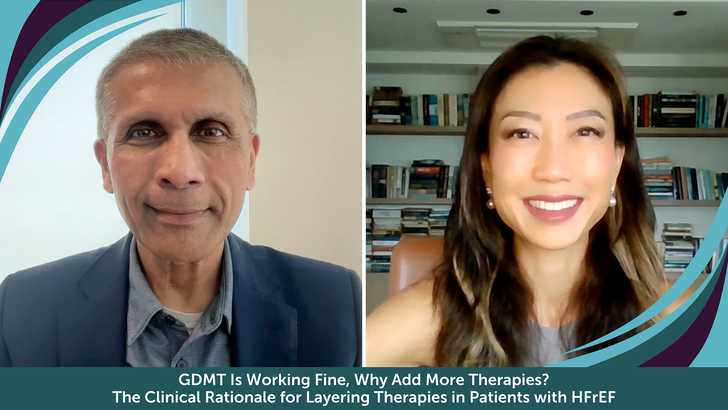
This is CE on ReachMD, and I'm Dr. Javed Butler. Here with me today is Dr. Carolyn Lam. We are discussing the clinical rationale for layering therapies in patients with HFrEF, or heart failure with reduced ejection fraction.
So, Carolyn, let me ask you a question. Why should we consider adding more therapies to patients with heart failure who may be on multiple therapies and may not be having a whole lot of symptoms?
Dr. Lam:
You know what, Javed, I think the main keywords here is residual risk. We now have the quadruple therapy, right? And we know that that is the ARNI, beta-blocker, MRA, and then the SGLT2 inhibitor. But if you even look at our SGLT2 inhibitor trials, EMPEROR-Reduced and DAPA-HF, in the treated arms—the treated arms, which means on quadruple therapy, usually—there is a significant residual risk. For cardiovascular death, that's like 6% to 8% per 100 patient-years. For the combined cardiovascular death or heart failure hospitalization, that's like 12% to 16%. So that's a lot. That means like in 5 years, for example, that's like more than 50% who would have experienced one of these events. And this is the treated arm with SGLT2 inhibitors on top of the triple. So surely, we need to do something about that residual risk.
Now, to add to that, here we're talking about heart failure hospitalization and cardiovascular death. We're not even counting the so-called softer, perhaps, signs that patients are getting worse. And I think you've nicely shown us before that that kind of manifestation of worsening heart failure is getting more and more common in our trials.
For example, in the PARADIGM trial, I believe that heart failure hospitalizations, in the whole manifestation of worsening heart failure, was, yes, the majority, but there was at least almost a quarter of patients experiencing outpatient worsening. And that has increased over time in all our trials, so that in VICTOR, that was like 60%, the majority of the manifestation.
So what we need to get over is, first, that there is residual risk. Secondly, that there are more subtle manifestations of this risk that we're not even counting and are getting more common because of the way we're treating patients more as an outpatient. In other words, we should never look at the patient with chronic heart failure as stable. That should be removed from the lexicon of our vocabulary, and we should recognize that they are always at risk of worsening. And if they are, why aren't we doing something about it? Why are we wasting time when we could be adding therapies that could be helpful on top of the existing therapies?
Dr. Butler:
This is so well said. I sort of think about it like any other disease, if you look at it. We have sort of looked at it over a spectrum, right? So initially, when the cholesterol treatment came about, it was like total cholesterol of 300, and then 240, and then 200, and then we get into the details about LDL, HDL, and then we individualize it to a person.
Same thing with blood pressure. Remember, there was a time when they used to say, if you're old, high blood pressure is fine, and then those thresholds changed also. Here is the same thing that you very aptly say, that what we call worsening heart failure, or the danger signs, that actually is a much bigger spectrum than hospitalization that we were talking about.
Let me ask you a very quick question. What about the risk of sudden cardiac death in these patients?
Dr. Lam:
Absolutely. So the risk of sudden cardiac death is also very real. And so far, what have we been doing? We've been putting in defibrillators. And frankly, where I come from in Asia, we can't afford and patients cannot afford, because of the out-of-pocket costs, to put defibrillators in everybody, right? And there is that very real risk that also may not be heralded by any symptoms—and that's why we call it sudden cardiac death. And so that's why we really, really owe it to our patients to put them on all the best therapies that are available.
Now, with VICTOR, we have a drug that works with a completely different mechanism of action from the quadruple therapy, and we have shown that it reduces cardiovascular death and sudden cardiac death, in particular.
Dr. Butler:
Well, very well said. So if I were to just summarize what you said, one thing you first said is that residual risk on good medical therapy is about 12% to 15%. In other words, 1 in 6 to 7 persons will die or get hospitalized within a year on good medical therapy. And this risk is substantially higher than what patients face, suppose, if they were to come in with myocardial infarction and stroke. So this is a real risk that the patients have, and that there are no such things as sort of stable patients, even if their symptoms are stable. And then you have this risk of cardiovascular mortality and sudden cardiac death, which is a little bit unabated.
And obviously, ICDs are not therapy for arrhythmias per se. They don't lower the risk, but if you were to get arrhythmias, they were to give you a shock.
So basically, lots of work to do. Vericiguat is one, but I think we need more effective drugs and devices, and the science will continue to move forward.
I really, really appreciate all your insights. And to all our listeners, thank you very much for listening, and we'll see you next time.
Announcer:
You have been listening to CE on ReachMD. This activity is provided by Medcon International and is part of our MinuteCE curriculum.
To receive your free CE credit, or to download this activity, go to ReachMD.com/CME. Thank you for listening.
 This enduring activity is accredited by the European Board for Accreditation of Continuing Education for Health Professional (EBAC®) for 45-minutes of effective education time.

