
Transcript
Announcer:
Welcome to CE on ReachMD. This activity is provided by Medcon International and is part of our MinuteCE curriculum.
Prior to beginning the activity, please be sure to review the faculty and commercial support disclosure statements as well as the learning objectives.
Dr. Bauersachs:
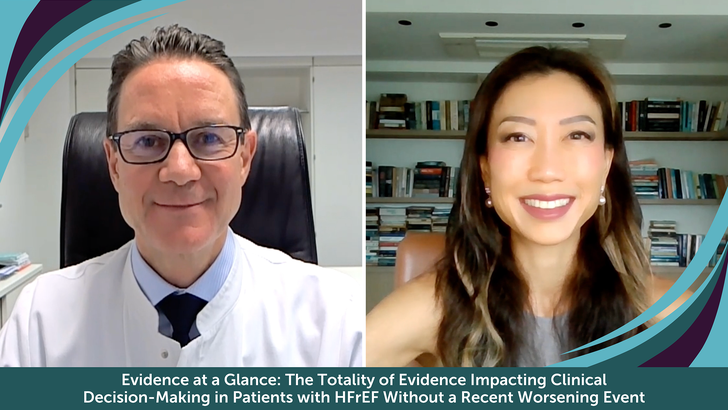
This is CE on ReachMD, and I'm Dr. Johann Bauersachs. I'm joined by Dr. Carolyn Lam. Today we are going to look at the evidence supporting the use of sGC stimulator therapy in patients with heart failure with reduced ejection fraction, HFrEF, without a worsening event.
Carolyn, would you like to start us off?
Dr. Lam:
Yes, I would love to talk about the VICTOR trial. When you talk about HFrEF in patients without a recent worsening event, the largest trial to date is, in fact, VICTOR. So VICTOR randomized patients with heart failure and ejection fraction of 40% or less to vericiguat 10 mg a day versus placebo. And these were patients who did not have a heart failure hospitalization within 6 months or IV diuretic use as an outpatient. In fact, almost half of these patients were never even hospitalized before. So it's that kind of patient who were also very well treated with background guideline-directed medical therapy, and almost a third had ICDs, devices in place. So it's in this kind of, quote/unquote, stable, right, patients. Vericiguat, although, did not reach the primary endpoint of a significant reduction in cardiovascular death and heart failure hospitalization, the composite, there were numerical trends in the correct direction and, very importantly, a significant reduction in cardiovascular mortality. That was a 17% reduction in cardiovascular mortality, 16% reduction in all-cause mortality, and really, really showing that we are able to move the needle on survival even in this quite stable population. If we now put this together with the large VICTORIA trial, that was a mirror to VICTOR and included HFrEF only within 6 months of a hospitalization—and this was a positive trial that significantly reduced the composite of heart failure hospitalization and cardiovascular death—we pool this together, there's now incredible totality of evidence in more than 11,000 patients with HFrEF showing that vericiguat, compared to placebo, reduced the composite of heart failure hospitalization, of cardiovascular death, and this occurred with no new safety signals, was very well tolerated in a once-a-day oral regime.
Dr. Bauersachs:
Thank you very much. It's so important that you so nicely summarized here the VICTOR and the VICTORIA studies in this broad spectrum of heart failure with reduced ejection fraction. I think it's especially important that in VICTOR, for example, there were the patients on the best possible therapy, and they had a lot of SGLT2 inhibitors, they had a lot of ARNI in place, and a lot, as you mentioned, of ICD. So really very well-treated patients with heart failure with reduced ejection fraction. Maybe you can also comment on a broader heart failure endpoint. It was not only heart failure hospitalization, but it was also analyzed in a broader sense, heart failure endpoints.
Dr. Lam:
What a great point, Johann. So in VICTOR, hospitalizations were not the majority of the events. The majority of the events of heart failure worsening in the patients was actually outpatient diuretic intensification. So it was patients who needed to either be initiated on new oral diuretics or have their oral diuretic dose increased.
Now this is not traditionally recognized as an event, but now we know it's a very, very important signal that patients are worsening. In fact, it's becoming the more common manifestation in patients, like in VICTOR, who are relatively the outpatient type of population or who may not have been hospitalized before.
When we put these events into the totality of the consideration, there was, in fact, a reduction in these total heart failure events with vericiguat compared to placebo.
Dr. Bauersachs:
So, and really important additional medications for our patients with HFrEF, easy to apply, working in reduction of mortality and heart failure hospitalizations, and therefore, I think, very important for our clinical practice.
Well, we covered a lot of ground today. Thanks for sticking with us and we'll see you next time. Thank you.
Announcer:
You have been listening to CE on ReachMD. This activity is provided by Medcon International and is part of our MinuteCE curriculum.
To receive your free CE credit, or to download this activity, go to ReachMD.com/CME. Thank you for listening.
 This enduring activity is accredited by the European Board for Accreditation of Continuing Education for Health Professional (EBAC®) for 45-minutes of effective education time.


