Transcript
Dr. McDonough:
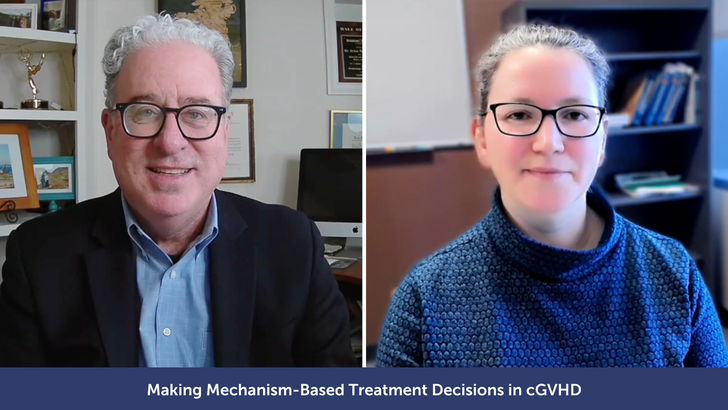
You're listening to Project Oncology on ReachMD, and I'm Dr. Brian McDonough. Joining me to explore how the pathophysiology of chronic graft-versus-host disease, or cGVHD for short, can inform mechanism-based treatment decisions is Dr. Alicia Lieberman. She's a rheumatologist at Roswell Park Comprehensive Cancer Center, where she specializes in GVHD and post-transplant immune dysregulation, as well as cellular therapies for refractory autoimmune disease. Dr. Lieberman, welcome to the program.
Dr. Lieberman:
Very happy to be here today.
Dr. McDonough:
Dr. Lieberman, let's just jump right in. Recent guideline updates and expert recommendations are highlighting the growing rate of targeted cGVHD therapies with direct mechanisms of action. What stands out to you about this move toward a more mechanism-driven approach?
Dr. Lieberman:
I'm really excited to see renewed focus on targeting the specific mechanism of action for chronic GVHD. Chronic GVHD certainly has a much broader umbrella in terms of immune dysregulation and how that manifests from patient to patient.
So I think diving back into the specific mechanisms and unique patient characteristics, refocusing on developing new tools and biomarkers, and working with our pathologists to really hone in on what's driving the inflammation for a particular patient makes so much sense now that we have more tools at our discretion to use to try and regulate this inflammation.
Dr. McDonough:
So with that in mind, I'd like to walk through the available therapies one by one, focusing on their mechanism of action and the specific immune pathways they target. Starting with cytokine-driven disease, how do you think about T-cell activation and cytokine signaling in cGVHD, and where do JAK inhibitors fit in?
Dr. Lieberman:
Cytokine-driven inflammation is sometimes the easiest and first step to wrap our brain around because we think about a single cytokine or a single signal and then the response, which we can characterize fairly easily. It does become much more complicated when we start to think about the milieu of all the different cytokines—pro-inflammatory, counter-inflammatory, and so on.
So I think when we see Th1 or Th17—maybe particularly Th1-driven inflammation—it makes a lot of sense to think about going after IL-6, TNF-alpha, and those sorts of things. That's also why we use corticosteroids upfront in so many cases. JAK inhibitors are just such a nice therapeutic option, especially for this Th1-driven response. They tend to work fairly quickly. They're hitting those pro-inflammatory cytokine mechanisms. So I think JAK inhibitors first line in many cases, especially for robust inflammatory response, is becoming standard of care.
Dr. McDonough:
B-cell activation is another key driver. How does that biology translate into clinical decision-making, and when do you consider BTK inhibition?
Dr. Lieberman:
So this is very interesting. I'm trained as a rheumatologist; we spend a lot of time thinking about dysregulated B-cell responses and conditions that are driven by pathologic antibodies. In some cases like chronic GVHD, I really feel like this story still needs to be investigated some. Perhaps not upfront except in rare cases, but a secondary pro-inflammatory or dysregulated B-cell response is clearly involved, especially for our fibro-inflammatory conditions which so many forms of cGVHD turn into. So I spend a lot of time thinking about when to target B-cells.
I have just joined the GVHD community in the past couple of years where we've had a number of new medications become available. So my experience with BTK inhibitors is a bit limited. In particular, there are some side effects or risks when it comes to kinase inhibitors that we do need to be mindful of in our patient population who may be treated with other medications, such as corticosteroids. And so the side effect profile of the BTK inhibitors does tend to have me place them a little bit lower in my triage when thinking about therapeutic decisions.
Dr. McDonough:
That's valuable information. For those just tuning in, this is Project Oncology on ReachMD. I'm Dr. Brian McDonough, and I'm speaking with Dr. Alicia Lieberman about the importance of understanding pathophysiology when making treatment decisions for cGVHD.
So, Dr. Lieberman, as the disease evolves, fibrosis can become a major challenge. How do you recognize that shift, and where do ROCK2 inhibitors come into play?
Dr. Lieberman:
The fibrosis that patients experience and those who develop sclerosis and fibrosis is really striking and is somewhat unique to cGVHD compared to the broader world of autoimmunity. I tend to think of it upfront. It can be challenging to recognize because what we're often seeing is more of a hot form of inflammation, and then over time, the response develops into more of a fibrotic pattern. So it is something that I'm worried about upfront. Whether or not I'm seeing it, I would like to prevent its development. Fibrosis sclerosis is effectively a form of scar tissue, and so if it is reversible, it can take a long time, and it really impacts patients' quality of life and organ function.
Dr. McDonough:
We're also learning more and more about innate immunity in its role. What's the significance of macrophage and monocyte involvement, and how might emerging therapies target this pathway?
Dr. Lieberman:
So tissue macrophages and dendritic cells are long-lived resident directors of local immune responses, and they're really important and powerful and have been mysterious to the immunology community for a long time. Once they develop and they take on certain characteristics, we have not had many tools to really modulate how they respond to inflammation. They're very complex cells; we almost talk about them having different signatures and moods.
So being able to potentially modulate the tissue response is, in many cases, a game changer. They're very important in Th2 fibrotic inflammatory responses. And so now we have a new tool: CSF-1 inhibitor therapy. This is a fairly new agent that we're using in the clinic, and we're still learning a lot. But for fibrotic disease and certain organ systems, it does seem to offer a unique therapeutic effect.
Dr. McDonough:
Finally, Dr. Lieberman, now that we're able to target multiple mechanisms, how are you thinking about sequencing and switching therapies to improve durability of response?
Dr. Lieberman:
It's a fascinating question, and I think it's highly individual to the patient. So I would say for patients who are early in the course of developing cGVHD that perhaps involves multiple organ systems, sometimes even with a variety of clinical manifestations—so we may have lichenoid skin and mucosal inflammation but also with some serositis or some edema and very early musculoskeletal manifestations, so I'm worried about fibrotic progression—I really want to use some tools that allow for broad immune modulation, so something that is both covering the Th1 inflammation but then also is antifibrotic or at least decreasing the risk of fibrotic progression. So combinations of therapies that will hit multiple patho-mechanisms is really important. Whereas sometimes over time, someone will get a very strong profibrotic signature, in which case I may want to use multiple lines that are primarily antifibrotic, so your ROCK2s and then maybe your CSF-1 inhibitors. So we're seeing more powerful responses to some chronic manifestations that we really haven't had good treatments for in the past.
Dr. McDonough:
With those final takeaways in mind, I want to thank my guest, Dr. Alicia Lieberman, for joining me to discuss how pathophysiology informs mechanism-based treatment decisions in chronic graft-versus-host disease. Dr. Lieberman, it was great having you on the program.
Dr. Lieberman:
Thank you so much.
Dr. McDonough:
For ReachMD, I'm Dr. Brian McDonough. To access this and other episodes in our series, visit Project Oncology on ReachMD.com, where you can Be Part of the Knowledge. Thanks for listening!