Transcript
Announcer:
You’re listening to Heart Matters on ReachMD, and this episode is sponsored by CSL Behring. Here’s your host, Dr. Brian McDonough.
Dr. McDonough:
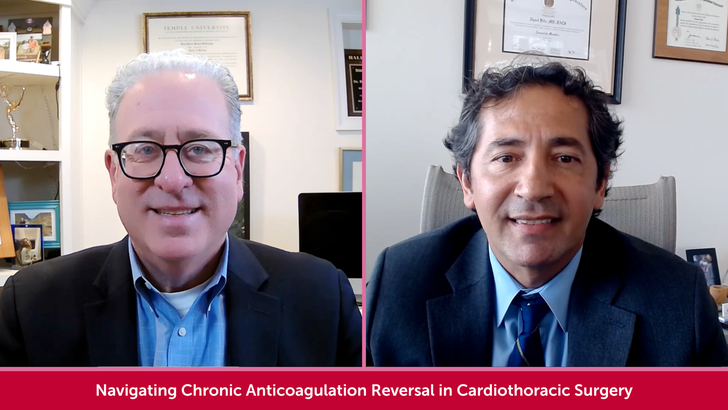
Welcome to Heart Matters on ReachMD. I'm Dr. Brian McDonough. And joining me today for a discussion on chronic anticoagulation reversal decision-making in cardiothoracic surgery is Dr. Ahmet Kilic. He's a Professor of Clinical Cardiac Surgery and the Program Director for the Cardiothoracic Surgery Residency Program at Johns Hopkins Medicine in Baltimore.
Dr. Kilic, thanks so much for being here today.
Dr. Kilic:
I appreciate the invitation. Looking forward to our discussion.
Dr. McDonough:
Dr. Kilic, let's start with an urgent clinical scenario. Say a patient on chronic anticoagulation therapy for atrial fibrillation or a mechanical valve presents with aortic tamponade or needs emergent CABG. What makes reversal agent selection so time-sensitive in this setting, and how do you communicate that urgency to the patient and family?
Dr. Kilic:
In the two cases that you described, if an aortic tamponade or an aortic dissection happens, that means that we need to operate right away to save someone's life. A significant amount of our patients already has diseases that involve the heart, and those usually involve some kind of anticoagulation. If you've had a heart valve that's mechanical, it's vitamin K antagonists. If you have atrial fibrillation and other non-valvular reasons to be on anticoagulation, it usually involves something called a DOAC, or direct oral anticoagulant. And both of those things make the blood fairly thin.
As a result, when someone needs an emergent operation, we don't have the luxury of time to allow the body to naturally get rid of that anticoagulant, and we'll need to operate fairly quickly. In that scenario, we'll take an aortic dissection. Every minute counts, and what I do is counsel patients and their families that the chance of bleeding with this operation is significant. In the specific case of an aortic dissection, it involves utilizing the heart-lung machine, cardiopulmonary bypass, where in order to do the operation, I have to circulate the blood outside of the body by giving it, ironically, more blood thinners. Then, I have to cool the body down to a temperature that will allow me to safely stop all blood flow, which once again leads to further bleeding.
So I give them that kind of scenario just so they know what they're in for, in addition to going over a whole bunch of things that include that we may not be able to get ahead of the bleeding, we may need to leave the chest open for a period of time, and at the very least, we will use a host of reversal agents for the anticoagulation that they were on.
Dr. McDonough:
So Dr. Kilic, I'd like to turn now to the patient-specific factors that can shape reversal strategy selection. How do reduced cardiac reserve, fluid tolerance, and overall hemodynamic stability influence your choice?
Dr. Kilic:
Oftentimes, we have patients who are quite sick, and when you're quite sick, a host of metabolic derangements can happen. And what I mean by that is when the heart is stressed, particularly on the right side, there's venous congestion that occurs. When venous congestion occurs, the kidneys act up and the liver acts up, and when those two things happen, you tend to bleed a lot more. Your body auto-anticoagulates itself, and that makes it very difficult for us to be able to get patients safely through without relying heavily on reversal agents.
Now, if the right heart is significantly backed up and there's venous congestion, the last thing you want to do is give a high volume of reversal agents. These patients are in a little bit of a delicate balance. For that reason, we tend to try to utilize other types of agents that reverse the anticoagulation without fluid overloading the patient. And there's a host of those things that we use in our armamentarium, and although they're all fairly new, they're becoming more routine in adult cardiac surgery.
Dr. McDonough:
And beyond hemodynamics, how do factors like anticoagulant type and INR level guide your approach to reversal for a given patient?
Dr. Kilic:
Absolutely. In the operating room, we have become increasingly used to utilizing objective measures of anticoagulation. Unfortunately, things like INR or PTT sometimes take a little bit of time to come back. In addition, they're not very sensitive to some of the specific types of anticoagulants, and as a result, we kind of have to do our operation, and in the operating room, run certain tests.
Right now, something called thromboelastography with either TEG or ROTEM is something that we rely heavily on, and it looks at specific different factors in the blood that are being activated or are inadequate numbers so that we can objectively reverse the anticoagulation that we subjected the patient to.
Specifically for DOACs, we don't have a great assay, and we don't have great reversal agents. And as a result, what we often do is stop the DOAC several days before and allow the body to clear the medication effects before operating.
When patients are on vitamin K antagonists like warfarin, what we can end up doing is actually more rapidly reversing things with things like vitamin K and FFP. And so depending on which one of those anticoagulants you're on, we may or may not be able to speed up the body's reversal process.
In addition, I think it's important to know that we don't know everything. We don't have all of the answers. As we have new anticoagulants that are coming on board, we're asking new questions. We're trying to figure out how to assay things to see how effective they are and how thin the blood is. And one of the ongoing things that we'll be answering, I hope soon with some of our studies that are ongoing, is the effects of 4-factor PCC versus FFP in these specific cases.
Dr. McDonough:
For those just joining us, this is Heart Matters on ReachMD. I'm Dr. Brian McDonough, and I'm speaking with Dr. Ahmet Kilic about chronic anticoagulation reversal decision-making in cardiothoracic surgery.
Now, even when the clinical picture and the available evidence and guidelines point toward a particular reversal strategy, the ideal approach might not be feasible in practice. Where do real-world considerations come into play?
Dr. Kilic:
In the operating room, you're left with something that you absolutely have to do in the postoperative period, in the preoperative period. Clinical scenarios don't fit into nice little boxes. And so for that reason, heart surgery, just like many of the other specialties in medicine, is a team-approached, multidisciplinary collaboration. And so I rely very heavily in the operating room on my perfusionists, who deal with the heart-lung machine and get us real-time ACT, or activated clotting time, so we can see what the blood thinner is. It relies on my cardiac anesthesia colleagues, who actually run these tests and get the laboratory values in real time for us.
And my job is to really coordinate all of this and to say what I'm seeing in the field. In the field, I am seeing that there's a lack of clot formation, and I need to know why it's not clotting and whether it's the temperature's low or the fibrinogen level's low, and then we all communicate back together. Certain times, it's a tincture of time. Certain times, it's anticoagulation with protamine because we gave a huge amount of heparin to be able to do the operation. And other times, there's specific factors. And we go back and forth, and we talk about things, and I keep saying what I'm seeing in the field. Sometimes we pack and allow the body to kind of start getting over things, and we do that all in constant communication.
Dr. McDonough:
Well, finally, Dr. Kilic, none of these decisions are possible without the team around you. What does effective coordination across the care team look like when rapid anticoagulation reversal is needed?
Dr. Kilic:
Just like everything else in life, the more you experience things, the more you realize what you can anticipate and how you need to communicate effectively and get the team around you for the common goal. It's not too uncommon that we'll have a patient who we've done a large operation on who has required a lengthy procedure that's been complex, and when we do that, we are expecting the coagulation to be off when we come off the heart-lung machine. So it's of utmost importance to communicate that we're going to need blood products and we're going to need certain reversal agents and for the team to be ready.
Sometimes, we use the pump suckers that go back to the heart-lung machine for an extended period of time, so I need to communicate with my perfusionist. Sometimes, we need to make sure that the cell saver that we use is readily available. That's a transfusion back to the patient. Other times, we make sure that there's a cooler of blood products available as we come off the heart-lung machine, and that'll allow the body to kind of reconfigure itself.
Oftentimes, it may also require that we have a certain set of laboratory values immediately available so we can assess the medical coagulopathy that may be present. In extreme cases, we communicate that there may be a rapid transfuser readily available for us to be able to transfuse back to the patient.
So all of those things are done in coordination because we have to ensure that we have a transparent mode of communication and everyone's on the same page. Otherwise, it leads to massive amounts of blood and volume shifts that occur with the patient, and that can put the patient at risk of hemorrhagic shock.
Dr. McDonough:
This has been a great conversation. I want to thank my guest, Dr. Ahmet Kilic, for sharing his perspective on chronic anticoagulation reversal decision-making in cardiothoracic surgery.
Dr. Kilic, it was great having you on the program.
Dr. Kilic:
Thank you so much for the invitation and the wonderful discussion.
Announcer:
This episode of Heart Matters was sponsored by CSL Behring. To access this and other episodes in our series, visit Heart Matters on ReachMD.com, where you can Be Part of the Knowledge. Thanks for listening!