Transcript
Announcer:
You’re listening to DermConsult on ReachMD, and this episode is sponsored by Leo Pharma Inc. Here’s your host, Dr. Brian McDonough.
Dr. McDonough:
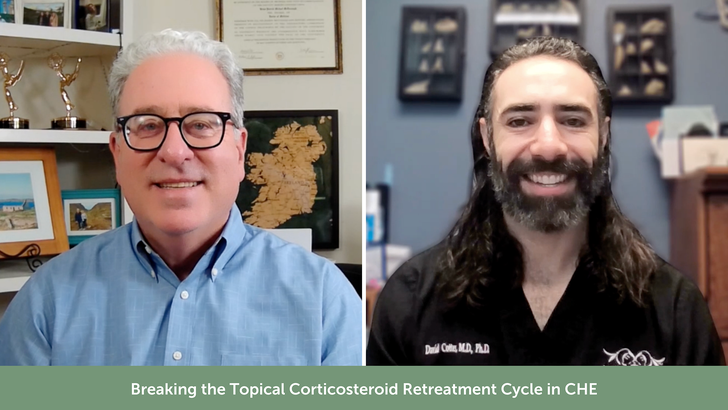
Welcome to DermConsult on ReachMD. I'm Dr. Brian McDonough, and joining me to share his insights on how we can better recognize when repeated topical corticosteroid retreatment may no longer be enough for patients with chronic hand eczema is Dr. David Cotter. In addition to being a dermatologist at Las Vegas Dermatology, he's also an Assistant Clinical Professor at the Kirk Kerkorian School of Medicine at the University of Nevada, Las Vegas. Dr. Cotter, thanks so much for being here today.
Dr. Cotter:
Thanks for having me, Dr. McDonough. It certainly is a pleasure to chat about chronic hand eczema.
Dr. McDonough:
Well, why don't we start, Dr. Cotter, by examining a scenario I think many of us have encountered in clinical practice. Let's say you have a patient with mild-to-moderate chronic hand eczema whose symptoms have improved with topical corticosteroids, but they were experiencing three flares in the past 12 months. What does that tell you about the patient's overall disease control?
Dr. Cotter:
This is an important clinical scenario to discuss because we see it often. It's a common pitfall in clinical medicine where someone ends up being referred to dermatology after having utilized topical steroids, and the story is like you described: “I got better for a while, but when I stopped using it, my hand rash came back.” And that's because chronic hand eczema is multifactorial.
Some patients have atopic dermatitis as a driver in addition to other external drivers, such as irritant contact dermatitis and allergic contact dermatitis. And any of those three can potentially be impossible to avoid. Hence, you have ongoing exposure and an ongoing driver of disease state, and our role is to help break that cycle of repeated topical steroid use because topical steroids in the long run can actually be harmful for the skin barrier.
When I have a patient that's telling me, “I got better on the steroids, but then I flared a few months later,” that's a patient who has no disease control at all, in my opinion.
Dr. McDonough:
As a follow-up to that, can you explain why temporary symptom improvement doesn't necessarily reflect true disease control? What's contributing to the ongoing disease activity beneath the surface?
Dr. Cotter:
When it comes to disease control, it's more than just temporary symptom control that we're going for. Topical steroids shouldn't necessarily be used like Tylenol for your skin. You have a headache, you pop a Tylenol, and you feel better. When it comes to eczematous diseases, you have ongoing inflammation, even subclinical microscopic levels of inflammation, and just treating PRN in a reactive manner may not be appropriate, particularly for many patients that have ongoing drivers of disease, such as occupational exposure, irritant dermatitis, allergic contact dermatitis, etc.
And what ends up happening is that when we do these repeated cycles of topical steroids on and off, you're actually negatively impacting the skin barrier over time. Topical steroids inhibit synthesis of the lipid bilayer, resulting in decreased barrier function, increased transepidermal water loss, and increased susceptibility to irritants and allergens. Hence, we can create a vicious cycle where we're just essentially spinning our patients' wheels. Use the triamcinolone as needed when you get the rash, and then they get into this cycle of continuous use that's actually maladaptive in the long run.
Dr. McDonough:
And how does recurrent itch fit into that picture?
Dr. Cotter:
Itch is an incredibly burdensome component of disease for many of our patients with inflammatory dermatoses. It turns out that chronic itch is more burdensome from a quality-of-life standpoint than chronic pain when we look at its impact on quality-of-life scores.
I think about my son who had hand eczema, and he'd go to school, and he'd sit down at his desk and immediately start scratching his hands. It's because his desk was being cleaned with a cleaning agent that had a fragrance, and he was fragrance sensitive. And the burden on this little guy was that he couldn't go to school and learn because his hands itched so uncontrollably.
That’s why we need to globally work on exposure control. But the trouble is for many patients, whether or not they're a child like my son or someone working in plumbing, healthcare, or the construction industry, etc., many different occupations have continuous ongoing exposures to allergens or irritants, and they just can't avoid it enough to be able to overcome that itch to a satisfactory level.
Dr. McDonough:
With that in mind, what are the potential consequences of re-treating patients with topical corticosteroids over time, particularly when it comes to the skin barrier?
Dr. Cotter:
As we think about the skin barrier, we get into a bit of a paradox as it relates to topical steroid utilization. Certainly, topical steroids will get people under control pretty quickly, and they're still a mainstay of treatment across dermatology.
But the issue with repeated cycles of topical steroid utilization emerges as we consider some of the biologic remodeling that's actually happening in the skin. In addition to decreasing inflammation, which is a good thing, we're also changing the way the skin barrier matures. We have atrophy of the epidermis. We have decreased synthesis of the lipid bilayer. In doing so, we get increased exposure to allergens, irritants, pollutants, and other things that can drive the eczematous reactions in the skin. We also have increased susceptibility to infections, whether that be bacterial, fungal, etc. Chronic steroid utilization is not something we should be looking towards as the goal of care for any inflammatory skin disease.
Dr. McDonough:
For those just tuning in, you're listening to DermConsult on ReachMD. I'm Dr. Brian McDonough, and I'm speaking with Dr. David Cotter about the limitations of repeated topical corticosteroid retreatment in chronic hand eczema.
So given the challenges you just discussed, Dr. Cotter, how long do you typically keep patients on topical corticosteroids before considering a different therapeutic approach? And what factors ultimately trigger that decision?
Dr. Cotter:
A typical treatment protocol for a patient with chronic hand eczema might absolutely include topical corticosteroids at the initial visit. Often, I'm simultaneously prescribing a non-steroidal agent, of which we have a number to choose from. And I'll typically ask the patients to use both medicines twice a day for the first two weeks. After two weeks, I'll ask them to discontinue their steroid and continue on with their non-steroidal until I see them in about four weeks. From the topical steroid standpoint, we can use ultra-potent steroids like augmented betamethasone or clobetasol in appropriate patients, particularly for those with thick hyperkeratotic hand eczema, to jumpstart that treatment.
But the workhorse and the mainstay of therapy for them is going to be a non-steroidal, something like a topical calcineurin inhibitor like tacrolimus or a topical Janus kinase inhibitor like topical delgocitinib or topical ruxolitinib, which is also used to treat hand eczema, although it doesn't have a specific indication. Topical delgocitinib does have a specific FDA indication for chronic hand eczema.
Dr. McDonough:
And once you determine that retreatment with topical corticosteroids is no longer enough, how do you transition patients to a different treatment strategy?
Dr. Cotter:
For me, the transition starts at the initial consult. For the majority of patients, we're dual-prescribing a steroid and a non-steroidal at that first visit if they're steroid naive. We'll have them use both medicines twice a day for two weeks and then discontinue the steroid at week two.
For patients who are coming to me that have already been on steroids cyclically on and off or potentially continuously at the time of their first visit, we're transitioning those patients to a safe non-steroidal option at that initial consult. And my advice to them is to continue to use the medicine twice daily until they achieve complete clearance. Once patients get to completely clear, we give them the option of using the medicines reactively, particularly in a patient that may not have ongoing exposures versus using them preemptively.
For example, we can use a topical non-steroidal cream two to three times a week, even in the absence of symptoms or clinical manifestations that they can see with their eyes or feel with their skin, because we want to get ahead of that curve for patients who have ongoing allergic or irritant exposures for their hand eczema.
Dr. McDonough:
Lastly, Dr. Cotter, it's clear from our discussion today that meaningful disease control is the ultimate goal here. So can you tell us what that looks like after patients have moved beyond repeated topical corticosteroid retreatment?
Dr. Cotter:
Meaningful disease control in dermatology isn't different than meaningful disease control in any other realm of the house of medicine. We want our patients to live symptom-free. We want them to live a life where essentially, they don't realize they have the disease, and that's my goal. I want to get everyone to a state of complete clearance. I want them to have no itch or little to no itch, and I want them to do that with the least burdensome treatment protocol. That’s why providing patients with something that's safe that can be used chronically—should they need to—gives me hope that we can get most patients to that ideal disease state control of clear or almost clear with little to no itch.
Dr. McDonough:
As those final comments bring us to the end of today's program, I want to thank my guest, Dr. David Cotter, for sharing his practical considerations for reassessing our treatment approach and goals in patients with chronic hand eczema who have been retreated with topical corticosteroids. Dr. Cotter, it was great speaking with you today.
Dr. Cotter:
Thank you, Dr. McDonough. The pleasure was all mine.
Announcer:
This episode of DermConsult was sponsored by Leo Pharma Inc. To access this and other episodes in our series, visit DermConsult on ReachMD.com, where you can Be Part of the Knowledge. Thanks for listening!