
Transcript
Announcer:
Welcome to CE on ReachMD. This activity is provided by Global Learning Collaborativeand is part of our MinuteCE curriculum.
Prior to beginning the activity, please be sure to review the faculty and commercial support disclosure statements as well as the learning objectives.
Dr. Hicks:
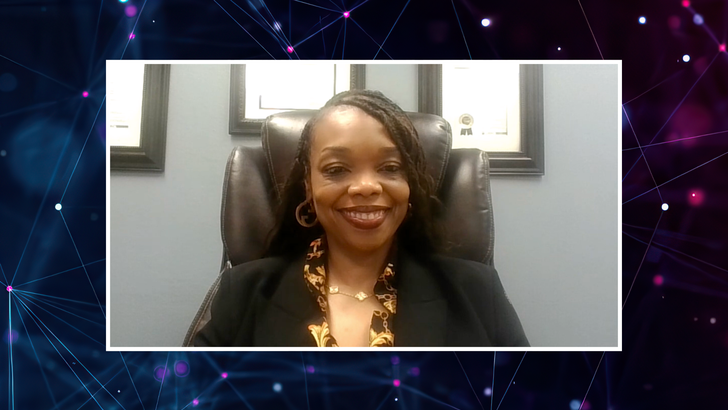
This is a CE on ReachMD, and I'm Dr. Tracy Hicks, Nurse Practitioner. So today I will discuss the impact of tardive dyskinesia.
Impact, let's really think about that word. We really have to be cognizant of how tardive dyskinesia can impact a person's life, and that includes socially, it includes the quality of life, work, relationships, and daily tasks.
I'll give you a quick example from professional practice. I see clients via telehealth, and I noticed that one of my clients, because I’ve built that rapport, she wasn't holding her coffee like she usually does. And so I asked her, I said, “I noticed that you don't have your coffee today.” And she said, “I have these darn movements in my hand, and I’ve had it for a long time, but I've never really talked about it, but it seems to be getting worse.” And so I was able to explore that with her.
And then personal experience with my dad. I grew up with my dad having tardive dyskinesia, and so he developed a severe case of tardive dyskinesia, and the kids in the neighborhood were not very forgiving, so they made fun of him, they made fun of me, and that's something that we are still talking about and dealing with today.
We think that over 800,000 people today are living with tardive dyskinesia. But still, about 6 out of 10 of those are undiagnosed, so we have work to do.
So the onset, let's think about the onset. So tardive meaning slower onset, and then dyskinesia meaning difficult movements. And so these people living with tardive dyskinesia have had exposure to dopamine receptor-blocking agents, and these are slow, nonrhythmic movements.
So how does TD affect function? Well, I talked to you about my dad. He worked as a machinist, and he had really severe movements in his hands and his mouth, and as he was working as a machinist, he accidentally cut off one of his fingers because of the movements in his hand. But of course, back in those days, there was no discussion about it. He didn't know what was going on. This was part of his illness. So again, reducing the stigma and discussion is so important. This impacted him. As the disease got more severe, the tardive dyskinesia, this impacted him socially, it impacted his quality of life. Of course, we talked about the work and him having his finger dismembered because of the movements. Relationships, I remember my mom saying, “Maybe if you stop taking so much of that medicine, those movements will get better.” Again, she not knowing, and that's increasing that stigma. And then of course daily tasks, his work. It is really impactful on not only the patients but family members as well. And so how can we use practical language to reduce stigma and preserve the therapeutic alliance during TD conversations? Let's go back to asking the simple question, how has this impacted your life?
And always, always use your entire team, use the caregivers because they have a wealth of information for you. And again, building that rapport so that the client or the patient feels comfortable sharing that information with you and letting them know that this is a safe space.
So this has been a great bite-sized discussion. Our time is up. Thank you so much for listening.
Announcer:
You have been listening to CE on ReachMD. This activity is provided by Global Learning Collaborativeand is part of our MinuteCE curriculum.
To receive your free CE credit, or to download this activity, go to ReachMD.com/CME. Thank you for listening.
 In support of improving patient care, Global Learning Collaborative (GLC) is jointly accredited by the Accreditation Council for Continuing Medical Education (ACCME), the Accreditation Council for Pharmacy Education (ACPE), and the American Nurses Credentialing Center (ANCC) to provide continuing education for the healthcare team.
  Global Learning Collaborative (GLC) designates this activity for 1.00 contact hour(s)/0.10 CEUs of pharmacy contact hour(s).
  Global Learning Collaborative (GLC) has been authorized by the American Academy of PAs (AAPA) to award AAPA Category 1 CME credit(s) for activities planned in accordance with AAPA CME Criteria. This activity is designated for 1.00 AAPA Category 1 CME credit(s). Approval is valid until 05/14/2027. PAs should claim only the credit commensurate with the extent of their participation in the activity.
