Transcript
Announcer:
You’re listening to GLC on ReachMD. This activity is provided by Global Learning Collaborativeand is part of our MinuteCE curriculum.
Prior to beginning the activity, please be sure to review the faculty and commercial support disclosure statements as well as the learning objectives.
Dr. Dolinger:
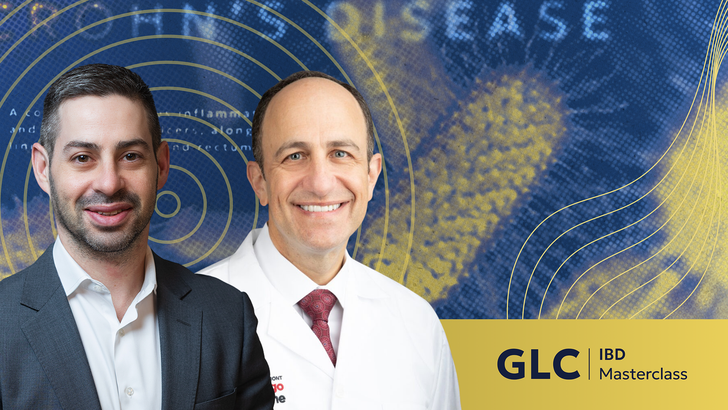
Hello. I'm Dr. Michael Dolinger from the NYU Grossman School of Medicine, and here with me today is Dr. David Rubin from the University of Chicago. This episode is about the future of biologic treatments in IBD and what's on the horizon.
Dr. Rubin, can you talk to our community gastroenterologists about what therapies and classes of therapies they have to look forward to to bring to their patients to improve their care?
Dr. Rubin:
Hi Mike. Well, I'll start by saying that there are a flurry of new therapies that are in development, and we could talk all day about many of the startups and the new early phase therapies. I'm going to focus more on some of the later phase developments that are more likely to come to our world in the nearer future; near meaning within 1 to 3 years.
Let me start with the general principle that we're looking at combination strategies of some of our therapies in formal randomized trials. So looking at anti-TNF with anti-IL-23, those are the DUET trials in both Crohn's and UC based off of the principal study called VEGA in moderately to severely active UC. We're eagerly anticipating those results.
There's also ongoing work with engineered antibodies that provide longer half-lives that will take our therapies like our alpha 4 beta 7 anti-integrin drug. People know their version of that of vedolizumab. Well, this version will provide a longer half-life, that means less frequent infusions, maybe only 3 times a year or maybe even less than that. And also they're developing an IL-23 inhibitor that has a longer half-life, and they're developing one of the new mechanisms that's being studied in multiple different areas now, which is a TL1A inhibitor.
TL1A was discovered during the gene-wide association analyses looking for causes of IBD and genetic linkages related to IBD. And they discovered this a number of years ago and now target it as a therapy. So an anti-TL1A therapy had very favorable phase 2 results, and now there are multiple companies working on phase 3 studies that will likely bring this to market. One is tulisokibart. Another is afimkibart, and there are others that are being developed as well. Duvakitug is one of them.
I also want to highlight for you that the IL-23 class of therapy which is working so well will have an oral peptide that targets the interleukin-23 receptor. That therapy is called icotrokinra, and that already has favorable review and approval in psoriasis and some earlier phase results in ulcerative colitis. So we're very excited to see that continue to be developed.
And another one I'll bring up is a different small molecule called obefazimod. This is a therapy that enhances micro-RNA expression, and the micro-RNA it enhances is— it doesn't matter which one it is—but it's a very specific one that truncates messenger RNA subsequent translation to proteins related to inflammation. It is thought to be related to resetting homeostasis. So rather than targeting the active inflammatory cytokines or cells, it's shutting things off at the faucet is what I say.
So this is a therapy that's in phase 3, and we're waiting for those results, which will be a very nice and different mechanism and oral option.
So lots of choices in the ulcerative colitis world and in the Crohn's world that are coming our way, whether it's a modification of existing therapies that we already know well or some new mechanisms that we're looking forward to.
Dr. Dolinger:
Wow. Lots of new names amidst the armamentarium of already a significant number of names. I guess with a crystal ball and a look forward, could you envision any of these therapy or therapy classes immediately impacting your practice? And if the answer is yes, could you provide a little bit of glimpse of how you think that may pan out?
Dr. Rubin:
I think I would start by saying that we all assume that patients prefer an oral therapy and taking pills over injections and that may be true. I personally think there are many patients who would like that.
On the other hand, if you offered them a pill they take every day to an injection or infusion they might do three times a year or even twice a year, I think many people would choose the less frequent options. So we shouldn't just assume that an oral option will replace everything we currently have and I think that's important to know. Having said that, we're certainly enthusiastic about the IL-23 receptor peptide.
Having said that, I would add that the mechanism that everyone's been excited about, the TL1A inhibitor, is interesting. TL1A ends up being a protein expressed on all of the inflammatory cell lines including fibroblasts. So there's been interest in whether the anti-TL1As may also prevent or at least reduce the progression of fibrotic disease which of course is well described in some patients with Crohn's.
And I would add that because this had a genetic association—that's how it was discovered—there's been ongoing interest and some days enthusiasm and other days less enthusiasm about a companion diagnostic test. So for the first time, we would have a blood test we might order that would tell us whether TL1A is a more or less likely effective strategy. So imagine having that? I've been calling that the holy grail in IBD. If we could order a blood test and tell us which treatment to use or which treatment not to use? That's partly why so many people are enthusiastic about TL1A inhibitors and that might define our whole field.
Dr. Dolinger:
I could feel the weight lift off my own shoulders as you said that test could be available. The decision making and the thought process behind that, it’s a lot.
Dr. Rubin:
Yeah, I think that's really an important point you're saying because I've often said now when people ask about it, it doesn't have to be perfect, it just has to give us a nudge in the right direction, right? And if it shows us that there's more or less likely maybe with a 10 or 15% Delta to respond or not respond, we would be more or less likely to choose that so I think that that's a really good thing.
Dr. Dolinger:
I couldn't agree more. And I think your comments about the fibroblasts and the TL1A will be really interesting over the long-term. I think we're probably not the greatest at studying that in clinical trials and real-world data and our earliest uses in patients who need those therapies now who often don't qualify for these types of trials as well on Crohn's disease. But we'll learn a lot as these therapies get approved in the next few years.
Dr. Rubin:
I would just end perhaps with the point about obefazimod as a novel mechanism but also a different phase of management in the sense of thinking about it as not being a direct anti-inflammatory the way we usually think of these things, but potentially offering a different strategy for homeostatic control, and that might offer a new way to think about maintenance. And it remains to be seen how this plays out but I think that that's very unique and important to consider too.
So lots of good things. As I always say to my patients, every 2 years we have some major shift in what we're doing in our field, so I tell them that so that they are comfortable with what they're doing now. I say don't save the best therapy for last; use the best therapy now until something better comes along.
Dr. Dolinger:
Incredibly well said. I think I'll summarize the rest with we have new therapies, new classes, combinations of classes, new mechanisms and delivery modes with oral options, extended half-lives, and there's going to be options that fit individualized patients in better ways than they did before.
So with that, we will end this great bite-sized discussion. Our time is up. Thank you so much for listening. And thank you, Dr. David Rubin, for joining us.
Dr. Rubin:
My pleasure as always, thank you.
Announcer:
You have been listening to GLC on ReachMD. This activity is provided by Global Learning Collaborativeand is part of our MinuteCE curriculum.
To receive your free CE credit, or to download this activity, go to ReachMD.com/CME. Thank you for listening.

 Global Learning Collaborative (GLC) designates this activity for 2.0 contact hour(s)/0.2 CEUs of pharmacy contact hour(s).
  Global Learning Collaborative (GLC) has been authorized by the American Academy of PAs (AAPA) to award AAPA Category 1 CME credit(s) for activities planned in accordance with AAPA CME Criteria. This activity is designated for 2.0 AAPA Category 1 CME credit(s). Approval is valid until 6/1/27. PAs should claim only the credit commensurate with the extent of their participation in the activity.