
Transcript
Announcer:
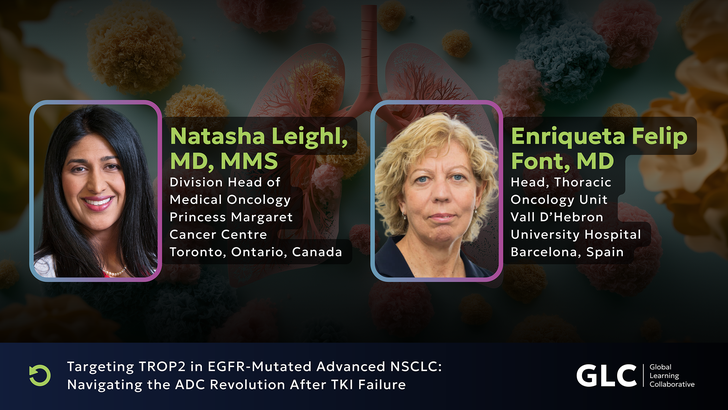
This is GLC Live. Today's program, titled “Targeting TROP2 in EGFR-Mutated Advanced Non-Small Cell Lung Cancer: Navigating the ADC Revolution After TKI Failure,” is provided by Global Learning Collaborative and is supported by an educational grant from Merck & Co., Inc. Please welcome your host, Dr. Natasha Leighl.
Dr. Leighl:
Hi there, and welcome to today's webinar. We're delighted to be talking about a new target in EGFR-mutated lung cancer, TROP2, and the ADC revolution after TKI failure. I'm honored today to be joined by my world-famous colleague and friend, Professor Enriqueta Felip, who is the head of Thoracics at Vall d'Hebron University Hospital in Barcelona, Spain.
And she's going to be taking us through some of the evidence about targeting TROP2 using ADCs in advanced lung cancer. We'll talk a little bit about how the clinical evidence translates to patients, then talk a bit about safety. You know, it's a new class of drugs. How do we manage these toxicities?
And finish up with some key takeaways. So our learning objectives today are to evaluate the current and emerging evidence on TROP2-directed ADCs for patients with EGFR-driven advanced lung cancer after frontline TKI therapy, to talk about the implementation of proactive monitoring and management of class-specific toxicities with these agents, and also to discuss some of the emerging clinical and molecular factors to help guide us in this new world of many different treatment options and where TROP2 ADCs fit.
So with that, I'm going to turn it over to Professor Felip.
Dr. Felip:
Thank you, Professor Leighl. Thank you, Natasha, my dear friend. So thank you all for being with us today. It's a real honor for me to share this conversation with Natasha and with all of you. So I think targeting TROP2 is really important using ADCs in patients with EGFR mutations.
That is our topic today. We know that TROP2 is a transmembrane glycoprotein, and this glycoprotein is highly expressed in non-small cell lung cancer. So >80% of the tumors of patients with non-small cell lung cancer have a TROP2 expression. And we know that the expression of TROP2 is associated with poor prognosis.
There is an analysis of patients with adenocarcinoma, and clearly those patients with high TROP2 expression had a poor overall survival. So the question is, do we need to test TROP2? At present, there is no need to test TROP2 in our clinical practice. It's true, as I commented, that the vast majority of patients with non-small cell lung cancer have some kind of expression when tested by immunohistochemistry.
There are some analyses of TROP2 by using artificial intelligence means, but overall in our clinical practice, we do not need a test for this alteration by immunohistochemistry. And also, we are today discussing ADCs. As mentioned by Professor Leighl, there is a large number of ADCs highly active in non-small cell lung cancer.
We know ADCs are mainly composed of an antibody targeting an antigen, a linker, and a payload. And the TROP2-directed ADCs target TROP2 that we discussed is expressed in lung cancer tumors and then deliver the cytotoxic payload. So we know the mechanism of action. So the antibody binds the antigen in the tumor cells.
There is internalization, a degradation of the ADC in the lysosome, the release, and an action of the payload. The cancer cells go to apoptosis, and also there is a bystander effect. And when we discuss TROP2 ADCs, we know that there are a large number of TROP2 ADCs now in development.
I'm going to focus on the 3 for which we have more data and mainly are the sacituzumab govitecan, datopotamab deruxtecan, and sacituzumab tirumotecan. The 3 agents are TROP2 ADCs but are different among them. We are discussing agents with a humanized IgG1. However, the payload is not exactly the same.
For sac-govitecan, the payload is SN-38. For Dato-DXd, it's the deruxtecan. And for sac-TMT, it's the KL610023. And although the 3 payloads are DNA topoisomerase I inhibitors, they are different, and this may well reflect the differences in toxicity. The 3 agents have a bystander effect. The DAR is different: 7.6 with sac-govitecan, 4 with Dato-DXd, 7.4 with sac-TMT.
And also there are differences in the half-life and the dosing. With sacituzumab govitecan, the dose is day 1 and day 8 every 3 weeks. For Dato-DXd, it's every 3 weeks. For sac-TMT, the treatment is every 2 weeks. And we have approvals in patients with EGFR mutations of TROP2-directed ADCs.
In China, sac-TMT, sacituzumab tirumotecan, is approved for those patients with EGFR mutations after EGFR-TKI therapy and platinum-based chemotherapy. And also in the United States, Dato-DXd is approved in the same indication, patients with EGFR mutations after EGFR-directed therapy and platinum-based chemotherapy.
So this is the data that we have, no? I think it's important that we have approvals and also that there is a new treatment option for patients with EGFR mutations.
Dr. Leighl:
Great. Thank you so much. That was a wonderful summary of the data. And I was hoping we could talk a little bit about how this relates to a patient.
So this is one of my patients: 58-year-old woman, lifetime never smoker, Caucasian. And 2 years ago, we started her on osimertinib with chemo based on the FLAURA2 data. She had lung and bone metastases, and she was very interested in intensified therapy. And then she was on maintenance for about 6 months, and then we stopped the pemetrexed because, of course, her creatinine was rising, and we know that the osimertinib can continue for even up to 3 years in that particular setting.
Unfortunately, though, she did progress, particularly in bone. And I guess the question is what should we do as our next step? Professor Felip, what would you do as your next step for this lady?
Dr. Felip:
Thank you, Professor Leighl. So this is the newest scenario that we have. So the patient is receiving a combination as a first line.
Also, in a number of patients, we have moved from osimertinib as monotherapy to combinations in first line. So I think in this situation, and yeah, it's important to determine the mechanisms of acquired resistance. It's true that rebiopsy is a standard of care. Perhaps, in our experience, we use a lot of liquid biopsy because not in all cases we have a lesion feasible for biopsy.
So I think this is relevant. And then I think everything changed, and we have different treatment options. This patient was previously treated with platinum pemetrexed, so I think the MARIPOSA-2 probably is not an option in this scenario after platinum chemotherapy. But just at ESMO, we have seen also the results in patients with MET amplification that I think is important that the study, it's true that it's after osimertinib, but shows that for those patients with MET amplification or MET high by immunohistochemistry as a mechanism of acquired resistance, the combination of Osi plus savolitinib is very active.
But also, we have the ADCs. I think we have mentioned the 2 TROP2 ADCs, and we have very good results with both in patients with EGFR mutations, and also, we have other ADCs targeting other antigens that also show very good results in patients with EGFR mutations.
Dr. Leighl:
Great. Thank you so much.
That was a great summary of the data. And I agree where we can do liquid biopsy, we do. For this lady we did do a biopsy. We just found her original exon 19 deletion. We also found a MAP kinase mutation, but nothing actionable at the time. We weren't doing MET IHC, so it'd be interesting now to go back and do it and see.
They say up to a third of patients might have high MET protein expression or a true MET amplification. But so she of course, you discussed the data for OptiTROP-Lung04 after first-line TKI. This case, she had FLAURA2. We presume that the data are similar, and of course, there's OptiTROP-Lung03 that shows similar benefit with the TROP2 ADCs versus drugs like docetaxel or the usual standard of care.
And so for this lady, we did offer her datopotamab deruxtecan based on the single-arm data that have previously been published by Dr. Ahn. And you can see she's actually had a beautiful response, and she's tolerated it very well, although we did learn a few things about side effects.
And I've noted in the history here that she doesn't have a history of interstitial lung disease. So important to be mindful of lung toxicities, of course, in our patients as we pick them for that next line of therapy. Could we have done chemo amivantamab? Of course, that's definitely an option.
And of course there are other emerging target-agnostic approaches as well as you've reviewed. So back to you, Professor.
Dr. Felip:
So I think the TROP2 ADCs are a very good option for these patients. We have data. We are going to review the data. So Dato-DXd was analyzed in a pool analysis of the patients included in the TROPION-Lung05 and TROPION-Lung01.
TROPION-Lung05 is a phase 2 trial in patients with actionable genomic alterations, including EGFR mutations that are the majority of patients included, and patients who are previously treated with previous targeted therapy and also chemotherapy. And also, there is a group of patients in this analysis from the TROPION-Lung02, the trial in second line comparing Dato-DXd versus docetaxel.
As in this trial, there was a group of patients with actionable genomic alterations also previously treated with TKIs and also chemotherapy. So overall in this analysis, 117 patients with EGFR mutations previously treated received Dato-DXd. And in the patients, and perhaps are the most important, patients previously treated with osimertinib, the response rate with Dato-DXd was 44% of the patients.
The median duration of response was 6.9, and the median progression-free survival 5.8 months, and also an overall survival in this scenario of 15.6 months. And, when we analyze toxicity, we know that we need to manage the toxicity and with these agents, and we will discuss later.
But stomatitis was the most relevant in the majority of cases, grade 1 or 2, nausea, fatigue, and constipation. But there was also ocular surface events in approximately 12% of the patients. And when we analyze the ILD, it was seen in 4% of the cases, grade 3 in only 1%.
So this is the toxicity that we need to manage, mainly with Dato-DXd. And then very important, I think, is the study of OptiTROP-Lung04, because here we have randomized information, and these are phase 3 in patients with EGFR-sensitizing mutations with disease progression after first-generation EGFR TKI.
And the patients were randomized to receive sacituzumab or chemotherapy with platinum pemetrexed. And the primary endpoint was progression-free survival. And it's a study in this randomized setting, highly positive. So sacituzumab improved progression-free survival when compared to chemotherapy, 8.3 months versus 4.3 months, with a hazard ratio of 0.49.
And I think it's important, the estimated progression-free at 12 months is 32% of the patients in the sacituzumab arm. And importantly, because at the end is our goal, the study shows a difference in overall survival. This data was updated during the ESMO meeting in Madrid, and the treatment with sacituzumab govitecan improved overall survival when compared to chemotherapy.
I think this is important in patients with EGFR mutations. The median overall survival was 25.9 months, 17.4 months with a chemotherapy, a hazard ratio of 0.69 favoring sacituzumab govitecan. And the overall survival at 3 years is 40% of the patients in the sacituzumab govitecan group, 28% in the chemotherapy arm.
And the toxicities, the agent is well tolerated. Importantly, the treatment-related adverse events leading to discontinuation is 0%. So I think the toxicity is really manageable with this agent. And also, when we discuss a special toxicity the most important toxicity, most frequent, is anemia.
There is also neutrophil decrease, stomatitis in a number of cases. But ILD, that is something that is perhaps of concern with this agent, was reported only in 1 patient in the sacituzumab govitecan group and in 2 patients in the chemotherapy group. So I think it seems that with this agent, sacituzumab govitecan pneumonitis ILD is not a relevant issue.
We have also in patients with EGFR mutations, some trials. We have the analysis in patients with treatment naive. There is 1 trial comparing osimertinib versus datopotamab deruxtecan plus osimertinib, and another trial comparing osimertinib versus sac-TMT plus osimertinib. And also, we have confirmatory trials in second line.
The study that we have discussed was performed in China, and there are now worldwide trials testing the same strategy. So I think, again, very good results in patients with EGFR mutations.
Dr. Leighl:
Thank you so much. And of course, there's now a whole wave, isn't there? The HER3 ADCs are back, HER3 EGFR, bispecific ADCs, MET ADCs.
So I think it's so exciting to see this expand. I think TROP2 is just the first wave, which is so exciting. So of course, with every new class of drugs back in the clinic, we have to learn new tricks. And I'm going to talk a little bit about some of the common AEs that Professor Felip has already talked a bit about.
So of the 3 drugs that have been in development, 2 of which are now approved, so sacituzumab govitecan, which of course is approved in breast cancer, but not in lung cancer, or at least not yet, but remains in development. Sac-TMT, tirumotecan, which we've talked about. So same antibody, but different warhead.
And, of course, datopotamab deruxtecan. And what's interesting, of course, is that these are all camptothecin-based. So to some extent with the TROP2 part and the camptothecin base, we see mucositis as a key endpoint, ocular toxicity, interstitial lung disease especially with deruxtecan-based compounds.
And of course, this is a type of chemotherapy, although smarter chemo, as I tell my patients, so of course, we get some myelosuppression. And each of the drugs is slightly different. This is not a head-to-head comparison, but for example, with sacituzumab govitecan, we see a little bit more myelosuppression.
We do see stomatitis, but less perhaps in the way of GI toxicity and lung toxicity. For sacituzumab govitecan, a bit more GI toxicity in particular, and a bit more myelosuppression. And for datopotamab deruxtecan, perhaps less myelosuppression; perhaps a bit more stomatitis and more interstitial lung disease.
Although fortunately, only 3% of patients have grade ≥3. So what do we need to be watching for in clinic? And I think it's so important to really get nurses and your allied health teams involved. The first thing, of course, is prevention. So good mouth care, staying hydrated, dental care and good hygiene, flossing, and of course, be very careful of things like alcohol-based mouthwashes.
If you do have a steroid-based mouthwash, this is very helpful as prophylaxis and, of course, good education. Many of us also sometimes will have patients suck on ice chips during the infusion, sort of like a cold cap concept. Does it work? Hard to know, but of course, my clinic swears by it.
Here you can see some early stomatitis. So really important to check a patient's mouth. Don't leave their mask on. Make sure you take their mask off and look and see what's going on, and make sure you take a really good history, right? Can your patient eat? Are they losing weight?
What are some of these signs that the stomatitis is really becoming problematic? So as management again, steroid mouthwashes topical anesthetics and cryotherapy, of course. If it's grade 1, so mild, you can continue with the same dose. If it's grade 2, so more severe, I'll often delay or dose reduce, and I think dose reduction is a very powerful strategy.
If it's really severe, you do want to make sure that you optimize things, right? Sometimes patients don't do as you ask. But if not, definitely patients needed a dose reduction, and if you're worried that it's life-threatening, of course, you'll stop. What about eye toxicity? And we've seen this in other ADCs as well, for example, on many of the vedotin ADCs.
But really important for patients to keep their eyes moist. I think we all, with increased screen time, have dry eyes. So really important that patients are educated about using artificial tears if they need to, avoiding contact lenses. For some patients, this is a big deal. If patients have a problem, red eyes, itchy eyes, painful eyes, or you notice something when examining them, you really do want to make sure that you get an ophthalmologist involved.
We've got some of the different grading here. So either it's either clear or normal, you have sort of a localized defect or something that's interfering with vision. Of course, these are more severe. You want to hold the drug and get your patient in to see the ophthalmologist right away.
So grade 1, you can continue for now, but important to make sure patients are using prophylaxis and you have a connection with the eye clinic. Grade 2 definitely needs an eye assessment, and I would hold the dose until things improve. You can maintain the dose to see if it's okay next time, but sometimes it's also okay to reduce the dose.
Certainly for grade 3, you want to hold until patients recover and then reduce if your patient's going to go ahead. And of course if it's grade 4 you don't want to re-expose patients to that. Very uncommon though, and certainly not seen in our trials. For interstitial lung disease, of course grade 1 is really asymptomatic and not treated with steroids.
You really want to be careful and watch your patients. And in lung cancer patients, it's so hard to know, right? What's radiation-related? Obviously in these EGFR-mutated lung cancer patients, we're not going to see IO toxicity, but for other patients we will. So you want to monitor for signs or symptoms.
Obviously cough, dyspnea, fever. You want to make sure that you do a good diagnosis. You want to keep an eye on GGOs, and see how they evolve, and you want to get a high-resolution CT, bronchoscopy if it's needed, PFTs if they're needed, and rule out other potential causes. If it's grade 1, you can hold.
If you start steroids just make sure that it's very clear that this was just grade 1. And if patients are okay and things resolve within a month, you can keep on the same dose. Otherwise, you can reduce a dose level. For grade 2 where a patient requires steroids for symptoms, you're supposed to permanently discontinue.
In the breast cancer literature this has been a real challenge, right? They really want to push that envelope. So I think this is something that you'd want to do with a multidisciplinary tumor board, and the recommendations are just to stop. And obviously for severe toxicity, you want to treat them with steroids, treat other potential causes, and hold the drug and switch.
And of course, you can consider infliximab if need be. So with that, we're happy to take some questions. We've got a couple. Professor Felip, what are some of the biomarkers that are out there that are either being investigated or that you think are ready for prime time for the use of TROP2 ADCs?
Dr. Felip:
Thank you, Professor Leighl. So it's true that TROP2 analyzed by immunohistochemistry is not working to predict those patients who benefit from TROP2 ADCs. But there is the analysis of the normalized membrane ratio of TROP2 is a quantitative continuous scoring and the analysis is performed by computational pathology approach.
And this was analyzed and presented and published now by Dr. Marina Garassino in the patients without actionable genomic alterations in the randomized trial in second line. And according to this analysis, this computational analysis, those patients with high ratio had poor prognosis.
So this is something that is being analyzed now in prospective randomized trial in patients’ treatment naive without actionable genomic alterations receiving Dato-DXd. But I think in a retrospective manner, this method was analyzed also in patients with EGFR mutations treated with Dato-DXd, and there was no clear value in these patients with EGFR mutations with actionable genomic alterations.
So probably in patients with mutations, I do not see any biomarker that could help us to determine which patients may well benefit from these strategies. I don't know, Professor Leighl.
Dr. Leighl:
I agree 100%. The biomarker seems to be EGFR mutations, right? Like, that seems to be where this works.
And it's so interesting, right, because we have so many platinum-based options, right? There's amivantamab, platinum, of course. There's ivonescimab and platinum. And what do we do with how do you decide who does or doesn't need platinum? We have the OptiTROP-Lung04 study, which means that patients can avoid platinum or push it down the line, but is it really an all-comers approach?
And so I agree with you. I guess the biomarker does not have another biomarker to target, so not having MET amplification or MET IHC 90%, or not having an emergent fusion or small cell transformation. So I agree. It's so interesting and looking forward to more work here.
Dr. Felip:
Yeah. I think, sorry, in general with ADCs, we have challenges, no, with the biomarkers, not only lung cancer, but also in breast and yeah.
Dr. Leighl:
I agree. And hopefully it'll be a bit easier with other ADCs. I think we're starting to see with HER3, maybe it is relevant in a recent study from China, maybe.
And with MET, of course maybe it is relevant, but the cutoff is much lower, right? You don't need much of that protein to see activity. You started addressing our audience's second question already. Are these ADCs being looked at in patients without EGFR-driven disease or in early-stage disease?
And I think you showed some of the studies already, and you talked about some of the frontline approaches. Can you elaborate a bit more on sort of what's out there or what you're excited about?
Dr. Felip:
So, I think in general, this is being analyzed as you mentioned, also in early stage.
So I think also Dr. Cascone presented and published the results of the NeoCOAST analyzing the combination of durva plus datopotamab deruxtecan in the neoadjuvant setting in a group of patients. So I think there are a lot of trials with ADCs. I think in general, in EGFR-mutated space, I'm impressed with the combinations in the first line.
You mentioned the results with FLAURA2. I think we have a new standard of care. But I'm really impressed with the results of sac-TMT, is a reality. So the trial shows a novel survival improvement in the randomized setting, and also the toxicity seems manageable. So it's true that the studies are performed mainly in China, but I think the trials are very well designed, and it's important to have these kinds of drugs in the second third-line scenario in patients with EGFR mutations.
Dr. Leighl:
I agree. Thanks so much. And I guess the question is, can these ADCs help us overcome resistance to chemo IO in early stage or replace adjuvant therapy? So I agree. I think it's very exciting. So just to wrap up, Dr. Felip, would you be able to share a key takeaway for our audience today?
Dr. Felip:
Yeah, I think a lot of advances in EGFR mutation space. So, during years, we had only EGFR TKIs. Now we have combinations in first line, and now we have second line that are highly active. We have the ADCs, and the TROP2 ADCs show very good results in this scenario. But we have other treatment approaches for those patients with MET amplifications, other ADCs, also bispecifics.
So, we need, yes, to have these treatment options available for the patients with EGFR mutations.
Dr. Leighl:
Great. Thank you so much. And I agree. I think when patients progress on frontline therapy, we need to get that biopsy. We need to do the testing and stream patients either to molecularly targeted therapies or this amazing wealth of untargeted, although truly they are targeted, approaches such as TROP2 ADCs and, of course, other platinum-based combinations, and of course, getting your patients on trial.
So I want to thank you, Professor Felip. It's been such an honor to spend the last 30 minutes with you. Also want to thank the GLC team for this webinar and to thank our great audience. Have a great day.
Dr. Felip:
Thank you.
Announcer:
Thank you for joining us for this special GLC Live broadcast. You'll receive an email shortly with more information about claiming your free credit. Thank you for your participation.
 In support of improving patient care, Global Learning Collaborative (GLC) is jointly accredited by the Accreditation Council for Continuing Medical Education (ACCME), the Accreditation Council for Pharmacy Education (ACPE), and the American Nurses Credentialing Center (ANCC) to provide continuing education for the healthcare team.
 Global Learning Collaborative (GLC) has been authorized by the American Academy of Physician Associates (AAPA) to award AAPA Category 1 CME credit for activities planned in accordance with AAPA CME Criteria. This activity is designated for 0.50 AAPA Category 1 CME credit(s). Approval is valid until 11/24/2027. PAs should claim only the credit commensurate with the extent of their participation in the activity.
 Global Learning Collaborative (GLC) designates this activity for a maximum of 0.50 contact hour(s)/0.05 CEUs of pharmacy continuing education credit.

