
Transcript
Announcer:
Welcome to CE on ReachMD. This activity, titled “Targeting B7H3 Extensive Stage small cell lung cancer: Advancing Targeted Therapy Through Evidence-Based Innovation and Multidisciplinary Care” is provided by Daiichi Sankyo, Inc. and Merck Sharp & Dohme LLC.
Prior to beginning the activity, please be sure to review the faculty and commercial support disclosure statements as well as the learning objectives.
Dr. Owonikoko:
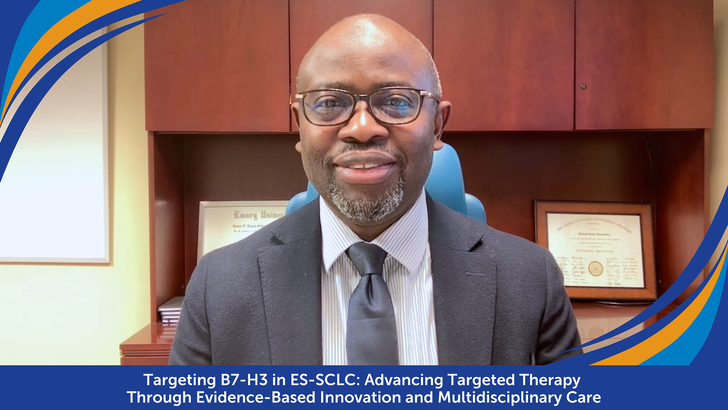
Hello, and welcome to this educational activity. I'm Taofeek Owonikoko from University of Maryland, Greenebaum Comprehensive Cancer Center. Today, I will be discussing strategies to target B7-H3 in extensive-stage small cell lung cancer (SCLC). So let's begin.
The rationale for targeting B7-H3 in small cell lung cancer is well supported by published data. B7-H3 is a transmembrane protein of the B7 family, with minimal expression in healthy lung tissue but highly expressed in small cell lung cancer. Indeed, majority of SCLC, about 65% of cases, would show moderate to high cytoplasmic or membrane staining by immunohistochemistry based on high intensity 2+ or 3+ scoring.
While the biological function for B7-H3 is currently poorly understood, these included multiple mechanisms implicated, such as increased cell proliferation, promotion of metastasis, immune evasion, and angiogenesis. In patients with small cell lung cancer, expression of B7-H3 has been shown to correlate with greater tumor size and independently to predict poor overall survival. This differential and preferential expression of B7-H3 in tumor tissue versus normal lung tissue provides the rationale, a very strong rationale, for this as a valid target for drug development in SCLC.
This slide is a summary of all the B7-H3-targeted antibody-drug conjugates in clinical development for small cell lung cancer. All of these are based on an IgG1 monoclonal antibody background. Different payload, but all of them targeting topoisomerase 1 and drug-to-antibody ratio ranging from 4:1 to 8:1. Linkers can be tumor-selected, cleavable, as well as site-specific linker technology.
Looking at currently available data from ongoing clinical trials, we'll go through some of the very promising data available for this agent in development. The IDeate-Lung01 is a phase 2, multicenter, randomized, open-label study of I-DXd or ifinatamab deruxtecan that was tested in patients with histologically or cytologically confirmed extensive-stage SCLC, who have received at least 1 prior line of chemotherapy-containing regimen, platinum doublet chemotherapy, and not more than 3 lines of prior systemic therapies.
And this trial, of note, allowed patients with asymptomatic, untreated, or previously treated brain metastasis. Primary endpoint of overall response rate by BICR.
Here is the data available, showing that I-DXd at the 12-mg dose showed an overall confirmed response rate of 48%. And there were some differences between those who received the treatment at second line versus those who received at third line, with 56% versus 45.7% response rate. It is notable, however, that close to 90% of patients experienced some degree of tumor reduction, whether or not this met objective criteria for response.
Looking at this in a different way, this is the spider plot, again reflecting the fact that vast majority of patients showed some reduction in tumor volume and tumor burden, and only a small, select number of patients did not derive any benefit. Time to response was very quick, at 1.4 months median time, and duration of response in those who responded was meaningful at 5.3 months, noting that this is heavily pretreated patient population that was enrolled on this trial.
Early preliminary efficacy data in terms of progression-free survival and overall survival is also encouraging. Median PFS of 4.9 months. And at 9 months, about 20% of patients were still free of progression or death. Overall survival median for a heavily pretreated population was 10.3 months, quite encouraging. And at 9 months, close to 60% of patients were still alive.
As this allowed those with asymptomatic treated or untreated intracranial involvement, central nervous system response rate was characterized in patients with baseline brain mets at 46% response rate, which was identical to those response assessment in the systemic space in this cohort of 65 patients with brain metastasis. Comparatively, the systemic response rate in those without baseline brain mets was 50%, demonstrating the intracranial activity of I-DXd in this patient population.
Treatment-related adverse events were notable for classic payload-related toxicity, including nausea and hematologic toxicity, neutropenia, anemia, and thrombocytopenia. Notice that a majority of these toxicities were mostly grades 1 and 2. Adjudicated treatment-related interstitial lung disease, or pneumonitis, was reported in about 12.4% of patients. Majority of these were also grades 1 or 2 events.
For those just tuning in, you are listening to Continuing Education on ReachMD. I'm Dr. Taofeek Owonikoko, and I'm discussing strategies to target B7-H3 in relapsed extensive-stage small cell lung cancer.
The second compound I want to give a quick overview of is GSK5764227, or HS-20093, that was tested in the ARTEMIS-001 trial. Following a dose-escalation study that identified the 8 mg/kg as a promising dose, a randomized dose-expansion study was conducted comparing 8 to 10 mg dose every 3 weeks. This study also enrolled patients previously treated with not more than 3 lines of therapy.
This is the overall response rate across the 2 cohorts. The 8 mg/kg dose showing overall response rate of 61%, and the 10 mg/kg dose, a 50% rate. Disease control rate was north of 80% in both cohorts. And the median duration of response in responders, median progression-free survival, and median overall survival were very, very promising with this compound.
Safety outcomes, again, showing that hematologic toxicity reflecting the payload of this antibody-drug conjugate is common, anemia, leukopenia, and thrombocytopenia being the most common, but also noticeable that about 58% of patients experienced some degree of nausea, mostly grades 1 and 2.
The third ADC targeting B7-H3 that I want to review in this quick overview is MHB088C, which was also tested in a dose-escalation phase 1a study. A dose-expansion study in small cell lung cancer patients who have failed prior systemic chemotherapy with or without PD-1 or PD-L1, but not more than 3 lines of prior therapy, looked at 1.6, 2 mg, and 2.4 mg/kg doses given either every 2 weeks or every 3 weeks.
Across the 3 doses tested, there is a very promising signal of efficacy with confirmed overall response rate of about 40%, especially with the 2 and 2.4 mg/kg with overall response rate confirmed of 42% and 43%, respectively. The median duration of this response was also very promising at about 6 months on average. Median overall survival was 11.5 months.
The toxicity profile is similar to what we saw with the other 2 compounds, mostly hematologic toxicity, and mostly grades 1 and 2.
These are some of the key eligibility criteria being employed in ongoing phase 3 trials of these antibody-drug conjugates in relapsed small cell lung cancer. Across the 4 agents, key eligibility required the confirmation of small cell lung cancer histology, good performance status of 0 or 1, no evidence of symptomatic brain involvement, and patients were not allowed to have had exposure to any B7-H3-targeted agent. History of interstitial lung disease or pneumonitis also excludes patients. And all of these studies had overall survival as primary endpoint or co-primary endpoint.
As I indicated, there is a class effect from the TOPO1-targeted payload causing hematologic toxicity, so it will be important to be aware of this toxicity and to be familiar with the best management approaches. So anemia and neutropenia are very common with these ADCs, so regular monitoring of blood count and management with dose reduction or interruption of the treatment is required. Growth factor support should be considered to maintain dose intensity, and for symptomatic anemia, packed red blood cell transfusion should be offered as necessary support in appropriate patients.
Interstitial lung disease is expected to occur based on historical data with this class of agents, ADCs in general. While it is still unclear what the predictors or predisposition to interstitial lung disease is, there appear to be some dose-response relationship, higher doses being more likely to induce interstitial lung disease. It's important to be vigilant to monitor for signs and symptoms such as cough, shortness of breath. And low-grade interstitial lung disease could be managed with short-course steroid treatment, as well as dose hold and modification at resumption. Higher grade, including requirement for oxygen support, and invasive respiratory support would necessitate treatment discontinuation after long-term steroid therapy.
Interprofessional collaboration is critical to manage some of these adverse events that the oncology professional may not be very familiar with, especially interstitial lung disease. Engaging the involvement of pulmonologists very early, as well as providing adequate support for all the players of oncology care professionals in the management of this patient will be critical to optimize success. Dose delays and dose reductions should be used as needed to maintain dose intensity, and additional practical strategies will be developed as we learn more about these agents to ensure patient safety and long-term adherence.
So key takeaways, salvage therapy for relapsed SCLC remains an area of unmet need. Antibody-drug conjugate is a promising class of agents, and B7-H3 is a validated drug target for which antibody-drug conjugate technology is appropriate.
Early clinical trials to date support the safety of this class of drugs. Interstitial lung disease is an important adverse event of special interest. While the mechanism is still poorly understood, dose adjustment and steroid therapy appears to be safe and effective. Across 5 different agents, we've seen consistent clinical efficacy signal with these ADCs and a TOPO1 targeted cytotoxic payload.
All the ongoing phase 3 trials investigating this class of agents are currently enrolling, and we await full mature data to help establish this class of agents in the management of our patients.
With that, we will conclude today's activity. Thank you for your participation.
Announcer:
You have been listening to CE on ReachMD. This activity is provided by Daiichi Sankyo, Inc. and Merck Sharp & Dohme LLC.
To receive your free CE credit, or to download this activity, go to ReachMD.com/CME. Thank you for listening.
 In support of improving patient care, AXIS Medical Education is jointly accredited by the Accreditation Council for Continuing Medical Education (ACCME), the Accreditation Council for Pharmacy Education (ACPE), and the American Nurses Credentialing Center (ANCC), to provide continuing education for the healthcare team.
  This activity was planned by and for the healthcare team, and learners will receive 0.25 Interprofessional Continuing Education (IPCE) credit(s) for learning and change.
 AXIS designates this activity for .25 contact hour(s)/0.025 CEUs of pharmacy contact hour(s).
 AXIS has been authorized by the American Academy of PAs (AAPA) to award AAPA Category 1 CME credit(s) for activities planned in accordance with AAPA CME Criteria. This activity is designated for 0.25 AAPA Category 1 CME credit(s). Approval is valid until 02/15/2027. PAs should claim only the credit commensurate with the extent of their participation in the activity.

