
Transcript
Announcer:
Welcome to CME on ReachMD. This activity is provided by Medcon International. This episode is part of our MinuteCE curriculum.
Prior to beginning the activity, please be sure to review the faculty and commercial support disclosure statements as well as the learning objectives.
Dr. Ray:
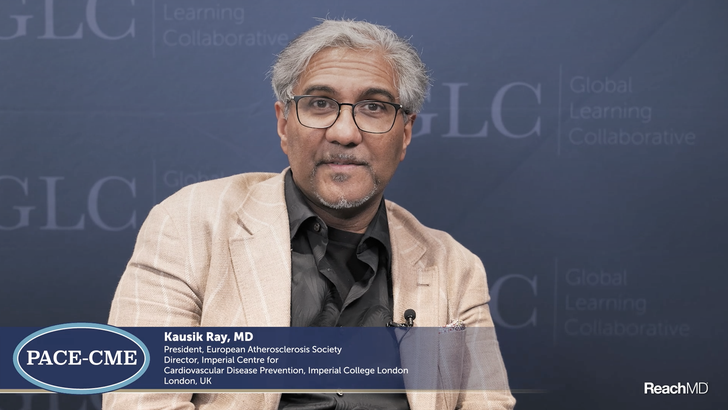
This is CME on PACE-CME and ReachMD. I'm Kausik Ray and joining me today is Dr. Pam Taub. Welcome, Pam.
Dr. Taub:
It's always great to see you, Kosh.
Dr. Ray:
Lovely to sit here and have this discussion with you about an important group of patients where there's a huge unmet need, and in particular, you're going to be talking about those patients with severe hypertriglyceridemia, really to set the scene for the challenges of diagnoses that our colleagues face.
Dr. Taub:
Yeah. So, I'm going to talk to you about a real patient of mine who's a 34-year-old gentleman who has a prior diagnosis of fatty liver based on ultrasound, elevated triglycerides. His BMI is 32, and I'll just review briefly, his lipid panel. His triglycerides are 620. His total cholesterol was 198. Direct LDL is 74. Non-HDL is 179, and his HDL is 19. So, he clearly has metabolic syndrome, but the reason that his case is challenging is because he's statin-intolerant.
Dr. Ray:
Oh. Ok. Right.
Dr. Taub:
And so, we tried multiple statins and his LFTs increased. He had severe myalgias. So, this is a lipid profile that I could get on phenyl fibrate and icosapent ethyl. Even with those two agents, his triglycerides are still 620.
So, my next step was to really focus on the weight, both lifestyle and pharmacotherapy. So, I did start him on a GLP-1 receptor agonist for his weight, but I find this group of patients very challenging because they have triglycerides that are greater than 500 but they're not severely elevated where they qualify for some of the newer drugs, and they don't have a diagnosis of FCS. But still, very high triglycerides, still at an increased risk of pancreatitis. So, tell us what we have in the pipeline for patients that are challenging like this?
Dr. Ray:
Well, I think for patients like this, the diet and lifestyle component are essential. So, I think you'd want to be focusing on the weight loss, and the GLP-1s clearly are the most important therapies. But what we've now got coming down the pipeline are some of the therapies that will target triglyceride metabolism, and of those, there’s APOC3 inhibition, and that's a very important target because it's a key regulator of triglycerides. So if you lower APOC3, what you will do is you kind of take the break that that puts on lipoprotein lipase and then you'll lower triglyceride levels.
So, we can do this in a number of ways. We can do this with two different types of RNA-based therapies. One, the so-called antisense oligonucleotides dosed every month and then, you've got the small interfering RNAs dosed less frequently, every 3 months.
Dr. Taub:
So, it sounds like we have a lot of options that are in the pipeline for these patients. I know there is a trial that is ongoing called the SHASTA trial that's recruiting patients with severe hypertriglyceridemia with triglycerides greater than 500, so that will be a great trial to see what the results are, and hopefully we can offer some newer therapies to patients like this.
Dr. Ray:
Yeah. I think it's an exciting time. Thank you for starting with a case, so that we can actually see what it is at the everyday case that we all see in clinical practice that is a real challenge. So, it's been a great discussion.
If I could ask you to give one take-home?
Dr. Taub:
I think it's really important for us to identify these patients who have severe hypertriglyceridemia and still work with all of the tools that we have, whether it's statin therapy, fibrate, GLP-1 receptor agonists, lifestyle, because those strategies will help with bringing their triglycerides down. We can't neglect it.
Dr. Ray:
Very good. The first thing is to have that holistic approach. Diet and lifestyle are really important in people with high triglyceride levels, modifying factors like alcohol intake and glycemic control, weight loss. But then, for those that we clearly aren't quite getting there, these new therapies are going to be essential. So, thank you very much, Pam. It's been a great pleasure, and I hope the audience enjoyed it.
Announcer:
You have been listening to CME on ReachMD. This activity is provided by Medcon International and is part of our MinuteCE curriculum.
To receive your free CME credit, or to download this activity, go to ReachMD.com/CME. Thank you for listening.

