
Transcript
Announcer:
Welcome to CE on ReachMD. This activity is provided by PROVIDER . This episode is part of our MinuteCE curriculum.
Prior to beginning the activity, please be sure to review the faculty and commercial support disclosure statements as well as the learning objectives.
Dr. Raje:
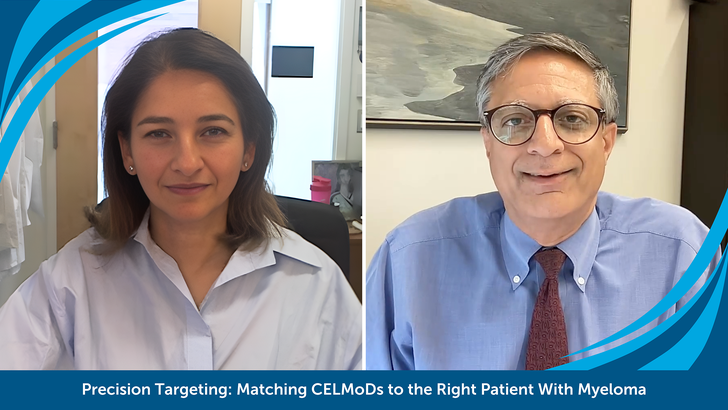
This is CME on ReachMD, and I am Noopur Raje. Here with me today is Dr. Sagar Lonial, and what we're going to be talking about today is identifying eligible patients with multiple myeloma for CELMoD-based treatment.
Sagar, it's great to have you here today. Can you get us started with starting off with the description of CELMoDs and how would you think about which patients would be considered eligible for CELMoD therapy?
Dr. Lonial:
Yeah. Thank you very much, Noopur. It's a great question. And what we know about the CELMoD category is that it does represent a new category of agents in the context of multiple myeloma. I'm sure we'll touch on this, but while we typically think about these new drugs in the context of late-line therapy, there’ve been a number of studies looking at CELMoDs in early and newly diagnosed myeloma as well that I think is particularly exciting.
What I think is unique about the CELMoD category is not just that it binds cereblon, which is what the previous immunomodulatory category, such as lenalidomide or pomalidomide, did, but it does that with greater potency, meaning the downstream impact on agents are targets such as Ikaros and Aiolos, is faster and it's more potent than what we saw with len or pom.
What it also seems to do is that it activates similar targets within T cells and NK cells. And this to me is really where it brings a unique aspect of treatment, because not only does it target the myeloma cell, but it also targets the immune system at the same time, taking an exhausted T cell phenotype and making it active and able to proliferate and even kill myeloma cells yet again. And this real immune effect, to me, is the exciting portion of what I think the CELMoDs bring to the table, because they allow us to partner with new categories of drugs like anti-CD38 antibodies, like bispecific antibodies, like antibody-drug conjugates, potentially, and even enhance the efficacy or perhaps the quality of the product of a CAR-T cell prior to apheresis. And so I think these are really, really exciting.
And in some of the preliminary data, what we've seen is response rates of about 30%, for instance, with iber in 5 prior lines of therapy, triple-class refractory myeloma. If you look at mezi plus dex in a similarly heavily pretreated group of patients, you'll see response rates of about 50% in combination with dexamethasone. But what I'm really impressed by is the ability to potentially get deep responses. In the early lines of therapy, we're seeing MRD negativity at higher rates than we've seen before with lenalidomide or pomalidomide as partners, and particularly in the relapsed/refractory setting, we're seeing combinations of iber with dara that look as good, if not better than what we've seen with len or bortezomib with dara and mezi in partnership with carfilzomib. Again, looking better than what we've seen with other carfilzomib-containing regimens.
So these combinations really are very forward-thinking and, I think, will be great opportunities for our patients in the near future.
Dr. Raje:
Yeah. No, that was a fantastic overview of the mechanism of action, Sagar. And the beauty of these drugs is they are oral, they are orally bioavailable, they're convenient to a patient. And you touched upon the combinability of these with all of the sort of backbone drugs that we have for myeloma. So when I'm thinking about who’s the patient that I would be thinking about? Well, anybody with relapsed disease at this point in time is probably eligible.
I think the fact that you've talked about the potency of these CELMoDs in practice, we know that these drugs work in patients who've been on years’ worth of lenalidomide and years’ worth of pomalidomide. So that speaks to, in the clinical setting, that they are way more potent than both lenalidomide and pomalidomide.
So thank you so much for those insights, Sagar. And we're looking forward to their approval so more of us can be using these drugs in the future. Thank you.
Announcer:
You have been listening to CE on ReachMD. This activity is provided by PROVIDER and is part of our MinuteCE curriculum.
To receive your free CE credit, or to download this activity, go to ReachMD.com/CME. Thank you for listening.

