
Transcript
Announcer:
Welcome to CME on ReachMD. This episode is part of our MinuteCE curriculum. Prior to beginning the activity, please be sure to review the faculty and commercial support disclosure statements as well as the learning objectives.
Dr. Cohen:
Hello. I'm Dr. Ander Cohen, and this is CME on ReachMD. And today I’d like to talk to you about the risk and benefit of managing patients with venous thrombosis. And I thought we should concentrate on what we do in patients with cancer-associated thrombosis because, in many respects, they're the most difficult to treat. And they’re difficult to treat because of their high risk of bleeding, as well as being high risk of thrombosis. And many of these patients also have more extensive venous thrombosis. And you can often see patients presenting with bilateral PE or large proximal DVT.
So the question is, what is the optimal treatment for these patients? And two decades ago, we started replacing the use of vitamin K antagonists with low-molecular-weight heparin. And we did that because low-molecular-weight heparins provided about a 40% reduction in the risk of recurrences. So it wasn't so much that they were safer or had a better safety profile than VK, they just reduced recurrences. Now, over the last 10 years or so, we’ve looked at a lot of comparative studies comparing the low-molecular-weight heparins with the DOACs, and we can now see that the data shows that the DOACs are better at reducing recurrences than low-molecular-weight heparin. And once again, we’re seeing about a 30% to, some studies, a 40% reduction in recurrences compared to low-molecular-weight heparin. So the message here is that low-molecular-weight heparins are better than vitamin K antagonists like warfarin, but DOACs are better than low-molecular-weight heparin.
So this is important because when we have patients with recurrences, we don't necessarily want to go back to an inferior treatment. We don't want to say, well, they had a recurrence on this particular DOAC, we need to go to low-molecular-weight heparin or warfarin.
We probably need to consider another DOAC as the first treatment, unless they need more intensive therapy.
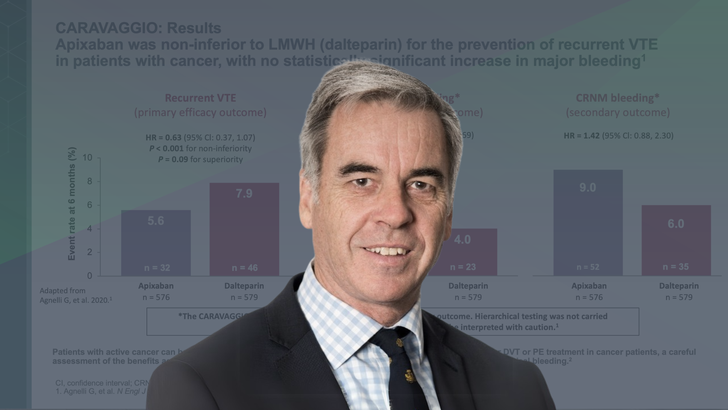
The other message here is the safety aspects, and when we look at all the studies comparing the safety of the DOACs versus low-molecular-weight heparin, the safety profiles are similar. But if we look at individual studies, we start to see some clinical heterogeneity, and for some of the DOACs, particularly the once-a-day DOACs, we see a little bit of a trend to more bleeding or a significant increase in bleeding. But with apixaban, the twice-a-day DOAC, we see no increase in bleeding, and that means that, really, in this setting, that apixaban is a very good option for managing these patients. And that was shown in the CARAVAGGIO study. And the CARAVAGGIO study showed about a 40% reduction, nonsignificant, but a trend to reduce recurrences similar to the other studies but showed no increase in major bleeding.
But remember that in clinical trials, we need to have relatively homogeneous population, and the data doesn't always extrapolate to clinical practice. And so more recently, we have some real-world data looking at patients with cancer-associated thrombosis, comparing DOACs with low-molecular-weight heparin. And in this study, I’m showing this comparison of apixaban with low-molecular-weight heparin. And we can see that, for all the high-risk cases that might not have been involved in the clinical trials, that there are advantages with respect to safety and effectiveness for apixaban.
So my overall message is that DOACs are the treatment of choice for patients with cancer-associated thrombosis, and that apixaban has a very good efficacy and safety profile.
So thank you for tuning in and I look forward to seeing you next time.
Announcer:
You have been listening to CME on ReachMD. This activity is provided by TotalCME and is part of our MinuteCE curriculum. To receive your free CME credit, or to download this activity, go to ReachMD.com/CME. Thank you for listening.

