
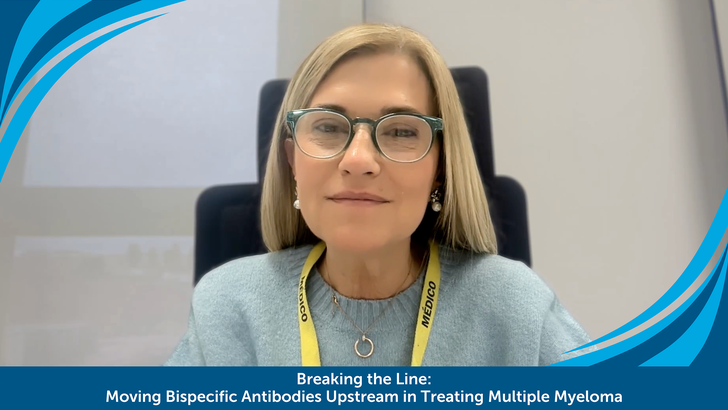
This expert lecture offers a focused review of the expanding role of bispecific antibodies earlier in the disease course of multiple myeloma. Learn about pivotal trial data with unprecedented efficacy that support this shift to use in early-line settings. Safety considerations, including infection risk and mitigation strategies, are addressed to guide real-world implementation. Together, these insights help clinicians optimize patient outcomes as bispecific antibodies move toward earlier integration in multiple myeloma care.
Breaking the Line: Moving Bispecific Antibodies Upstream in Treating Multiple Myeloma

Transcript
Breaking the Line: Moving Bispecific Antibodies Upstream in Treating Multiple Myeloma
closeTranscript
Breaking the Line: Moving Bispecific Antibodies Upstream in Treating Multiple Myeloma
closeTranscript
Breaking the Line: Moving Bispecific Antibodies Upstream in Treating Multiple Myeloma
closeAnnouncer:
Welcome to CE on ReachMD. This activity, titled “Breaking the Line: Moving Bispecific Antibodies Upstream in Treating Multiple Myeloma” is provided by Prova Education. Prior to beginning the activity, please be sure to review the faculty and commercial support disclosure statements as well as the learning objectives.
Dr. Mateos:
Hello and welcome to this educational activity. I am Dr. María-Victoria Mateos and today I will be discussing recent data and strategies to move bispecific monoclonal antibodies earlier in the treatment paradigm for multiple myeloma.
So let's begin. The first topic is an overview of approved bispecific monoclonal antibodies for treating multiple myeloma. Bispecific monoclonal antibodies are antibodies targeting an antigen expressed on the surface of the plasma cells, and at the same time, these monoclonal antibodies are going to target CD3 T lymphocytes. They are going to redirect these T cells into the tumor niche. They are going to release cytotoxic cytokines, resulting into the destruction of the myeloma cell.
And on the slide, you can see different proteins that can be targeted with this bispecific monoclonal antibodies. This table represents the BCMA and GPRC5D bispecific monoclonal antibodies so far approved for patients with relapsed/refractory myeloma. These clinical trials were basically conducted in heavily pretreated myeloma patients, majority of them triple-class refractory, and when we have a look to the efficacy in terms of overall response rate of outcomes, it is possible to see how all these bispecific monoclonal antibodies, teclistamab, elranatamab, linvoseltamab, or talquetamab, covered the unmet medical need we had in this triple-class refractory myeloma population.
But the second topic and the next step is to move with the bispecific monoclonal antibodies to earlier lines of therapy in patients with multiple myeloma. We have MajesTEC-3, the first phase 3 clinical study combining teclistamab in this case with daratumumab in a phase 3 clinical study in relapsed/refractory myeloma patients after 1 to 3 prior lines of therapy in comparison with daratumumab in combination with either Pd or bortezomib and dexamethasone.
Almost 600 patients were so far included, and I would like to remark that teclistamab and daratumumab followed the Dara schedule, indicating that this combination is given monthly from cycle 7, and in addition, this regimen is steroid-free after cycle 1, day 8.
Baseline characteristics of the patients were comparable between both arms. The median age was 64. Approximately 8% of the patients were ISS III, and one-third of patients high-risk cytogenetic abnormality.
Median number of prior lines of therapy was 2, and all patients were PI and IMiD exposed, 5% exposed to anti-CD38 monoclonal antibodies, and of note, over 80% of the patients were refractory to lenalidomide.
MajesTEC-3 met its primary endpoint, progression-free survival, with a hazard ratio of 0.17. After a median follow-up of approximately 3 years, 83.4% of the patients in Tec-Dara remain alive and progression-free versus 29.7% in the control arm.
It is possible to see like a plateau phase from month 6 with the outcomes data I've just reported. But it's important to see how the superiority for Tec-Dara was sustained across all pre-specified groups of patients, including those previously exposed to anti-CD38, those previously refractory to lenalidomide, and even in those patients with high-risk features like soft tissue plasmacytomas, high-risk cytogenetic abnormalities, or high tumor burden.
Tec-Dara demonstrated also significantly higher overall response rate and complete response rate or better, almost 82%, in comparison with the control arm. And the same superiority is applicable to minimal residual disease negativity rate, with almost 60% of the patients treated with the Tec-Dara in MRD negative. But important, in the evaluable population, almost 90% of the patients achieved minimal residual disease negative.
Tec-Dara significantly improved overall survival in comparison with the control arm, and 83.3% of the patients remained alive after 3 years, with a hazard ratio for overall survival 0.46.
In terms of safety profile, neutropenia was the most frequent hematological adverse event, similar in both arms. Cytokine release syndrome was specific for Tec-Dara observed in 60% of the patients, but majority of them grade 1, 15.9% grade 2, and all patients resolved. ICANS in just 1.1% of the patients and all resolved.
And in terms of infections, the incidence of grade 3/4 infection was slightly higher in Tec-Dara, 54 versus 43.4. The most frequent infections were COVID-19, as well as upper respiratory tract infections. And hypogammaglobulinemia was observed in almost 85% of the patients treated with Tec-Dara.
But it's important to know that at the beginning of the trial, there was not any specific guideline for the management of bispecific monoclonal antibodies, and the result of this was that 13 patients died because of infection with the Tec-Dara. But 12 of these deaths occurred during the first 6 months of treatment. The protocol was amended. It was implemented the use of immunoglobulins as well as adequate prophylaxis, and after this amendment, only 1 patient died beyond the month 6, indicating that these patients should be monitored for infections. And it is important to remark the use of immunoglobulins as well as adequate prophylaxis.
Quality of life was also better for teclistamab and daratumumab. And based on all these data, teclistamab plus daratumumab showed unprecedented efficacy, supporting a new standard of care in patients after just 1 prior line of therapy. And I would like to remark that the use of this combination is going to be very broad, not only across academic, but also in the community settings. This combination is now under FDA review with a national priority voucher, and it is possible to have a decision within 1 to 2 months after the submission.
For those just tuning in, you're listening to CE on ReachMD. I'm Dr. María-Victoria Mateos, and I'm discussing recent data and strategies to move bispecific monoclonal antibodies earlier in the treatment paradigm for multiple myeloma.
But together with this study, we have other bispecific monoclonal antibodies that are being evaluated in newly diagnosed myeloma patients. The MagnetisMM-6 trial is comparing elranatamab, lenalidomide, and daratumumab with the dara/len/dex in transplant ineligible, and the safety running cohort showed promising efficacy and safety data. The same is for teclistamab plus daratumumab in elderly patients with newly diagnosed multiple myeloma, also with encouraging efficacy but also safety data.
If we move to other bispecific monoclonal antibodies clinical trials in newly diagnosed myeloma, MajesTEC-4 is evaluating teclistamab and lenalidomide as maintenance after autologous stem cell transplantation, and all patients achieved minimal residual disease negative at the 12th month.
Phase 2 IMMUNOPLANT trial evaluated the role of linvoseltamab as consolidation in transplant-eligible, newly diagnosed myeloma patients with MRD positivity after transplant and all evaluable patients achieved minimal residual disease negative.
But another important topic is the future directions of bispecific monoclonal antibodies in multiple myeloma. And this table collects all bispecific monoclonal antibodies-based combination in evaluation in phase 3 clinical studies in relapsed/refractory myeloma patients, majority of them after 1 to 3 or 1 to 4 prior lines of therapy. And of note, these studies are being conducted basically in patients already exposed to lenalidomide and anti-CD38 monoclonal antibodies.
And based on these, phase 3 clinical studies ongoing in newly diagnosed myeloma patients: MajesTEC-7: tec-dara-len, tal-dara-len versus dara-len-dex; LINKER-MM6: dara-len-dex followed by linvoseltamab versus dara-len-dex; or MagnetisMM-7: elranatamab versus lenalidomide as maintenance after autologous stem cell transplantation.
All these studies are ongoing.
In conclusion, you've had the opportunity to see how the bispecific monoclonal antibodies covered the unmet medical need in the triple-class exposure and refractory myeloma patients, but now they are moving earlier on. We have exciting data of teclistamab plus daratumumab in patients after just 1 prior line of therapy with other combinations that are coming. But the next step, as we have also had the opportunity to see, they moved to the first line of therapy. And this means that at the end of the day, we will be able to offer bispecific monoclonal antibodies-based combination throughout the different lines of therapy to our patients with multiple myeloma.
With that, we will conclude today's activity. Thank you for your participation.
Announcer:
You have been listening to CE on ReachMD. This activity is provided by Prova Education. To receive your free CE credit, or to download this activity, go to ReachMD.com/Prova. Thank you for listening.
Ready to Claim Your Credits?
You have attempts to pass this post-test. Take your time and review carefully before submitting.
Good luck!
Overview
Disclosure of Relevant Financial Relationships
In accordance with the ACCME Standards for Integrity and Independence, it is the policy of Global Learning Collaborative (GLC) that faculty and other individuals who are in the position to control the content of this activity disclose any real or apparent financial relationships relating to the topics of this educational activity. Global Learning Collaborative (GLC) has full policies in place that have identified and mitigated financial relationships and conflicts of interest to ensure independence, objectivity, balance, and scientific accuracy prior to this educational activity.
The following faculty/staff members have reported financial relationships with ineligible companies within the last 24 months.
Faculty:
María-Victoria Mateos, MD, PhD
Head of Myeloma Unit
University Hospital of Salamanca
Zamora, Spain
Consulting Fees: AbbVie, Amgen, BMS, GSK, Johnson & Johnson, Kite, Oncopeptides, Regeneron, Roche, Sanofi, Stemline (Menarini)
Reviewers/Content Planners/Authors:- Cindy Davidson has no relevant relationships to disclose.
- Bing-E Xu, PhD, has no relevant relationships to disclose.
- Brian P. McDonough, MD, FAAFP, has no relevant relationships to disclose.
Learning Objectives
Upon completion of this activity, learners should be better able to:
- Evaluate efficacy and safety data of bispecific antibodies as early-line treatment for multiple myeloma
- Apply evidence from recent trials of bispecific antibodies as early-line treatment for multiple myeloma to optimize patient outcomes
Target Audience
This activity has been designed to meet the educational needs of oncologists as well as all other physicians, physician assistants, nurse practitioners, nurses, pharmacists, and healthcare providers involved in managing patients with multiple myeloma.
Accreditation and Credit Designation Statements
In support of improving patient care, Global Learning Collaborative (GLC) is jointly accredited by the Accreditation Council for Continuing Medical Education (ACCME), the Accreditation Council for Pharmacy Education (ACPE), and the American Nurses Credentialing Center (ANCC) to provide continuing education for the healthcare team. Global Learning Collaborative (GLC) designates this enduring activity for a maximum of 0.25 AMA PRA Category 1 Credit(s)™. Physicians should claim only the credit commensurate with the extent of their participation in the activity.
Global Learning Collaborative (GLC) designates this activity for 0.25 nursing contact hour(s). Nurses should claim only the credit commensurate with the extent of their participation in the activity.
Global Learning Collaborative (GLC) designates this activity for 0.25 contact hour(s)/0.025 CEUs of pharmacy contact hour(s).
The Universal Activity Number for this program is JA0006235-0000-26-004-H01-P. This learning activity is knowledge-based. Your CE credits will be electronically submitted to the NABP upon successful completion of the activity. Pharmacists with questions can contact NABP customer service (custserv@nabp.net).
Global Learning Collaborative (GLC) has been authorized by the American Academy of PAs (AAPA) to award AAPA Category 1 CME credit(s) for activities planned in accordance with AAPA CME Criteria. This activity is designated for 0.25 AAPA Category 1 CME credit(s). Approval is valid until 01/23/2027. PAs should claim only the credit commensurate with the extent of their participation in the activity. Provider(s)/Educational Partner(s)

Prova Education designs and executes continuing education founded on evidence-based medicine, clinical need, gap analysis, learner feedback, and more. Our mission is to serve as an inventive and relevant resource for clinical content and educational interventions across a broad spectrum of specialties. Prova Education's methodology demonstrates a commitment to continuing medical education and the innovative assessment of its effects. Our goal is clear—to develop and deliver the best education in the most impactful manner and to verify its results with progressive outcomes research.Commercial Support
Supported by an educational grant from Johnson & Johnson.
Disclaimer
The views and opinions expressed in this educational activity are those of the faculty and do not necessarily represent the views of GLC. This presentation is not intended to define an exclusive course of patient management; the participant should use his/her clinical judgment, knowledge, experience, and diagnostic skills in applying or adopting for professional use any of the information provided herein. Any procedures, medications, or other courses of diagnosis or treatment discussed or suggested in this activity should not be used by clinicians without evaluation of their patients’ conditions and contraindications or dangers in use, review of any applicable manufacturer’s product information, and comparison with recommendations of other authorities. Links to other sites may be provided as additional sources of information.
Reproduction Prohibited
Reproduction of this material is not permitted without written permission from the copyright owner.
System Requirements
- Supported Browsers (2 most recent versions):
- Google Chrome for Windows, Mac OS, iOS, and Android
- Apple Safari for Mac OS and iOS
- Mozilla Firefox for Windows, Mac OS, iOS, and Android
- Microsoft Edge for Windows
- Recommended Internet Speed: 5Mbps+
Publication Dates
Release Date:
Expiration Date:
Overview
This expert lecture offers a focused review of the expanding role of bispecific antibodies earlier in the disease course of multiple myeloma. Learn about pivotal trial data with unprecedented efficacy that support this shift to use in early-line settings. Safety considerations, including infection risk and mitigation strategies, are addressed to guide real-world implementation. Together, these insights help clinicians optimize patient outcomes as bispecific antibodies move toward earlier integration in multiple myeloma care.
Disclosure of Relevant Financial Relationships
In accordance with the ACCME Standards for Integrity and Independence, it is the policy of Global Learning Collaborative (GLC) that faculty and other individuals who are in the position to control the content of this activity disclose any real or apparent financial relationships relating to the topics of this educational activity. Global Learning Collaborative (GLC) has full policies in place that have identified and mitigated financial relationships and conflicts of interest to ensure independence, objectivity, balance, and scientific accuracy prior to this educational activity.
The following faculty/staff members have reported financial relationships with ineligible companies within the last 24 months.
Faculty:
María-Victoria Mateos, MD, PhD
Head of Myeloma Unit
University Hospital of Salamanca
Zamora, Spain
Consulting Fees: AbbVie, Amgen, BMS, GSK, Johnson & Johnson, Kite, Oncopeptides, Regeneron, Roche, Sanofi, Stemline (Menarini)
Reviewers/Content Planners/Authors:- Cindy Davidson has no relevant relationships to disclose.
- Bing-E Xu, PhD, has no relevant relationships to disclose.
- Brian P. McDonough, MD, FAAFP, has no relevant relationships to disclose.
Learning Objectives
Upon completion of this activity, learners should be better able to:
- Evaluate efficacy and safety data of bispecific antibodies as early-line treatment for multiple myeloma
- Apply evidence from recent trials of bispecific antibodies as early-line treatment for multiple myeloma to optimize patient outcomes
Target Audience
This activity has been designed to meet the educational needs of oncologists as well as all other physicians, physician assistants, nurse practitioners, nurses, pharmacists, and healthcare providers involved in managing patients with multiple myeloma.
Accreditation and Credit Designation Statements
In support of improving patient care, Global Learning Collaborative (GLC) is jointly accredited by the Accreditation Council for Continuing Medical Education (ACCME), the Accreditation Council for Pharmacy Education (ACPE), and the American Nurses Credentialing Center (ANCC) to provide continuing education for the healthcare team. Global Learning Collaborative (GLC) designates this enduring activity for a maximum of 0.25 AMA PRA Category 1 Credit(s)™. Physicians should claim only the credit commensurate with the extent of their participation in the activity.

Global Learning Collaborative (GLC) designates this activity for 0.25 nursing contact hour(s). Nurses should claim only the credit commensurate with the extent of their participation in the activity.

Global Learning Collaborative (GLC) designates this activity for 0.25 contact hour(s)/0.025 CEUs of pharmacy contact hour(s).
The Universal Activity Number for this program is JA0006235-0000-26-004-H01-P. This learning activity is knowledge-based. Your CE credits will be electronically submitted to the NABP upon successful completion of the activity. Pharmacists with questions can contact NABP customer service (custserv@nabp.net).
Global Learning Collaborative (GLC) has been authorized by the American Academy of PAs (AAPA) to award AAPA Category 1 CME credit(s) for activities planned in accordance with AAPA CME Criteria. This activity is designated for 0.25 AAPA Category 1 CME credit(s). Approval is valid until 01/23/2027. PAs should claim only the credit commensurate with the extent of their participation in the activity. Provider(s)/Educational Partner(s)

Prova Education designs and executes continuing education founded on evidence-based medicine, clinical need, gap analysis, learner feedback, and more. Our mission is to serve as an inventive and relevant resource for clinical content and educational interventions across a broad spectrum of specialties. Prova Education's methodology demonstrates a commitment to continuing medical education and the innovative assessment of its effects. Our goal is clear—to develop and deliver the best education in the most impactful manner and to verify its results with progressive outcomes research.Commercial Support
Supported by an educational grant from Johnson & Johnson.
Disclaimer
The views and opinions expressed in this educational activity are those of the faculty and do not necessarily represent the views of GLC. This presentation is not intended to define an exclusive course of patient management; the participant should use his/her clinical judgment, knowledge, experience, and diagnostic skills in applying or adopting for professional use any of the information provided herein. Any procedures, medications, or other courses of diagnosis or treatment discussed or suggested in this activity should not be used by clinicians without evaluation of their patients’ conditions and contraindications or dangers in use, review of any applicable manufacturer’s product information, and comparison with recommendations of other authorities. Links to other sites may be provided as additional sources of information.
Reproduction Prohibited
Reproduction of this material is not permitted without written permission from the copyright owner.
System Requirements
- Supported Browsers (2 most recent versions):
- Google Chrome for Windows, Mac OS, iOS, and Android
- Apple Safari for Mac OS and iOS
- Mozilla Firefox for Windows, Mac OS, iOS, and Android
- Microsoft Edge for Windows
- Recommended Internet Speed: 5Mbps+
Publication Dates
Release Date:
Expiration Date:
Title
Share on ReachMD
CloseProgram Chapters
Segment Chapters
Playlist:
Recommended
We’re glad to see you’re enjoying ReachMD…
but how about a more personalized experience?
