
Transcript
Announcer:
Welcome to CE on ReachMD. This activity is provided by TotalCME and is part of our MinuteCE curriculum.
Prior to beginning the activity, please be sure to review the faculty and commercial support disclosure statements as well as the learning objectives.
Dr. Reau:
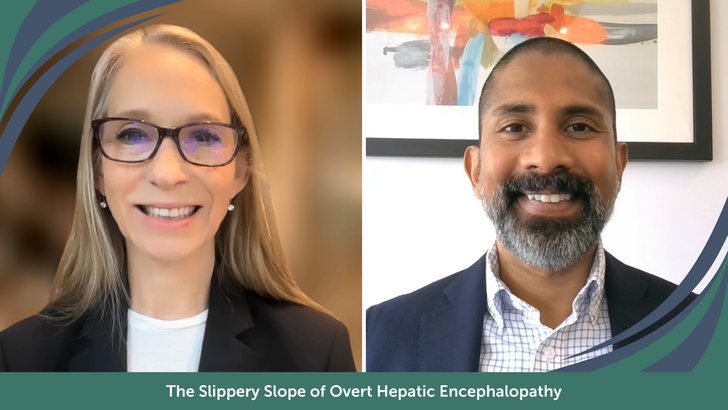
This is CE on ReachMD, and I'm Dr. Nancy Reau. Here with me today is Dr. Arun Jesudian.
Arun, can you start by reviewing the West Haven criteria?
Dr. Jesudian:
Sure. So the West Haven criteria provide us a grading system for how severe hepatic encephalopathy is. Early on or subtle hepatic encephalopathy is covert, and in the West Haven criteria, that encompasses both grade 1 and minimal hepatic encephalopathy. These are patients who are oriented and are tough to diagnose at the bedside, but they do have cognitive impairment.
Then as they get worse, we get into overt hepatic encephalopathy—grades 2, 3, and 4. This is the type of patient you can pretty easily diagnose at the bedside, and they can be very sick. So grade 2 patients often will have asterixis and maybe be disoriented. As we get into grade 3, they're more stuporous and grossly disoriented. And grade 4 patients are in a coma and require intubation for airway protection and usually ICU admission. So that's the full spectrum of the severity of hepatic encephalopathy.
Dr. Reau:
That's a great overview, and it really kind of shows the spectrum of encephalopathy. But there's also other components like the time-based classification. Why is this important? And how would you describe these?
Dr. Jesudian:
Yes, so these episodes can be one and done, but that's not usually the case. They usually do recur; that's the nature of hepatic encephalopathy. So patients might have episodes that occur with a long period of time in between. So that's sort of an episodic hepatic encephalopathy.
But as they progress and get worse, they can have more frequent episodes, like recurrent episodes, even despite being on therapies. And sometimes we see really refractory cases—patients who, despite our best efforts, remain overtly encephalopathic. And we give them the best therapies we have available, and we still can't fully manage them.
Dr. Reau:
So I think it's really important in our educational messaging to emphasize to patients and their families that just because something is under control, that the risk of an exacerbation is really high, and that that's why they should be kind of following up, making sure they don't miss doses, reporting back to their clinician when things are not going right.
We also talk a little bit about a 4-pronged approach to treatment. What does that mean?
Dr. Jesudian:
Yes, this really involves a patient usually being hospitalized or evaluated in the hospital for hepatic encephalopathy. So it starts out with recognizing that this patient with altered mental status needs care that any patient with altered mental status needs. They may need intubation for airway protection, for example, if they have really severe altered mental status. We then move into excluding other causes of altered consciousness. That could be brain bleeds or seizures or infections.
And then, once we've made that diagnosis of hepatic encephalopathy, we focus on what precipitated this episode. And again, we focus on things like infections or GI bleeding or kidney and electrolyte disturbances or medications that may be exacerbating hepatic encephalopathy or not taking medications for hepatic encephalopathy. These precipitating episodes could be life-threatening, so they're really important to evaluate patients for and address.
And then finally, we treat their hepatic encephalopathy with therapies we know can lower ammonia in their body.
Dr. Reau:
Excellent. So this is especially important in those individuals that are hospitalized. Our patients that have less degrees of encephalopathy, you're not going to necessarily do this 4-pronged approach as an outpatient.
Thank you so much, Arun.
If you take one thing away, we want to identify and correct precipitating factors in a timely manner, and that's knowledge you can put into practice right away.
Thank you so much, and we'll see you next time.
Announcer:
You have been listening to CE on ReachMD. This activity is provided by TotalCME and is part of our MinuteCE curriculum.
To receive your free CE credit, or to download this activity, go to ReachMD.com/CME. Thank you for listening.
 I
I



