
Transcript
Announcer:
You’re listening to GLC on ReachMD. This activity is provided by Global Learning Collaborativeand is part of our MinuteCE curriculum.
Prior to beginning the activity, please be sure to review the faculty and commercial support disclosure statements as well as the learning objectives.
Dr. Silvestri:
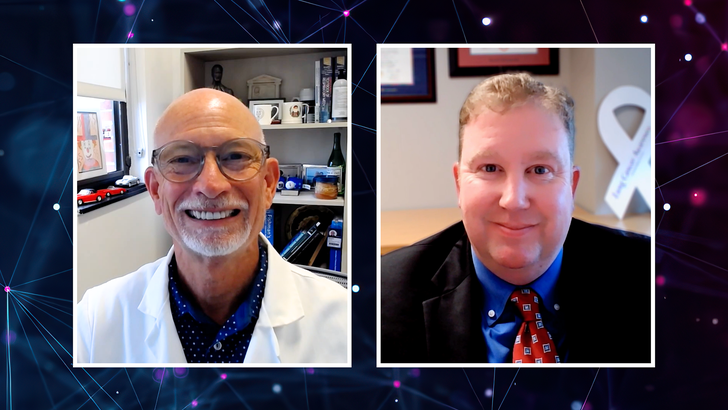
Welcome. This is Continuing Education with GLC. I'm Dr. Gerard Silvestri, a pulmonologist at the Medical University of South Carolina.
Dr. Burns:
And I'm Dr. Timothy Burns, a thoracic oncologist at the James Comprehensive Cancer Center, Ohio State.
Dr. Silvestri:
Tim, it's always good to see you. Could you describe the workflow for molecular testing in your institution?
Dr. Burns:
Sure, that's a great question. So at our institution, I know often these patients receive a biopsy from interventional pulmonology or from interventional radiology or from a thoracic surgeon; however, most of the time the molecular testing ends up being ordered by the medical oncologist. Sometimes our interventional pulmonary colleagues are better at that, of getting that testing going. And then once that's done, that's usually done in our internal lab. So we do have the option of sending stuff out to commercial labs like Caris or Foundation, but our internal panel generally will get us our NGS, our FISH, our IHC, and some limited RNA-seq, and that takes anywhere from 10 to 14 days to get that result.
Dr. Silvestri:
Well, that's great. Our institution I think is largely the same. I think sometimes for clinical trials they ask us to send it to a specific lab, but otherwise we're in-house testing.
Do you have a place where you've gotten together with our interventional pulmonology folks at your institution, interventional radiologists, your pathologists, to come up with more of a system to get that done? Or is it just sort of we think it should be done and it gets done somehow?
Dr. Burns:
We do have a multi-D tumor board each week, and I will say our interventional pulmonologists and our thoracic surgeons too, to a good extent, know the importance of sending the molecular testing. Oftentimes, where it does break down is when we have a biopsy of nonpulmonary sites, and our interventional radiology sometimes will send that or not. So at my former institution, there was reflex testing by pathology, and I think that's by far, if available, the best system.
Dr. Silvestri:
Yes, we're lucky enough to have reflex testing.
And there are some potential failure points in the pulmonology-to-oncology handoff. So specifically, if you don't know about the patient until it's referred to you, you may not know what's coming. And we've had difficulties there where even though we're at our tumor board together, we haven't had complete communication, which is why we've instituted a reflex testing pathway like your former institution. And we really do try to do a good job of when the biopsy specimen reaches the pathology lab if it's diagnosed as non-small cell lung cancer, there's an order set written, which we've all agreed upon and we update to make sure all the different mutations are tested for that have FDA-approved drugs. And so we've used reflex testing as a way to take out some of those gaps in communication so that by the time you see the patient—I'm there to help you get the tissue and enough of it to test, but then by the time you see the patient, you have that in hand so you can make treatment decisions.
Dr. Burns:
I'm just curious, do they ever ask you—or if you have a small biopsy and are you generally taking more cores given your experience level. But have you ever tried to send a liquid biopsy or been asked to send a liquid biopsy while you still have that patient there?
Dr. Silvestri:
Yeah, that's honestly becoming more and more common. And one of the things we're thinking about doing, which is to draw the blood for liquid biopsy, hold that blood until we're sure that we have what we need from tissue. I think, and I'm sure you think the same thing, but I don't want to speak for you—I think more and more people are going to use this sort of complementary nature of liquid biopsy and tissue biopsy simultaneously out of the gate. What I would say for our audience is you cannot just depend on liquid biopsy. If it's positive, great. If it's negative, the sensitivity is just not high enough to pick up the same things you'd pick up in tissue.
Dr. Burns:
Yeah, no, I completely agree. It's definitely a more rapid assay, but again, it's a rule-in not rule-out test. I think that's just critically important not to stop with the liquid if you don't find a result; you need to keep looking.
Dr. Silvestri:
And with that, our time is up. We hope you found this brief discussion helpful. Thank you so much for listening.
Announcer:
You have been listening to GLC on ReachMD. This activity is provided by Global Learning Collaborativeand is part of our MinuteCE curriculum.
To receive your free CE credit, or to download this activity, go to ReachMD.com/CME. Thank you for listening.
 In support of improving patient care, Global Learning Collaborative (GLC) is jointly accredited by the Accreditation Council for Continuing Medical Education (ACCME), the Accreditation Council for Pharmacy Education (ACPE), and the American Nurses Credentialing Center (ANCC) to provide continuing education for the healthcare team.

 Global Learning Collaborative (GLC) designates this activity for a maximum of 0.75 contact hour(s) (0.075 CEUs) of pharmacy continuing education credit.

