
Transcript
Announcer:
Welcome to CE on ReachMD. This activity, titled Patient-Centered Care and Integration of Photobiomodulation Therapy into Clinical Practice is provided by Evolve Medical Education.
Prior to beginning the activity, please be sure to review the faculty and commercial support disclosure statements as well as the learning objectives.
Dr. Do:
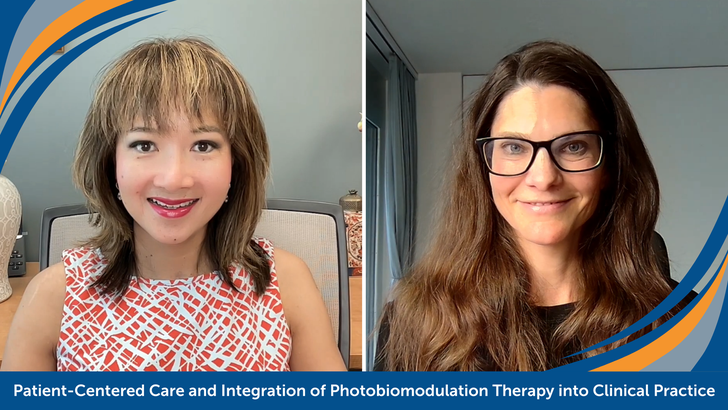
This is CE on ReachMD. I'm Dr. Diana Do, and today I have my colleague, Dr. Marion Munk, joining me. We're going to be discussing multiwavelength photobiomodulation as delivered in the LIGHTSITE III clinical trial.
Marion, how do you decide what type of patients you might discuss photobiomodulation with?
Dr. Munk:
Yeah, that's a very important question. So usually all patients with dry age-related macular degeneration who are meeting the label are eligible for photobiomodulation. And when I discuss photobiomodulation with the patient, I really try to kind of manage the expectations in the beginning. As we have discussed already, we know that in the LIGHTSITE III trial, the mean 5.9 letters were gained over 2 years. However, there was a range. This was only the mean, so there was a range of patients. So some patients gained 15 letters. However, there were also patient populations who lost letters. Of course, compared to the sham-treated group, it was significantly more visual function benefit and significantly less patients who lost visual acuity, but nonetheless, they existed. And I think it's very important for the patients to understand that they may see visual acuity improvement, but even not losing vision and remaining on a stable best corrected visual acuity is already a gain. Of course, over time, we know that it's a chronic degenerative disease. So over time, patients will lose vision, and staying on their same visual acuity level is already a gain here.
Dr. Do:
Marion, the photobiomodulation as delivered in the LIGHTSITE III clinical trial is a noninvasive, clinic-based treatment. How frequent do patients need to be treated to get the benefits seen in the clinical trial?
Dr. Munk:
Very important question. So I really try to do the treatment as often as done in the clinical trials, because here we have the evidence that it really works. So I tell the patients, the optimal scenario is that they get the treatments 3 times a year, so every 4 months. However, of course, there are also patients where it's impossible for them to really do 3 rounds of photobiomodulation. In these cases, I really try to do it at least twice a year.
However, we have to keep in mind that in the LIGHTSITE I trial, we actually did these kind of treatment rounds every 6 months, so actually twice a year. And what we saw there is that the patients in mean after 4, 5, 6 months, lost a little bit of the visual acuity they gained. However, they regained it after the retreatment. Nonetheless, I think the administration of 3 cycles of photobiomodulation every year is the best way to move forward.
Diana, regarding the patients, what do you tell the patients when you tell them about photobiomodulation before they start the treatment? So what can they expect in terms of visual function benefits? And what can they expect in terms of anatomical improvements?
Dr. Do:
Yes, in photobiomodulation, as delivered in the LIGHTSITE III clinical trial, that study was looking at the primary endpoint was a change in best-corrected visual acuity. And the study met its primary endpoint, showing a gain of about 5 letters in the patients that received the active photobiomodulation.
In clinical practice, we know that there'll be a range of responses and that some people may experience an improvement in their vision, others may see a benefit of slower progression to advanced AMD. So I think it's important to realistically discuss with patients that they might not all experience an improvement in their vision, but the basis of the photobiomodulation is to improve oxygenation at the mitochondrial level and preserve their tissue over time.
Marion, why don’t you share with us a clinical case from the LIGHTSITE III clinical trial, and we can look at what happened to the macula in this patient with intermediate AMD.
Dr. Munk:
Sure. More than happy to do this. So this is actually really a perfect case. So this is a case you want to see in your clinic. This patient started with a best-corrective visual acuity of 75 letters. And you can already see that the patient already had a lot of drusen right in the center. You can also appreciate that the patient already had some pigment migration. And usually when you see something like that, you're very careful, because this is a sign of activity, so either the patient is prone to fastly develop into GA or fastly develop neovascular AMD. So usually, this is a case you see more often in clinic in order to make sure that he's not advancing.
But what happened? The patient received photobiomodulation, and after 1 year of treatment, the visual acuity was improved by 4 letters, and you can see already in the middle, after 1 year, that actually the drusen volume has significantly decreased. Of course, we see this also when the patient advances in AMD. However, in this case usually the visual acuity is not improving because actually it's declining, because we see the collapse of the drusen. And usually this collapse of drusen leaves behind degeneration of photoreceptors and RPE, so geographic atrophy. However, this is not what happened in this case.
And then again 2 years after, so under continuous photobiomodulation treatment, the patient had a gain of even 7 letters after 2 years. You can still see a little bit of drusen volume buildup again, but nonetheless significantly less than at the beginning. And this is also what we see and know from the clinical data as well as from the trial data, that actually the drusen volume is not like tremendously decreasing, it’s just the buildup of drusen volume is much, much slower than in patients who are not treated.
Dr. Do:
This is a really good illustrative case that shows the anatomy correlating with the visual acuity benefits. We know that in the study, there were some patients who did lose vision over time, because macular degeneration is heterogeneous, and some patients still progress, but they progress more slowly with active photobiomodulation than those that receive the active sham treatment.
So is that important to also discuss with your patients, that not everybody may have this outstanding response that you shared with us?
Dr. Munk:
One hundred percent. So I share really with them the clinical trial data and show them that there were also a percentage of patients who lost vision. However, this percentage was significantly lower than in the group who only received sham treatment. And this is also what I tell the patient. So I said, as an ideal patient, if you would be a mean patient, you would gain like 5.9 letters. However, we see a range. And even if you look at the trajectory of AMD over 2 years, a patient would lose in mean 2 to 4 letters. However, we know in the trial that actually these patients gained vision. So I already tell the patient that not losing vision is already a benefit, because this is what you can expect if you're not treating at all.
Dr. Do:
Thank you so much for sharing your insights, Marion. I really appreciate it. And thank you again for joining us on ReachMD.
Dr. Munk:
Thank you, Diana.
Announcer:
You have been listening to CE on ReachMD. This activity is provided by Evolve Medical Education.
To receive your free CE credit, or to download this activity, go to ReachMD.com/CME. Thank you for listening.


