
TENS Lowers Movement-Evoked Pain in Fibromyalgia Trial
Key Takeaways
- By day 60, lower movement-evoked pain was observed with PT plus TENS than with PT alone, with the confidence interval remaining below zero.
- Patient Global Impression of Change favored PT-TENS at 120 (72%) versus 86 (51%), and 30% or greater reduction in movement-evoked pain occurred in 66 of 161 (41%) versus 22 of 169 (13%).
- No serious adverse events were reported, and 109 of 358 participants (30%) had minor events; by day 180, 217 respondents (81%) found TENS helpful and 147 (55%) used it daily.
FM-TIPS enrolled people with fibromyalgia from 28 outpatient physical therapy clinics across 6 health care systems, screening 958 participants and enrolling 459 between February 2021 and September 2024. In the modified intention-to-treat cohort, 384 completed baseline data collection, including 191 in PT-TENS and 193 in PT only; mean age was 53 years, and 91% were female. Clinics were assigned to PT plus TENS or PT only, and the PT-only group received TENS after day 60 during an extension phase. The primary outcome was change from baseline to day 60 in pain rated from 0 to 10 during the 5-times sit-and-stand task.
For the primary endpoint, the day 60 difference corresponded to a 95% CI of -1.6 to -0.7 and a standardized effect size of 0.46. The abstract also reported a dose-response pattern for TENS within the efficacy analyses. Patient-reported improvement favored PT-TENS, with P = .001 for the Patient Global Impression of Change comparison. Responder analysis likewise favored PT-TENS, with P < .001 for a 30% or greater reduction in movement-evoked pain. Across the efficacy measures reported in the abstract, results favored adding TENS to physical therapy during the randomized phase.
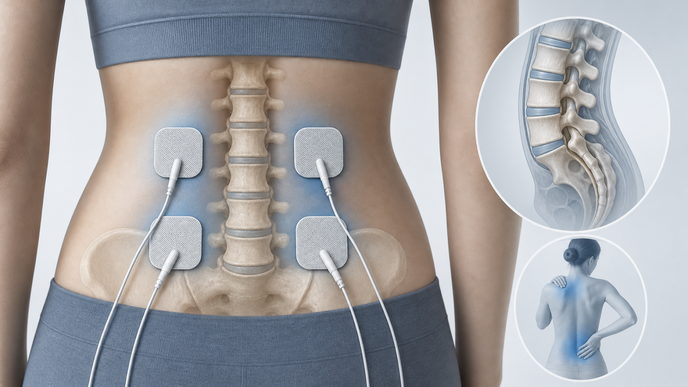
Assessments occurred on days 1, 30, 60, 90, and 180, and final data collection was completed in March 2025. No serious adverse events were reported over 6 months; minor events and day 180 respondent reports addressed tolerability and ongoing use. The day 180 figures reflected respondents rather than the full enrolled cohort. TENS was applied to the upper and lower back for 2 hours daily, using 2 to 125 Hz stimulation, 100 to 180 microseconds, and strong but comfortable intensity. The authors concluded that TENS remained effective for 6 months and described it as safe, inexpensive, and readily available in this outpatient population.