
PRP, ESWT, and Combination Therapy for Refractory Patellar Tendinopathy
Key Takeaways:
- In athletes with refractory patellar tendinopathy, PRP, ESWT, and combined therapy all improved pain and function over six months, but no significant between-group differences emerged in patient-reported clinical outcomes.
- The combined PRP-plus-ESWT approach showed greater improvement in select imaging parameters, especially on ultrasonography, but structural advantages were not consistent across every MRI measure.
- The findings are promising but preliminary: this was a very small pilot trial, so larger multicenter studies are needed before combined bio-mechano-therapy can be considered a standard treatment approach.
In athletes with refractory patellar tendinopathy, the combination of platelet-rich plasma (PRP) and extracorporeal shock wave therapy (ESWT) was associated with more favorable changes in select imaging outcomes than either treatment alone, even though patient-reported functional gains were broadly similar across groups over six months and did not differ significantly between treatments.
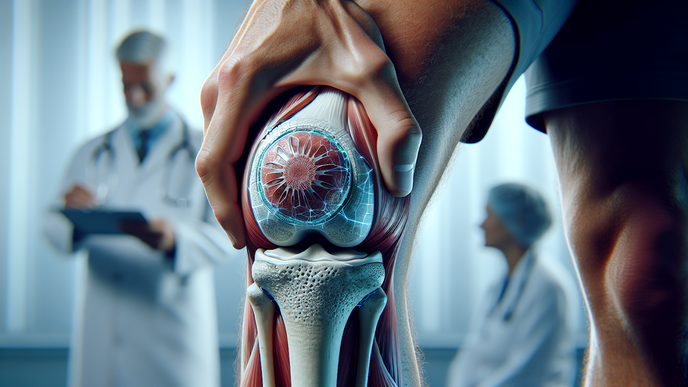
That distinction matters. Patellar tendinopathy is one of the most stubborn injuries in jumping sports, where repeated loading gradually disrupts collagen organization and leaves athletes caught between persistent pain and incomplete recovery. Eccentric rehabilitation remains the cornerstone of care, but once tendon degeneration becomes chronic, the tissue may appear biologically stalled. That is the clinical gap this study tried to address: whether combining a biologic signal such as PRP with a mechanical stimulus such as ESWT could support tendon repair more effectively than either modality alone.
The trial enrolled 10 competitive athletes with chronic patellar tendinopathy that had not responded adequately to prior conservative treatment. Participants were randomized to PRP alone, ESWT alone, or combined PRP plus ESWT, and all completed the same standardized eccentric rehabilitation program. The sample was very small, with only 2 athletes in the ESWT arm, 5 in the PRP arm, and 3 in the combination arm, so the study was clearly exploratory and underpowered for firm between-group conclusions. Still, its design allowed the investigators to track both symptoms and tendon structure over time using serial MRI and ultrasonography.
Across the cohort, the clinical story was encouraging. Pain scores fell, and functional scores improved steadily over six months regardless of treatment assignment. Significant time effects were seen for VAS, VISA-P, IKDC, Lysholm, and KOOS outcomes, indicating that athletes improved over time. But there were no statistically significant differences between groups for those patient-reported measures. In practical terms, all three approaches appeared capable of supporting recovery when paired with structured rehabilitation, but the study did not demonstrate a clinical advantage of one treatment over another.
The imaging results, however, told a more differentiated story. On ultrasonography, the combined PRP-plus-ESWT group showed significantly greater improvement in hypoechoic lesion area and intratendinous lesion length at six months than the monotherapy groups. MRI results were more mixed: axial lesion thickness differed significantly between groups at six months, whereas sagittal lesion length and axial lesion width did not. Taken together, the data suggest that combined therapy may be associated with greater improvement in select structural parameters, particularly on ultrasonography, even though the imaging findings were not uniformly superior across all measures.
That possibility is what makes the study interesting. PRP is intended to deliver growth factors that support tenocyte proliferation, collagen synthesis, and extracellular matrix remodeling. ESWT, by contrast, is thought to work through mechanotransduction, local perfusion changes, angiogenic signaling, and pain modulation. The authors’ central hypothesis is that ESWT may “prime” the local tendon environment, making it more responsive to the biologic cargo delivered by PRP. But that proposed synergy remains theoretical in this study, since no molecular or mechanistic endpoints were measured directly.
A representative case in the combined-treatment group helps illustrate the clinical narrative, though it should not be interpreted as evidence of treatment efficacy on its own. A 21-year-old male decathlete with six months of anterior knee pain showed improvement not only in symptoms and function, but also in MRI and ultrasound markers of tendon remodeling. He returned to competition by three months and had no recurrence during follow-up. As the authors make clear, this case is illustrative rather than generalizable.
There is also an important caution embedded in the findings. All athletes returned to sport within six months, and return-to-play outcomes did not differ significantly among groups. The study authors suggest that this may reflect the small sample size and a possible ceiling effect, given the uniformly high return-to-sport rate. More broadly, return to sport depends on factors beyond tissue morphology alone, including pain tolerance, neuromuscular control, and sport-specific loading capacity. The limitations here are impossible to ignore. The sample size was extremely small, treatment groups were imbalanced, and outcomes were assessed over only six months. Some effect sizes, especially in the smallest subgroup, appear striking but should be interpreted cautiously because very low within-group variability can inflate Cohen’s d when sample sizes are tiny. This was a pilot study, not a definitive practice-changing trial.
Even so, the study offers an intriguing signal for sports medicine: in refractory patellar tendinopathy, combining PRP with ESWT may improve select markers of tendon remodeling more convincingly than either therapy alone, even though clear between-group functional differences did not emerge. For clinicians managing athletes who have plateaued with rehabilitation, that may be enough to justify watching this bio-mechano-therapy concept closely as larger trials take shape.