
Liposomal Bupivacaine Cut Opioids After Elderly Hernia Repair
Key Takeaways
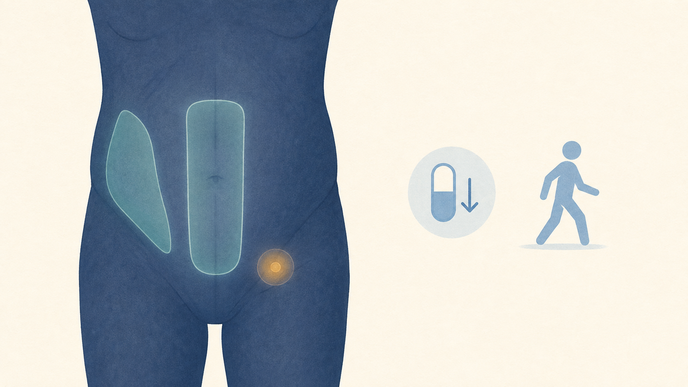
- Older adults undergoing laparoscopic TAPP inguinal hernia repair had significantly lower 48-hour opioid use with either TAP+RSB strategy than with no block, with relative reductions of 25% for plain bupivacaine and 29% for liposomal bupivacaine.
- Liposomal bupivacaine was associated with fewer early rescue analgesia requests than no block, and time to first rescue analgesia was longer in the liposomal group.
- Early recovery favored liposomal bupivacaine, with lower 8-hour pain scores and faster ambulation, while plain bupivacaine showed a more limited pain benefit.
- Both block groups had earlier extubation and shorter hospitalization than controls, with similar adverse event rates and no serious complications reported.
At Zhongshan Hospital, Fudan University, in Shanghai, China, a prospective, single-center randomized trial of liposomal versus plain bupivacaine TAP/RSB block after elderly TAPP hernia repair enrolled 147 patients aged 70 years and older undergoing elective laparoscopic transabdominal preperitoneal (TAPP) inguinal hernia repair and randomized them 1:1:1 to liposomal bupivacaine TAP+RSB, plain bupivacaine TAP+RSB, or no block. Patients, surgeons, and outcome assessors were blinded, although the anesthesiologist performing the ultrasound-guided blocks was not, and the primary endpoint was total perioperative opioid consumption through 48 hours converted to intravenous morphine equivalents within a standardized anesthetic and postoperative analgesic protocol.
Total perioperative opioid consumption through 48 hours averaged 24±7 mg in controls, 18±7 mg with plain bupivacaine, and 17±6 mg with liposomal bupivacaine. Compared with control, the reported mean difference was -5.53 mg (95% CI -8.08 to -2.99) for plain bupivacaine and -7.24 mg (95% CI -9.80 to -4.69) for liposomal bupivacaine. Sensitivity analyses adjusting for surgery duration did not materially change that opioid result.
Secondary outcomes favored liposomal bupivacaine for early recovery: 1 of 49 patients (2%) in that group required early rescue analgesia versus 9 of 49 (18.4%) in controls, with an odds ratio of 0.10 (95% CI 0.01-0.84). Mean time to ambulation was 14.1±2.5 hours with liposomal bupivacaine, 16.7±6.5 hours with plain bupivacaine, and 20.0±6.2 hours in controls. Kaplan-Meier analysis also favored liposomal bupivacaine for time to first rescue analgesia; 8-hour pain was lower with liposomal bupivacaine at rest and on movement, while plain bupivacaine improved rest pain but not movement pain. Both block groups had earlier extubation and shorter hospital stay than controls, baseline characteristics and hemodynamics were otherwise similar, and the liposomal group had a longer median surgical duration than controls.
Because the trial was conducted at a single hospital in Shanghai in a narrowly defined older TAPP population, its applicability outside similar settings, including U.S. practice, is uncertain. The anesthesiologist performing the intervention could not be blinded, follow-up ended during hospitalization, and later pain and functional recovery were not measured. The authors also noted the higher acquisition cost of liposomal bupivacaine and the absence of a formal cost-effectiveness analysis, and they framed the opioid-sparing and faster early recovery pattern as consistent with multimodal analgesia rather than as proof of broader superiority.
The trial reported lower 48-hour opioid use with both TAP+RSB strategies than with no block, while the liposomal arm also showed a broader early recovery signal that included fewer rescue analgesia requests and earlier ambulation. The authors called for multicenter study and longer follow-up to clarify how durable and generalizable those early differences are.
Clinician Questions
How was the primary opioid endpoint defined after elderly laparoscopic TAPP hernia repair?
The investigators defined the primary endpoint as total perioperative opioid consumption through 48 hours after surgery, expressed as intravenous morphine equivalents and including both intraoperative and postoperative opioid use. Rescue morphine was part of the standardized postoperative analgesic regimen.
Which patients were included and excluded in the TAP+RSB trial for older adults undergoing TAPP hernia repair?
Eligible participants were adults aged 70 years and older with American Society of Anesthesiologists physical status I to III who were scheduled for elective laparoscopic inguinal hernia repair at a single center in Shanghai. Exclusions included cognitive impairment, prior abdominal surgery, chronic opioid use or substance abuse, hepatic or renal dysfunction, allergy to local anesthetics or opioids, and contraindications to regional anesthesia, so the findings apply most directly to a similar older elective surgical population.
What remained uncertain after liposomal bupivacaine TAP+RSB in this older hernia population?
Longer-term pain and functional recovery after liposomal bupivacaine TAP+RSB were not assessed because follow-up was limited to hospitalization. Uncertainty also remained around generalizability beyond one center, the potential influence of an unblinded anesthesiologist performing the block, and whether any early recovery advantages would justify the higher acquisition cost because no formal pharmacoeconomic analysis was performed. The authors called for multicenter work with longer follow-up.
Recommended Reading
- For more on postoperative nerve-block pain control: The Expanding Role of Peripheral Nerve Stimulation in Acute Pain Control