
IgA Nephropathy Linked to Cardiometabolic Genetic Overlap
Key Takeaways
- An integrative genomic analysis of IgA nephropathy and related vascular, metabolic, and immune traits reported significant shared inherited susceptibility across multiple vascular and metabolic phenotypes.
- Risk-factor phenotypes showed stronger overlap than disease traits, with triglycerides positively and high-density lipoprotein cholesterol negatively correlated with IgA nephropathy.
- Shared variants and putative causal loci were identified across trait pairs, with recurrent immune-regulatory signals near HLA-B and HLA-DRA.
- Shared genes, tissue and cell-type enrichment, and computational drug-prioritization signals converged on immune, lipid-metabolic, and endothelial biology.
Dai et al conducted an integrative genomic analysis of published genome-wide association study (GWAS) summary statistics. The dataset paired immunoglobulin A nephropathy (IgAN) with 21 pan-vascular diseases, 8 IgAN-associated risk factors, 13 metabolic traits, and 11 immune cell characteristics. The analytic arc included genome-wide and local correlation testing with linkage disequilibrium score regression (LDSC), GeNetic cOVariance Analyzer (GNOVA), and SUPER GeNetic cOVariance Analyzer (SUPERGNOVA), followed by cross-trait meta-analysis, fine-mapping with 99% credible sets, colocalization using a P(H4) threshold above 0.6, multidimensional gene prioritization, tissue and cell-type enrichment, and gene-drug matching.
Significant genetic correlations were reported across 21 clinical traits, with rg values ranging from 0.16 to 0.44. Cardiovascular disease had the strongest disease-level signal at rg = 0.41, and risk-factor overlap was stronger overall, including hypertension at rg = 0.33 and familial hypercholesterolemia at rg = 0.44. Triglycerides correlated positively and high-density lipoprotein cholesterol negatively with IgAN, GNOVA was directionally concordant, and local analysis showed the densest regional overlap for the coronary artery disease-IgAN pair, with 5 significant and 77 suggestive regions.
Downstream analyses identified broader shared architecture beyond the correlation layer. Multi-Trait Analysis of GWAS (MTAG) and CPASSOC identified 64 shared single-nucleotide variants across 21 trait pairs, followed by 10 putative shared causal variants and 2 additional multi-trait causal variants from HyPrColoc. Recurrent signals appeared near HLA-B and HLA-DRA, and 60 shared genes from four gene-level approaches pointed toward immune regulation, lipid metabolism, and blood-pressure biology, with examples including SLC17A1, FGF5, CLEC18C, and PLEKHO1. Tissue and cell-type enrichment centered on spleen, lung, peripheral blood, endothelial cells, macrophages, fibroblasts, epithelial cells, and myeloid cells, and the drug-matching workflow narrowed 204 screened compounds to 40 candidates spanning seven functional groups; the highest-scoring categories included immunomodulatory, lipid-lowering, and antithrombotic agents.
These findings come from summary-statistic genomics and computational prioritization, so they map shared inherited architecture rather than showing causal clinical comorbidity or treatment benefit. The drug signals were model-based matching results, not efficacy or safety data in patients with IgAN. Glucose traits and immune cell traits did not clear the main significance screen in the initial correlation analysis.
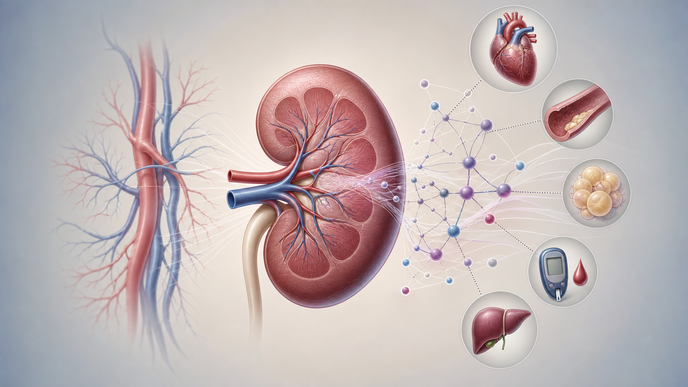
Overall, IgAN emerged as genetically connected to multiple vascular, blood-pressure, and lipid-related traits through convergent signals in immune regulation, lipid metabolism, and endothelial or vascular biology.
Clinician Questions
Which data sources and traits were included in the IgA nephropathy cross-trait genomic analysis?
The analysis used published GWAS summary datasets, spanning IgAN along with broad vascular-disease, risk-factor, metabolic-trait, and immune-cell panels.
How did the investigators decide that two IgA nephropathy traits might share a causal variant?
They combined Bayesian fine-mapping with colocalization to test whether the same locus plausibly contributed to both traits, then used HyPrColoc to assess whether a signal was shared across several traits at once.
What biologic themes linked IgA nephropathy with vascular and metabolic traits in this analysis?
The shared signal converged on immune regulation, lipid metabolism, blood-pressure-related biology, and endothelial or vascular pathways, with enrichment in spleen, lung, peripheral blood, endothelial cells, macrophages, and related immune or vascular cell populations.
Recommended Reading
- For more on IgAN treatment advances: What the Latest IgAN Clinical Trials Mean for Patient Care
- For more on evolving IgAN management: From Evidence to Action in IgAN
- For more on IgAN disease-modifying therapy: Targeting BAFF and APRIL in IgA Nephropathy