
Transcript
Announcer:
You’re listening to On the Frontlines of IgA Nephropathy on ReachMD. And now here's your host, Dr. Gates Colbert.
Dr. Colbert:
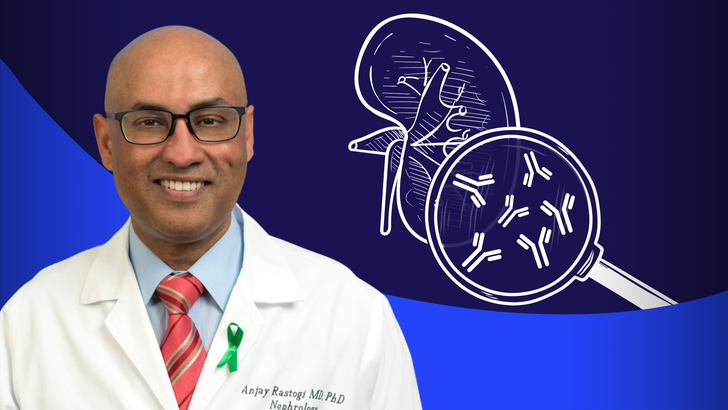
This is On the Frontlinesof IgA Nephropathy on ReachMD. I'm Dr. Gates Colbert, and joining me to discuss how emerging evidence is shaping the clinical management of IgA nephropathy, or IgAN for short, is Dr. Anjay Rastogi. He's a Professor of Medicine and Clinical Chief of Nephrology at the David Geffen School of Medicine at UCLA. He's also the Director of the UCLA CORE Kidney Health Program. Dr. Rastogi, it's great to have you here today.
Dr. Rastogi:
Likewise, Dr. Colbert. Thank you so much for having me.
Dr. Colbert:
So to start, Dr. Rastogi, we know that the treatment landscape for IgA nephropathy has changed dramatically over the past few years. From your perspective, what's the biggest shift in how we think about managing these patients, and what's driving that change?
Dr. Rastogi:
I've been a nephrologist for over twenty years, and my senior talk when I was a fellow was on IgA nephropathy. But the amount of changes—or actually, discoveries—that we have had in the last five years is amazing.
And if you ask me one thing that I think would be the most significant, it’s that IgA nephropathy—or IgAN for short, as you said—is not a benign disease. And it was called benign hematuria when it was first identified and described, way back in 1986. But based on multiple studies from across the globe that have come out, we now know that this is not a benign disease, and actually, a good portion of patients who are identified with IgA nephropathy will progress to end-stage kidney disease within 10 years.
What makes it even more important is that most of these patients tend to be younger. They're in their 20s and 30s. So if you think about that, if they end up with ESKD in ten years, they'll still be in the prime of their life. Now, what makes it even worse than that is the recurrence of IgA nephropathy in the transplanted kidney. IgA nephropathy is an immune-mediated kidney disease, and it's a systemic disorder.
So we have learned a lot in the last five years, and a lot of this has been driven by the partnership between ASN and FDA. We have a lot of medications that are now approved. From having none, we have now quite a few. Also, proteinuria as a key target and surrogate marker for kidney health and disease is also very important in all the progress that we've made, and there’s a lot more to come.
Dr. Colbert:
So when you're evaluating a patient in clinic, what clinical features or biomarkers help you decide not only when to intervene, but also which therapy may be the best fit?
Dr. Rastogi:
So I'm also a pharmacologist by training. My PhD is in pharmacology. And when you look at the pathogenesis, I do want stress, it's not just the pathogenesis of IgA nephropathy. People call it four-hit. I like to call it multi-hit. But each of those hits are potential therapeutic targets. So I think that's really important to keep in mind.
Now, when we are looking at, biomarkers, first of all, IgA nephropathy, can only be diagnosed, as of today, on a biopsy. Our biopsy is very important, and that's where the role of the nephropathologist is very important as well. And we at UCLA work very closely with our nephropathologist.
Now, besides the pathology specimen that says a lot—especially depending upon how fresh the biopsy is—the other key biomarker that we look for is proteinuria, which, like I said, is a surrogate marker. So proteinuria is a modifiable risk factor for progression of IgA nephropathy. The higher the proteinuria, the more rapid the rate of progression. And what's really important, also, to keep in mind, is that even when patients—quote-unquote—when we think their proteinuria is well controlled—that is less than 0.3 grams—studies have shown that even those patients are at risk for progression of kidney disease.
So proteinuria is something that we definitely look at on an ongoing basis. But at the end, what's most important is kidney function preservation—eGFR stabilization. And I think that's a really important point to keep in mind, because even if your proteinuria is controlled and the patient is still progressing, it's really not that helpful. And that's why, when FDA is looking at the final approval of medications, they are looking at the eGFR data. So the nine-month data is proteinuria—that gets the conditional approval or initial approval—and the final approval or full approval is based on the eGFR data. And what we are looking for is the eGFR slope to be less than one milliliter per minute per year.
The other point that I do want to mention is that all the medications that we have currently approved are not a cure for IgA nephropathy. The best they can do is stabilize kidney function. It's also a systemic disorder, the long-term treatment.
So all those factors and points go through my head when I'm looking at what is the best treatment for my patient.
Dr. Colbert:
As more therapies become available, how are you thinking about treatment sequencing? And what role do immune-targeted therapies play within your overall management strategy?
Dr. Rastogi:
When I'm evaluating my patients, my goal is to stabilize the kidney function—that is the eGFR stabilization—but also bring down the proteinuria, not just effectively, but rapidly, because the longer the patient stays with proteinuria, the more at risk they are for further kidney damage. That is because proteinuria by itself causes nephrotoxicity by multiple mechanisms.
Now, we have a lot of medications. I spoke about the multi-hit hypothesis and the different hits we have. When we look at the pathogenesis, it's very clear to all the people in the field of IgA nephropathy that B cells play a central role. There will be no immune complex formation, deposition, or activation of the pro-inflammatory and pro-fibrotic pathways if we don't have the abnormal antibody and the antibody against this, abnormal antibody.
So we have this class of drugs now called B-cell modulators: the anti-APRIL and anti-BAFF. And those are, in my opinion, central players when we look at the treatment for IgA nephropathy. So choke the system upstream. I think that's really critical. And so far, the data that we have, it’s the same that we had with our SGLT2 inhibitors. We had the dapagliflozin data, we had the empagliflozin. All of them were consistent with each other. So the body of information is the same when we look at the B-cell modulators. It's very strong. We have a lot of safety information. We have efficacy information. We have tolerability.
So at this point, based on what we know, this is central to my approach towards IgA nephropathy. But is that enough? And we don't know that yet. So my approach is that we go upstream for B-cell modulation, but also downstream when we have the hit four. So that is the way I contemplate my treatment. And obviously, it depends upon the patients, what they're going through, and a lot of other factors.
The other important point that I want to point out is when KDIGO guidelines came out last year, there were two big buckets in the treatment. One big bucket was what we would call foundational therapy, CKD therapy, whatever you want call that. That includes RAAS inhibitors, SGLT2 inhibitors, and also our endothelin antagonists. The second bucket was the immune drivers of nephron loss, and that includes, obviously, the B-cell modulation, our targeted steroids that we're using. So all those medications are important. What they clearly mention in the guidelines is that when you start treatment for IgA nephropathy, both the foundation therapy and the immune drivers of nephron loss should be started simultaneously, not sequentially. So I think that's an important point to to keep in mind.
Now, if despite all this, they're still progressing, then we look at other options to add on as well.
Dr. Colbert:
For those just tuning in, you're listening to On the Frontlines of IgA Nephropathy on ReachMD. I'm Dr. Gates Colbert, and I'm speaking with Dr. Anjay Rastogi about applying new clinical insights in IgAN care.
So, Dr. Rastogi, for patients who continue to progress despite existing therapy, how do you approach the next step in management, and what evidence informs those decisions?
Dr. Rastogi:
That's a great question, Dr. Colbert. So, like I said, we are very KDIGO-driven based on the guidelines that they have provided. So despite the therapy that we're putting our patients on, if they're still progressing… And how do we define progress? So the ultimate is the eGFR slope. So we really need to look at the trend of eGFR, and if it's going down over time, that means the disease is still progressing. This might be despite the fact that the proteinuria, quote unquote, are within goal. So that's number one, the eGFR trend.
The second thing is proteinuria. And once again, in KDIGO guidelines, it’s very clear that we should aim for complete proteinuria remission, because now we have the tools. And I also look at hematuria, but I won't get into that at this point. Proteinuria and eGFR.
Now, if a patient comes to me, and based on the proteinuria and/or eGFR, they're still progressing, then I would add more medications that would fall into the immune drivers of nephron loss. But I’d also make sure that the foundational therapies—the RAS therapies, the endothelin antagonists, the SGLT2 inhibitors, now we'll also have the non-steroidal MRAs and other aldosterone synthase inhibitors probably coming into the field as well—we really want to optimize both pathways, and we add on.
But once again, the key thing for at least the immune drivers of nephron loss is I think the B-cell therapies will play a very central role. And I do want to reinforce the point that so far so good, but we will need more data and more information as it's coming out. Now, as a pharmacologist and at the CORE Kidney Program, we came up with a criterion for adoption of new medications or therapies, and it's called the SEAT criteria: S-E-A-T. And for any new medication that we adopt, all four things should be met. S is safety, E is efficacy, A is affordability and accessibility, and T is tolerability.
And we don't know if it's going to be lifelong treatment, but it will definitely be a prolonged treatment. So with the medications that we adopt, the safety, efficacy, tolerability, and obviously, the accessibility, is very important.
So what we have in the data at this point is randomized control, the golden standard for these medications. What we don't have is the combination treatments and all the other stuff. So hopefully, that will be coming out in the near future.
Dr. Colbert:
Let's look ahead for a moment. Where do you see the biggest opportunities or perhaps the biggest unanswered questions as clinicians begin incorporating these newer treatment strategies into practice?
Dr. Rastogi:
It’s a great question, Dr. Colbert, and there are a few different ways we can answer that. As a pharmacologist, what I would like to see is drugs being combined. We can even use an approach of the induction followed by maintenance therapy. We combine two or more drugs, and the whole hope is that one and one is more than two, and their adverse events are less than two when you combine two of those medications. So I would like to see more data on combination treatment: if they can complement each other and, at the same time, maybe decrease the adverse events and increase the efficacy.
The other important point that I do want to point out is opportunities about implementing guideline-directed—not just therapies—but diagnostics as well. One of the challenges we have as nephrologists is the patients are in CKD stage three or advanced by the time they come to us. So we need to really go upstream and do kidney health screening by a simple urine test and blood test. One of our focuses at CORE Kidney is to not just screen patients at risk—like those with diabetes, cardiovascular disease, obesity, and hypertension, but also do universal screening. Because if you do at-risk screening, you will be missing out on all these rare diseases, including IgA nephropathy, because they don't have the classical risk factors when we think about the kidney disease and screen for them.
Dr. Colbert:
Finally, Dr. Rastogi, what's one key takeaway you'd like clinicians to keep in mind when treating patients with IgAN?
Dr. Rastogi:
Once again, like I said, this is a very exciting time, but what we need to do for IgA nephropathy is get over the clinical inertia and implement the diagnostics and most important therapeutics. There is a lot of information out there, and we just need to implement that. Awareness is important, but awareness without action doesn't get us too far. So I think it's all about action, action, action.
Dr. Colbert:
That's an excellent message to leave our audience with. A big thanks to my guest, Dr. Anjay Rastogi, for sharing his perspective on how emerging evidence is being put into practice for patients with IgA nephropathy. Dr. Rastogi, thanks so much for joining us.
Dr. Rastogi:
Thank you, Dr. Colbert. Thank you for having me.
Announcer:
You’ve been listening to On the Frontlines of IgA Nephropathy on ReachMD. To access this and other episodes in our series, visit On the Frontlines of IgA Nephropathy on ReachMD.com, where you can Be Part of the Knowledge. Thanks for listening!
