
EV miR-652-3p Distinguishes TB From NTM in AIDS
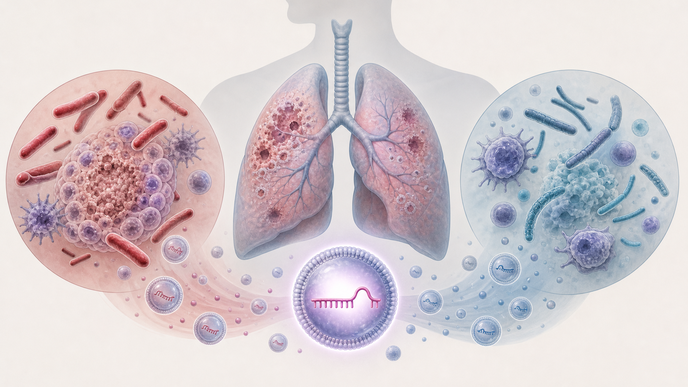
Key Takeaways
- Among adults with AIDS at a Shanghai center, plasma EV-associated miR-652-3p expression was higher with TB and lower with NTM disease than in AIDS controls.
- miR-652-3p distinguished NTM disease from TB with 98% sensitivity and 100% specificity in the internal qPCR evaluation.
- let-7c-5p increased in both infection groups relative to AIDS controls but separated NTM disease from TB less well than miR-652-3p.
- The authors cautioned that near-perfect discrimination within this single-center cohort remains unconfirmed externally.
Xu and colleagues enrolled 125 adults with AIDS at Shanghai Public Health Clinical Center, China, from January 2021 through January 2024 in a retrospective observational study of plasma EV-associated miRNAs. TB and NTM disease were pathogen-confirmed, and affected participants were treatment-naive; AIDS controls provided the non-mycobacterial comparison. Sequencing screened EV-associated miRNAs in a 15-person discovery phase. A distinct, 110-person internal quantitative polymerase chain reaction (qPCR) cohort assessed the selected candidates miR-374a-5p, miR-652-3p, and let-7c-5p.
The qPCR cohort comprised 30 adults with AIDS/TB, 50 with AIDS/NTM disease, and 30 AIDS controls. Investigators compared miRNA expression in plasma EV-enriched fractions across groups. They calculated receiver operating characteristic (ROC) curves and area under the curve (AUC) values, selecting thresholds with the Youden index.
In the internal qPCR cohort, miR-652-3p expression was significantly higher with TB than in AIDS controls and significantly lower with NTM disease than in either comparison group. For distinguishing NTM disease from TB, its AUC was 0.9993 (95% confidence interval [CI], 0.9971–1.0000) at a study-selected cutoff of 0.4530.
miR-374a-5p expression was lower with NTM disease than with TB or in AIDS controls, but the TB–control expression difference was not statistically significant. Its discrimination between NTM disease and TB was weaker than that of miR-652-3p. let-7c-5p expression was higher with either infection than in controls and higher with NTM disease than with TB. Within the internal cohort, let-7c-5p reached an AUC of 1.0000 for each infection-versus-control comparison, but its AUC for NTM disease versus TB was 0.6613.
The modest cohort, especially the small discovery phase, and single-center internal ROC estimates raise concern about overfitting. Larger, independent multicenter evaluation is necessary to assess whether the discrimination persists. The isolation process enriched total vesicles rather than yielding verified pure EV isolates; the authors also noted constraints involving U6 small nuclear RNA normalization and TRIzol LS extraction.
Xu and colleagues concluded that the three EV-associated miRNAs showed differing patterns across AIDS/TB, AIDS/NTM disease, and AIDS controls.
Clinician Questions
Which nontuberculous mycobacteria were represented in plasma EV-miRNA discovery among adults with AIDS?
Among 15 adults with AIDS in the plasma EV-associated miRNA sequencing phase, 3 had pathogen-confirmed TB, 9 had pathogen-confirmed NTM disease, and 3 were AIDS controls. The NTM cases were equally drawn from Mycobacterium kansasii, M. intracellulare, and M. avium; species-specific candidates were not separately evaluated in the larger internal qPCR cohort.
Can plasma EV-associated miRNAs for distinguishing TB from NTM in AIDS be generalized to people without HIV?
Diagnostic discrimination using plasma EV-associated miRNAs was evaluated in adults with AIDS, not in people without HIV.