
After Retinal Screening, 32.3% Had Documented Eye Follow-Up
Key Takeaways
- Among adults in Pennsylvania primary care whose diabetic retinopathy examinations prompted additional eye care, most examination events lacked a documented visit within six months.
- Recorded patient contact within 30 days was significantly associated with lower odds of loss to follow-up, without establishing a causal effect.
- Higher previous medical-appointment no-show rates were significantly associated with missed eye care across all three adjusted models.
- Findings suggestive of age-related macular degeneration were associated with higher odds of missed follow-up, while a history of eye disease was associated with lower odds.
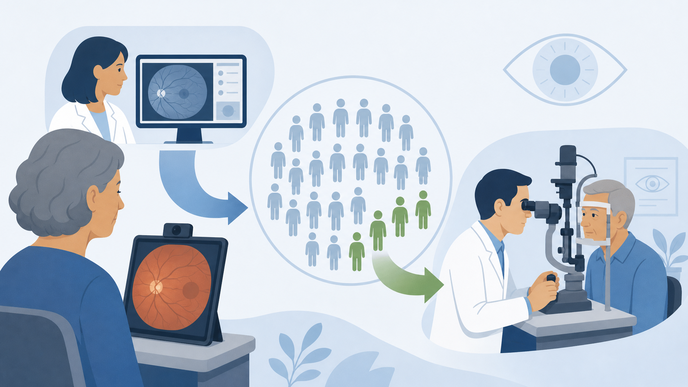
Bonilla-Escobar and colleagues, reporting in a PLOS ONE teleophthalmology cohort study, retrospectively evaluated 3,121 eligible examinations representing 2,959 adults at 75 primary care clinics in Western and Central Pennsylvania during 2017–2019. Eligibility required a recommendation for additional eye care, so the analysis was neither a tally of all examinations nor a unique-patient attendance rate. Ophthalmologists graded point-of-care images. An eye-care visit for any reason within six months counted if it occurred at the University of Pittsburgh Medical Center (UPMC) or was documented as an outside encounter in its electronic medical record (EMR). Adjusted mixed-effects models accounted for repeat examinations and clinics; investigators also analyzed gradable and indeterminate images separately. Patient contact was recorded, not assigned.
A documented eye-care visit occurred within 180 days after 1,009 of 3,121 eligible examination events (32.3%). In adjusted analyses, older age, unmarried status, and imaging findings suggestive of age-related macular degeneration (AMD) were associated with higher odds of missing follow-up. A prior history of eye disease was associated with lower odds. Diabetic retinopathy severity, socioeconomic variables, and comorbidities were not independently associated with missing follow-up after adjustment.
Compared with no documented contact or contact after 60 days, same- or next-day patient contact was associated with lower odds of loss to follow-up in the full cohort (adjusted odds ratio [aOR] 0.37; 95% confidence interval [CI] 0.20–0.67). Other recorded contact intervals through 30 days were also significantly associated with lower odds, but contact at 31–60 days was not; the timing pattern does not establish a causal cutoff. A higher historical medical-appointment no-show rate was associated with higher odds of missing follow-up (aOR 1.04 per percentage-point increase). No-show rate was the sole significant adjusted correlate in the indeterminate-image model and was significant across all three models; gradable-image findings broadly resembled the full-cohort findings.
Documented outside-system visits counted, but visits absent from UPMC records could have been misclassified as loss to follow-up. Electronic-record covariates could not eliminate residual confounding, and neighborhood poverty was measured by ZIP code rather than for individuals. Implementation varied among clinics, inactive sites were excluded, and the findings came from one teleophthalmology program. Recorded contact timing was observational: its association with attendance neither proves that earlier contact improved attendance nor establishes an intervention threshold.
The investigators concluded that completing a primary care retinal screen was distinct from documenting subsequent eye care; their observed associations did not test a strategy for closing that gap.
Clinician Questions
Which diabetic retinopathy screening examinations were eligible for the Pennsylvania teleophthalmology follow-up analysis?
Among 12,444 point-of-care diabetic retinopathy examinations, 3,738 generated a recommendation for an ophthalmologist or optometrist visit. The Pennsylvania analysis then excluded repeated examinations with identical findings, examinations involving death during the follow-up window, and examinations from clinics where the program became inactive. Its outcome concerned qualifying examination events, not an annual screening rate among patients with diabetes.
Which retinal imaging findings prompted an eye-care recommendation in the Pennsylvania diabetic retinopathy screening program?
In the Pennsylvania point-of-care diabetic retinopathy program, ophthalmologist-graded images prompted follow-up for moderate or worse diabetic retinopathy, diabetic retinopathy with macular exudates, other suspected ocular disease such as AMD or glaucoma, or images that could not yield a diagnosis. Qualifying examinations were therefore not limited to definite diabetic retinopathy.
Was a documented eye-care referral independently associated with attendance after diabetic retinopathy screening?
A documented ophthalmology or optometry referral was not independently associated with a recorded follow-up visit after point-of-care diabetic retinopathy examination in the Pennsylvania program's adjusted model. Referral documentation did not establish how clearly the recommendation was communicated or how much scheduling assistance patients received; the observational finding does not establish that referrals are ineffective.
Recommended Reading
- For more on diabetic retinopathy in teleophthalmology: Early Diabetic Retinopathy Regression in Teleophthalmology
This content is intended for healthcare professionals for educational purposes. The article and its image were developed with AI assistance and reviewed by members of the ReachMD team prior to publication. Please refer to the original source linked for the complete and most up-to-date information.