
ACL Graft Choice and Return to Sport: No Clear Autograft Winner
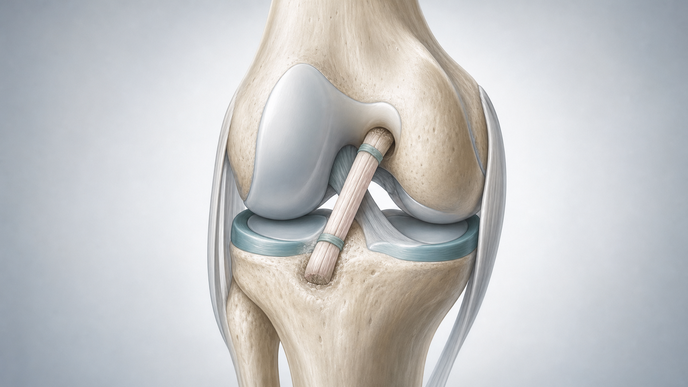
Key Takeaways
- Among young, active patients undergoing ACL reconstruction, autograft was associated with higher RTS and lower revision rates than allograft.
- BTB was associated with higher overall RTS than HT in one synthesis, but preinjury performance was similar there and randomized-trial evidence found no significant difference in return to baseline sport.
- BTB was linked to anterior knee pain, HT to possible flexion weakness, and QT to early quadriceps deficits.
- Pediatric QT recipients had encouraging RTS outcomes, although long-term comparisons with other grafts remain sparse.
Investigators synthesized published research in a narrative review of ACL graft choice. They examined bone–patellar tendon–bone (BTB), hamstring tendon (HT), quadriceps tendon (QT), and allograft reconstruction. The cited research spans young athletes and, for particular questions, elite and high-school athletes, pediatric recipients, revision cases, and older or lower-demand patients. Any-sport RTS, return to preinjury or baseline sport, and return-to-play measure different outcomes; the cohorts do not share a common denominator.
Across cited general cohorts, overall RTS ranged from 65%–73.2% at three years, compared with 83% to over 90% in separately reported elite and high-school groups. Those population-specific ranges are not graft effects. Among National Collegiate Athletic Association Division I football players, return-to-play rates were 84.9% with autograft versus 69.9% with allograft, a statistically significant difference reported in the review. The authors also associated autograft with fewer revisions in young, active populations. Allograft avoids harvest morbidity but has slower maturation and a small, nonzero disease-transmission risk; the review discusses it in the context of older, lower-demand patients. Football return to play is not interchangeable with RTS across other sports.
DeFazio and colleagues reported overall RTS of 81% with BTB versus 70.6% with HT, although return to preinjury performance was similar; a separate synthesis comparing BTB with four-strand HT favored BTB for preinjury-level return. Bergeron and colleagues’ randomized-trial meta-analysis found no significant BTB–HT difference in return to baseline sport. Scandinavian registry findings concerned lower revision with BTB, not proven graft-driven RTS. A pediatric QT synthesis reported RTS of 88.9%–91.6%, not a head-to-head result. BTB offers bone-to-bone healing but can cause anterior knee pain and, rarely, patellar fracture. HT has less anterior knee pain but variable graft diameter and potential flexion weakness; QT can have early quadriceps weakness, pain, or hematoma. A Danish QT revision signal was concentrated in lower-volume centers, and long-term comparisons remain sparse.
The narrative synthesis did not use a predefined search protocol or formal quality assessment. Athletic populations, RTS definitions, study designs, and follow-up differed, limiting comparisons across the cited findings. Registry and retrospective associations do not establish that graft choice causes an RTS difference. The senior author’s preference for BTB or QT in high-demand athletes is a clinical preference, not an evidence-established RTS ranking. The authors also discuss strength symmetry, hop tests, and psychological readiness as RTS assessments, along with graft-specific strength trajectories; rehabilitation and reinjury associations are not graft-randomized comparisons.
According to the authors, the evidence associates autograft with better RTS and revision outcomes than allograft in young, active patients, without identifying an autograft that consistently leads on RTS. Graft-site symptoms and strength recovery remain relevant when interpreting those sport outcomes.
Clinician Questions
Does graft choice affect return to sport after revision ACL reconstruction?
A synthesis cited by the authors found no significant RTS difference among BTB, HT, and QT grafts after revision ACL reconstruction; this does not establish that the grafts are equivalent.
Why does the senior author favor all-soft-tissue quadriceps tendon grafts for skeletally immature ACL patients?
For skeletally immature patients undergoing ACL reconstruction, the senior author prefers an all-soft-tissue QT autograft to avoid bone plugs crossing open growth plates while retaining sufficient graft tissue. This is an expert preference, not proof of pediatric superiority.
Recommended Reading
- For more on knee recovery after ACL reconstruction: Smartphone Steps Linked to Knee Outcomes After ACL Reconstruction