
Transcript
Announcer:
Welcome to CE on ReachMD. This activity is provided by Total CMEand is part of our MinuteCE curriculum.
Prior to beginning the activity, please be sure to review the faculty and commercial support disclosure statements as well as the learning objectives.
Dr. Brown:
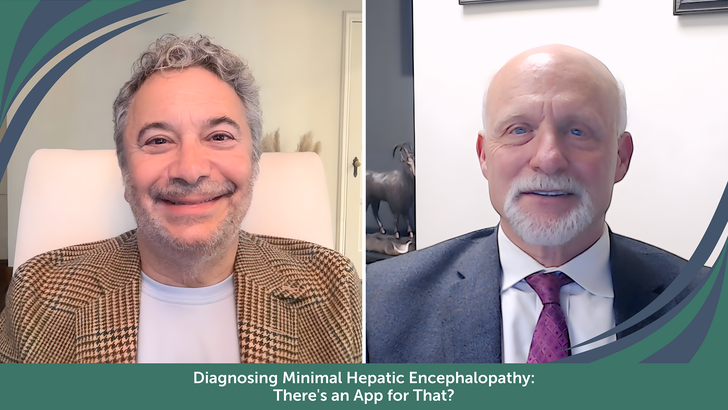
This is CE on ReachMD, and I'm Dr. Robert Brown from Weill Cornell in New York. Here with me today is Dr. Steven Flamm from Rush University in Chicago.
Steve, what can PCPs use to diagnose minimal hepatic encephalopathy, or HE?
Dr. Flamm:
Bob, that's a great question. I want to briefly review the definition: minimal hepatic encephalopathy means that, in the setting of portal hypertension from cirrhosis, patients have very subtle clinical deficits. They're not overt. The patients don't come in and say, “I'm confused.” They don't come in and say, “My personality is different,” or their family doesn't say it. They have very subtle deficits that impact on sleep, energy level, short-term memory, concentration. Studies on these patients have shown increased car accidents and traffic tickets and falls. This problem can really impact your quality of life severely, but it's very difficult to diagnose. And because of that, PCPs often wonder, how would I diagnose this if I were looking at it?
You often have to use neuropsychiatric or psychometric tests. There are a lot of them out there. A lot of them are paper-and-pencil tests, where you do number connection tests like you used to do when you were a kid—just going 1 to 2, 2 to 3, 3 to 4. There are other tests called critical flicker frequency tests, where there's a dotted light that's blinking and you need to say when it doesn't look like it's blinking. There are all kinds of these tests that are available, most of them are, if a primary care provider wants to look in a particular patient for minimal HE.
One that's readily available is on the EncephalApp. It's an EncephalApp Stroop test. Stroop test means a word comes up—the color red, for instance—but it's actually blue. And you ask the person: What color do you see? And believe it or not, people with minimal HE have trouble doing that. It takes them longer, and they make more mistakes. The word may be black, but the color of it’s white, and you ask the patient, “what color is this?” and they have trouble separating the processing out to say white because the word is black.
So that's a way you can do it in practice, Bob. Again, difficult to diagnose, but if a primary care provider wants to do it, it can be done.
Dr. Brown:
Well, if the app is available online, can family members do this for their family—the animal naming test and just time them, or do the EncephalApp Stroop test after watching some kind of YouTube video?
Dr. Flamm:
Absolutely, a family could do it. This isn't complicated once you get into the system. And primary care providers can do it in the office for patients. Absolutely it can be done. And if you’re worried about it—if a family member is worried about their patient's mentation or a provider is, they can, even with very subtle changes, detect them with these kinds of tests.
Dr. Brown:
So what do you do in your practice?
Dr. Flamm:
Bob, I don't look for this very much in my practice. I do ask patients about their short-term memory and concentration. I ask them about sleep disturbance. I ask family members how they think the patient is doing from a clinical standpoint. I don't use the psychometric tests in practice, probably because of time pressures.
What do you do in practice?
Dr. Brown:
I think it's hard. I think the time pressure is hard. I sometimes will do the animal naming test, because that's pretty quick; it only takes a minute. But I tend to just ask detailed questions of both the patient and their family members or significant others.
Dr. Flamm:
Bob, your point is well taken here. Providers need to ask questions. You need to ask questions one layer below what we normally ask if you really want to assess patients properly.
Dr. Brown:
Well, this has been a great bite-sized discussion. Our time is up. Thanks for listening.
Announcer:
You have been listening to CE on ReachMD. This activity is provided by Total CMEand is part of our MinuteCE curriculum.
To receive your free CE credit, or to download this activity, go to ReachMD.com/CME. Thank you for listening.

