Transcript
Dr. Agarwal:
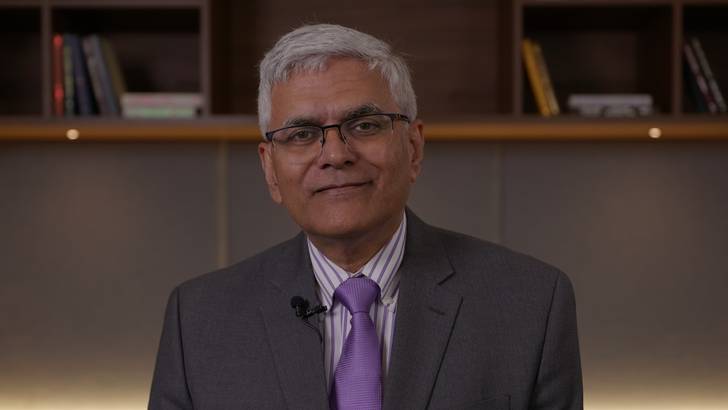
Hi, I'm Dr. Rajiv Agarwal, Professor Emeritus Indiana University School of Medicine, reporting from ERA 2026 in Glasgow, Scotland. I'm reporting to you on the individual-level meta-analysis called INFINITY that's published in Lancet, looking at safety and efficacy of finerenone in people with and without diabetes.
This is an analysis of more than 14,500 patients that come from either FIDELIO trial, FIGARO trial, or FIND-CKD. FIDELIO trial was done in people with a later-stage kidney disease with the primary intent to look at kidney failure outcomes. FIGARO was done in people with type 2 diabetes and earlier-stage kidney disease to look at cardiovascular outcomes. And FIND-CKD was done in non-diabetic CKD to look at kidney failure progression.
Together, we have 14,500 patients in the three trials put together, and we have a mean age of about 66 years; 70% are men, 25% from Asia, broad representation from all the continents. Well treated, mean blood pressure about 136, statin use very high, 100% on ACE or ARBs, and about 8% on SGLT2 inhibitors. About 8% of the people had heart failure history, and part of this lower incidence was because we excluded people with heart failure with reduced ejection fraction with symptoms.
Together, we find that we have CKD progression defined by 57% decline in eGFR or kidney failure outcome was reduced by 24%, the P-value being less than 1 in 10,000, and the data were consistent with and without diabetes. If you look at kidney failure alone, we have a 15% reduction, dialysis or transplantation 23% reduction, heart failure hospitalization 24% reduction, cardiovascular death and heart failure hospitalization in the same ballpark.
All-cause mortality was reduced 12%, and this was also statistically significant, as was cardiovascular death which was reduced 18%, also statistically significant. All in all, the data looked very good for the efficacy.
What about the safety? The safety and efficacy were balanced. The safety, the serious adverse events, and the adverse events were similar in the placebo and the treated groups. Hyperkalemia was more common in the finerenone group. If you look at hospitalized because of hyperkalemia, it was more common when people had diabetes, a 6-fold increase versus a 1.5-fold increase in people without diabetes, and that interaction effect is significant. In other words, if people didn't have diabetes, they were less likely to be hospitalized because of hyperkalemia.
All in all, all the P-values are significant. The data are very consistent across the board and tells us that this is a drug that can save kidneys and the hearts in people with type 2 diabetes across a broad range of glycemia, glucose control, the CKD stage, and albuminuria.
Reporting to you from ERA 2026, this is Dr. Agarwal. Thank you for listening.