Transcript
Announcer:
You’re listening to VacciNation on ReachMD. This episode is sponsored by CSL Seqirus. Here’s your host, Dr. Brian McDonough.
Dr. McDonough:
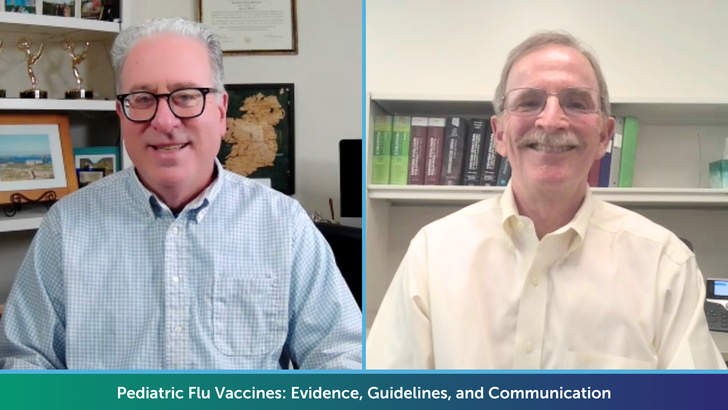
This is VacciNation on ReachMD, and I'm Dr. Brian McDonough. Today, I'm joined by Dr. Robert Frenck, and we'll be exploring evidence-based and guideline-informed approaches to support pediatric influenza vaccination decisions. Not only is Dr. Frenck a Professor in the Department of Pediatrics, he's also the Director of the Vaccine Research Center and Executive Chair of the Institutional Review Board at Cincinnati's Children's Hospital. Dr. Frenck, thanks so much for being here today.
Dr. Frenck:
Dr. McDonough, it's my pleasure.
Dr. McDonough:
To start us off, Dr. Frenck, what is the current state of pediatric influenza vaccination uptake, and what reasons for hesitancy are you seeing the most?
Dr. Frenck:
So influenza can be a very significant disease in pediatrics—actually, in adults too. So the Academy of Pediatrics is recommending that every child six months of age and above receive a dose of the current influenza vaccine.
And what we've seen in previous studies is that the flu vaccine in children not only can prevent disease in children, it can significantly decrease disease in grandparents, because, oftentimes, grandparents are taking care of the children after school, the children bring home flu from school, and transmit it to the grandparents. So vaccination in children really is for two purposes: protecting the children, and it actually can protect their family too.
Dr. McDonough:
In January 2026, the FDA required a new febrile seizure warning on flu vaccine labels for children under five. This was based on post-marketing data showing a small increased risk in the 24 hours after vaccination: about one additional case per 20,000 to 40,000 doses, depending on the season studied. Since that update, are you seeing or anticipating an increase in questions from parents about febrile seizures? And if so, how are you addressing them?
Dr. Frenck:
Parents have the right, and they should feel comfortable about asking any questions about any medical care, including vaccination. So, because we as pediatricians or we as healthcare providers have the answers to give them, I think one of the really critical things is that we have to feel comfortable in having the knowledge to try to answer the questions for the parents. Because a strong recommendation for vaccination has been repeatedly shown as the most important factor for parents accepting vaccination.
So, if you look at vaccines, they're really safe. If you're having side effects, they're not common. But one of the things that can happen is that you can get a fever sometimes. And so, if children have a fever, if they're predisposed to having a febrile seizure, that fever from the vaccine can induce a febrile seizure.
As you mentioned, there is a slight increase in febrile seizure—about one additional case per 20,000 to 40,000 doses. But let's put that in perspective. The average healthcare provider has probably about 5,000 people—maybe a little bit less—in their patient population. So they may see one additional seizure in four to eight years. So, really, it's something that, yes, we as providers need to let the parents know so they're fully aware. However, the reality is, it's such an unusual risk. It's really nothing that should weigh in their decision-making process.
But one of the things that's happened is that there has been so much disinformation that's been put out, it's confusing for parents. And that's why it's really important for we, as providers, to be objective, to be able to listen to the questions, and to provide them factual information so that the parents can make their decisions.
Dr. McDonough:
Building on that, we know the American Academy of Pediatrics, the Centers for Disease Control and Prevention, and state-level recommendations don't always align. So which guidelines are you following in your own practice and why?
Dr. Frenck:
I think one of the things that's really important to look back on is that the Academy of Pediatrics has been recommending vaccines since the 1930s. Now, it was a lot easier then, because all we had were DPT and smallpox vaccines, so the list of recommendations was a lot easier. But, for a long time, the Academy of Pediatrics has been providing vaccine recommendations.
But the Academy of Pediatrics saw that it was really important to have a unified vaccine recommendation for the country. And so, in the 1960s, the Academy of Pediatrics was really one of the leading bodies to get the federal government to start the Advisory Committee for Immunization Practices, which is a committee for the CDC.
The Academy of Pediatrics wants there to be a unified recommendation, but the recommendation needs to be based on science and data. And unfortunately, right now, many of the recommendations that have been made by the ACIP are not based on data, and that's why the Academy of Pediatrics felt there was no choice but to provide a schedule that is based on data and facts. And so I would strongly recommend to be following the Academy of Pediatrics-recommended vaccination schedule.
Dr. McDonough:
And as a follow-up to that, what do you do when a parent brings up a recommendation that conflicts with one you're following, whether it's from another organization, another provider, or something they read online?
Dr. Frenck:
As I was mentioning previously, I think it's the right and responsibility of parents to ask questions so that they feel that they're really understanding the issue and can make a qualified decision. So I have no problem with a parent asking me a question. And then I try to provide them the information—the data-driven information—and explain how the vaccine schedule was developed, and that, sometimes, there are things online that are confusing.
One of the things is that parents want to do what's right for their children. They want their children to grow up healthy. They want their children to grow up strong. And they just don't understand, sometimes, the importance of vaccines. You know, it's almost impossible to believe, but in the United States in 1900, one out of five children died before their fifth birthday. I mean, no one would believe that, but it's the truth. Now, it's less than three in 1,000. And that change is due to public health, and one of the major public health changes is vaccines. And so that's why it's so important for us as providers to be encouraging families to vaccinate and to explain why vaccines are so important.
And what happens now is that, because the vaccines have been so good and preventing so much disease, families don't understand, sometimes, the importance, because they say, "Well, there's only these risks and there's no benefits." Well, the benefits are that you don't see the disease. And if you don't continue to vaccinate, unfortunately, we're going to see outbreak, like how we've seen many cases of measles. We were measles-free in the United States, and now we're going to lose that measles-free status because of the number of outbreaks of endemic measles that we're having in the United States, which is directly related to the lack of vaccination.
Dr. McDonough:
For those just tuning in, you're listening to VacciNation on ReachMD. I'm Dr. Brian McDonough, and I'm speaking with Dr. Robert Frenck about supporting pediatric influenza vaccination.
So, Dr. Frenck, let's consider how this plays out in practice. When addressing a safety concern or hesitancy directly with a parent, what strategies do you recommend to help them feel heard while still moving the conversation toward vaccination?
Dr. Frenck:
So one of the things, Dr. McDonough, that we've seen is that the normative approach works most of the time. In other words, saying, "Today, your child is due for these vaccinations," and saying, "This is something that I recommend, and every child is recommended to receive these vaccines at this time in their lives." That, about 80 percent of the time, is all parents need to hear. You, as their healthcare provider, are the person that they trust, and there's research showing over and over again that the leading source of trusted information is the healthcare provider. So you being confident and you giving a firm recommendation and saying, "This is what I recommend," about eight out of 10 parents are going say, "Okay, I'm good with that. I will go vaccinate my child."
You will have some parents, very understandably, that have questions. And so what really I recommend is trying to understand what their concerns are. Ask a bit of leading questions. "Can you please explain to me what concerns you have? What things have you heard? What are you worried about?" Because if you, as a provider, don't understand what concerns the parents have, you may launch off on some sort of diatribe that is totally wrong. You may think parents are concerned because they're getting too many vaccines, and really, they're concerned because they heard that it may cause a febrile seizure, as we discussed earlier with a flu vaccine. So we really need to let parents tell us what their concerns are so we can address the questions, because we have the answers.
Dr. McDonough:
Now, after all of that, if a parent still declines the vaccine, how do you handle the conversation and keep the door open for future discussions?
Dr. Frenck:
I'm firmly committed to the belief that parents want to do what's right for their child and what's best for their child. And sometimes, they're going to have a differing opinion than we do. So we can tell the parents, "This is what we think," and we can have a respectful conversation.
If they say, "I choose not to do that," you respect that conversation, and you document it to say that you discussed. And then I would say, at a next visit, you could still bring it up, because if you have had a respectful conversation, that allows you a window to be able to readdress the problem in the future. Now, flu vaccine, obviously, is a fairly seasonal period, so you may not have the opportunity to discuss flu vaccines again. But in the broader scale of vaccinations, a parent may decide today they don't want to vaccinate their child, but you discuss with them at the next visit, and maybe they'll change their mind, because they've had the opportunity to think about it, and they see that you respect them, and they respect you.
So it really takes time, sometimes, to have parents be able to make their decision, and we have to accept that and say that that's their right.
Dr. McDonough:
As we come to the end of our program, Dr. Frenck, what are the most important things clinicians should remember to ultimately improve pediatric influenza vaccine uptake?
Dr. Frenck:
I think the number one thing to remember is that parents are bringing their children to you because they trust you, because they trust your opinion, and because they know that you're going to do the best for their child. So use that. Explain to people why you think vaccines are important, about why you vaccinate your family, about things that maybe you've seen happen in children that weren't vaccinated.
A lot of times, we need to work on addressing the heart, not the head, because parents will respond to emotional situations. There was a saying that said, "The death of 1,000 men is a statistic. A death of one man is a tragedy." And so, if we really play to the heart sometimes and say, "This is why I think it's so important.
This is why I understand your questions and concerns, but why I still recommend getting vaccinations," I think that's what we need to do and we need to continue to do.
We are going to have questions, because there has been a lot of disinformation in the press. But we know that vaccines are important. We know the data are there, and we just need to continue pushing forward and saying, "This is why these are the recommendations we're making."
Dr. McDonough:
With those important insights in mind, I want to thank my guest, Dr. Robert Frenck, for joining me to discuss how clinicians can apply safety evidence and guidelines to pediatric influenza vaccination conversations. Dr. Frenck, it was great having you on the program.
Dr. Frenck:
Thank you, Dr. McDonough. I really enjoyed it.
Announcer:
This episode of VacciNation was sponsored by CSL Seqirus. To access this and other episodes in our series, visit VacciNation on ReachMD.com, where you can Be Part of the Knowledge. Thanks for listening!