Transcript
Announcer:
You’re listening to Project Oncology on ReachMD, and this episode is sponsored by Stemline Therapeutics, Incorporated. And now, here’s your host, Dr. Alexandria May.
Dr. May:
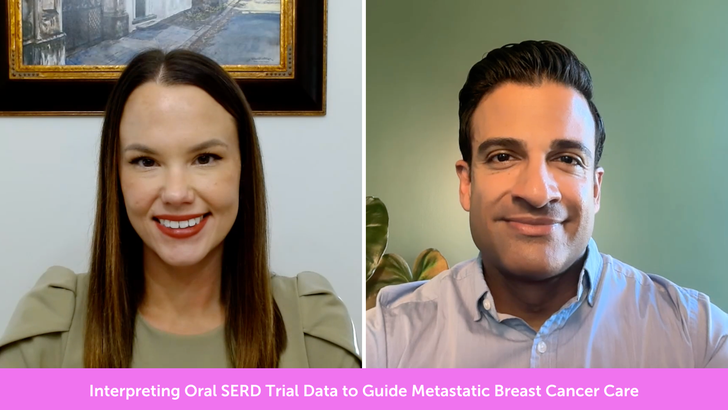
Welcome to Project Oncology on ReachMD. I'm Dr. Alexandria May, and joining me to share best practices for interpreting oral SERD trial data in metastatic breast cancer is Dr. Neil Iyengar, Associate Professor of Medicine and the Co-Director of Breast Medical Oncology at Emory Winship Cancer Institute in Atlanta.
Dr. Iyengar, thanks for being here today.
Dr. Iyengar:
Thanks for having me, Dr. May.
Dr. May:
To get us started, Dr. Iyengar, prior CDK4/6 inhibitor exposure was one of the eligibility criteria that varied across EMERALD, EMBER-3, and VERITAC-2. How do differences in prior CDK4/6 inhibitor exposure help you characterize the populations enrolled, and what does that mean for how each trial's population should be understood on its own terms?
Dr. Iyengar:
So this is a very important question, especially as we're seeing more and more data sets with regards to novel anti-estrogen therapies in metastatic breast cancer. And we know that the landscape of treatment, even the standard of care treatment, has been evolving pretty rapidly. So of course, currently the current standard of care in the first-line setting is endocrine therapy with a CDK4/6 inhibitor.
Now, when some of the earlier oral SERD trials were being developed, there was variable uptake at the time. It was the beginning days of using CDK4/6 inhibitors. So some trials were sort of forward-thinking and mandated that every patient was exposed to a CDK4/6 inhibitor before coming on the novel oral SERD or oral anti-estrogen therapy trial, whereas other trials either did not mandate it or stratified in a post hoc fashion.
So this is important, of course, because as we try to apply these data sets to our modern practice, we really have to ask ourselves, “Does this reflect the patient population that I treat? Does this reflect the patient who's sitting in front of me right now?” And we've seen several analyses which indicate that if a trial did not enroll patients who were previously exposed to a CDK4/6 inhibitor, this does variably impact several of the endpoints—several of the efficacy endpoints. So it is incredibly important that we look at the trial design and figure out what percentage of patients were exposed to a CDK4/6 inhibitor if the trial did not mandate it.
Dr. May:
Now, EMBER-3 and VERITAC-2 both excluded patients with prior fulvestrant exposure, and in both trials, fulvestrant was part of the comparator regimen, meaning both arms were fulvestrant-naïve. What does that tell you about what each trial's comparator arm is actually demonstrating?
Dr. Iyengar:
This is also important and really gets back to my point about if the trials reflect our contemporary practice here. Fulvestrant, of course, is an agent that we're now using in earlier lines of therapy, and so many of our patients are also exposed to fulvestrant. So the trials that excluded prior exposure to fulvestrant are really testing a standard of care that we might not be using in clinic in current practice. Whereas the trials that did allow for prior fulvestrant exposure, that's a harder-to-treat population, especially if we're following that with another endocrine therapy. But this is really the area of need because we are using fulvestrant in clinical practice.
And so in my opinion, when I see a trial that has allowed prior fulvestrant exposure, I think this is very helpful. Whereas if I see a trial that has excluded prior fulvestrant exposure, then we need to take that into consideration and consider that the control arm is fulvestrant-naïve, and the control arm with fulvestrant-naïve patients may actually perform a little bit better than those trials that exclude those patients with prior fulvestrant exposure.
Dr. May:
Chemotherapy in this setting is generally reserved for visceral crisis or endocrine-refractory disease. So given that EMERALD permitted it, while EMBER-3 and VERITAC-2 did not, what does that tell you about how differently these three trials may have defined their populations?
Dr. Iyengar:
So the EMERALD trial population was what I would consider a fairly heavily pretreated population. And again, that trial really enrolled patients where we would typically consider endocrine therapies to have been exhausted, especially with prior exposure to chemotherapy. So I think it's very exciting to have seen the efficacy data from EMERALD, where patients had received or had essentially exhausted standard endocrine therapy and even received chemotherapy. So to see activity of elacestrant monotherapy in that population really speaks to the efficacy of that agent.
Now, the other trials that you mentioned have also demonstrated efficacy of those agents, but we have to, of course, take into context where that efficacy was demonstrated, and that tends to be either in earlier lines or in more endocrine-sensitive types of breast cancer. So I think ultimately we have to, of course, look at the patient who's sitting in front of us, their treatment history, and what therapy is the most applicable.
Now, a trial like EMERALD, I think, allows for broad applicability because it did include some patients who were endocrine sensitive, but it also included those more difficult-to-treat patients who have seen multiple lines of endocrine therapy and chemotherapy. So ultimately, if we're looking for a solution that's more broadly applicable, a trial design like EMERALD is an attractive design that reflects modern practice.
Dr. May:
For those just joining us, this is Project Oncology on ReachMD. I'm Dr. Alexandria May, and I'm speaking with Dr. Neil Iyengar about patient differences across oral SERD trials and their implications for treatment decision-making in metastatic breast cancer.
So, Dr. Iyengar, these trials allowed different amounts of prior endocrine therapy before enrollment, with EMBER-3 limited to one line, VERITAC-2 to two, and EMERALD up to two plus chemotherapy. What does that number of prior lines tell you about a patient's tumor biology when interpreting their response to subsequent therapy?
Dr. Iyengar:
Well, there's a lot of heterogeneity, of course, in hormone receptor-positive breast cancer. And so when I look at the inclusion criteria that you just nicely outlined across these trials, a couple of questions come to mind. One is what we discussed earlier, and that is the applicability of those eligibility criteria to the patient population that we see in the real world, if you will.
The EMERALD trial design was a bit more broad by allowing more endocrine therapy and even chemotherapy. And so when I look at that data, it is helpful to be able to apply it to some of my patients who may be earlier on in their treatment course and more endocrine sensitive, or even those patients who are later on in their treatment course and have even gotten chemotherapy, where I would expect to see efficacy based on the EMERALD trial of elacestrant.
For the other trials, like EMBER-3, for example, these are earlier-line trials, and so these patient populations tend to be more endocrine therapy-sensitive. And we also have to look at the median lines of endocrine therapy as well, because even within the range of endocrine therapy sensitivity, we know that response to subsequent endocrine therapy does vary based on how much prior endocrine therapy patients have been exposed to and what the duration of that endocrine therapy was.
So again, it all really comes down to how applicable the datasets are, and some of those datasets are more applicable to a narrower population, whereas EMERALD, for example, is more applicable to a broader population.
Dr. May:
Each of these trials set its own threshold for how quickly a patient's disease could progress and still qualify for enrollment. With EMBER-3 at 12 months post-adjuvant, VERITAC-2 at six months on prior therapy, and EMERALD more broadly, how do those thresholds help us understand a tumor's underlying sensitivity to endocrine therapy?
Dr. Iyengar:
So this particular eligibility criteria is really trying to tease out endocrine sensitivity. And of course, the scientific question varies based on these eligibility criteria. So for the trials that really focused on a longer duration on prior endocrine therapy, those trials are really trying to identify a subpopulation of patients that are more endocrine therapy-sensitive. Whereas a trial like EMERALD, for example, includes some of those patients, but also includes those patients who we would typically consider to be endocrine therapy-resistant. And again, it gives us the opportunity then to really individualize our treatment selection for our patient sitting right in front of us.
I think it's also important because it really also speaks to sequencing of therapies as well. And certainly, the amount and duration of prior endocrine therapy in standard practice may help us decide, do we try another line of endocrine therapy? Do we move on to cytotoxic therapy? And so some of the trials that you outlined, like VERITAC-2 as well as EMBER-3, are really, I would say, more focused on mid-line, if you will, more endocrine-sensitive populations. EMERALD includes that population, but again, also is broader, and it includes those patients who we might consider to be endocrine therapy-resistant.
Dr. May:
Taking all of this together, Dr. Iyengar, how can looking at a trial's baseline patient characteristics and eligibility criteria help clinicians contextualize that trial's findings when considering treatment options for their patients?
Dr. Iyengar:
This is becoming increasingly important, and I would say, in fact, essential. We've now moved on from a space where we really had limited endocrine therapy options, limited molecular options in the metastatic setting, now to a landscape where we've had an explosion of endocrine therapy and molecular therapy options.
So it's really critical that we look at the trial design eligibility criteria, and not just the eligibility criteria, but we actually look at the patient population and the distribution of patients across these various categories that we've been discussing to ultimately determine whether or not the findings from those trials are applicable to the patient sitting in front of us.
I think it's incredibly exciting because we now have all of these treatment opportunities that we can really individualize to our patients. And certainly, if we are establishing standard new clinical workflow practices, it is attractive to use a trial that has broader eligibility criteria, enrolled a broader patient population, and demonstrated efficacy in that setting. So from a workflow perspective, that kind of design helps to create broader treatment selection that applies to more patients. But on the other hand, this landscape of differences in trial design also gives us the flexibility as clinicians to really individualize our treatment selection to the patient in front of us.
Dr. May:
With those considerations in mind, I want to thank my guest, Dr. Neil Iyengar, for joining me to share his perspective on evaluating oral SERD trial outcomes in metastatic breast cancer.
Dr. Iyengar, it was great having you on the program.
Dr. Iyengar:
Always a pleasure, Dr. May. Thank you.
Announcer:
This episode of Project Oncology was sponsored by Stemline Therapeutics, Incorporated. To access this and other episodes in our series, visit Project Oncology on ReachMD.com, where you can Be Part of the Knowledge. Thanks for listening!