Transcript
Announcer:
You’re listening to Project Oncology on ReachMD, and this episode is sponsored by AstraZeneca. Here’s your host, Dr. Alexandria May.
Dr. May:
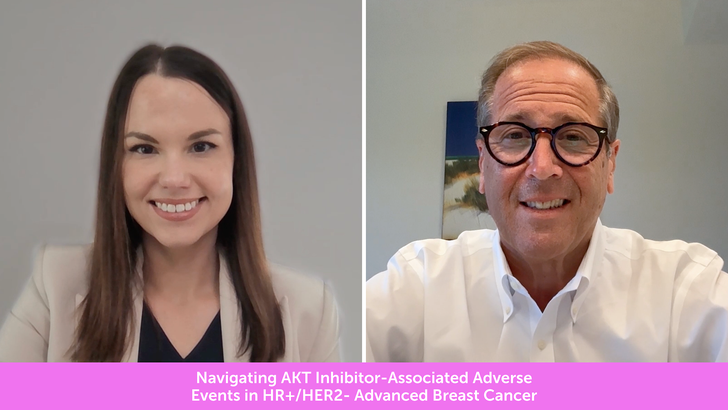
Welcome to Project Oncology on ReachMD. I'm Dr. Alexandria May, and joining me to discuss risk assessment for AKT inhibitor-associated adverse events in patients with HR-positive, HER2-negative advanced breast cancer is Dr. Adam Brufsky. He's a Professor of Medicine, the Associate Chief of the Division of Hematology and Oncology, and the Co-Director of the Comprehensive Breast Cancer Center at the University of Pittsburgh School of Medicine.
Dr. Brufsky, thanks for being here today.
Dr. Brufsky:
Thank you very much for having me.
Dr. May:
Now, for some context, Dr. Brufsky, could you briefly walk us through how the PI3K/AKT/PTEN signaling pathway works and why targeting AKT has become an important strategy in HR-positive, HER2-negative advanced breast cancer?
Dr. Brufsky:
Sure. I think what we're really more worried about is resistance in hormone receptor-positive metastatic breast cancer. CDK4/6 inhibitors have really changed the landscape. I think that there's a survival advantage, and a certain percentage of patients can do well for five to ten years, if not longer.
But there will be a number of people who will progress some fairly quickly. One of the resistance mechanisms that I think we're realizing is overactivity of the PI3-kinase/AKT/PTEN and mTOR pathway. And I think we realize that mutations in PI3-kinase are truncal. What that means is that they occur initially from the primary breast cancer. About a third of primary breast cancers have these mutations, but they don't really matter until a patient becomes resistant to their initial hormonal therapy, either in the first line or more likely the second line after CDK4/6 inhibitors.
And so the pathway has multiple components, but the three most important ones really are PI3-kinase, AKT in the middle, and then mTOR, which is at the bottom of the pathway if you think of it going from top to bottom. And again, you have overactivity of PI3-kinase, but PI3-kinase, in turn, phosphorylates AKT. And by inhibiting AKT, you're inhibiting that middle node of the pathway of the three. The feeling is that's a very powerful way of blocking the pathway, especially when there may not be any known mutations in PI3-kinase or mTOR—that in fact, when you're looking at the PI3-kinase pathway, it's the center part. I think the feeling is that AKT is really the central node of the PI3-kinase pathway. And that's why I think the belief is that these drugs are probably the more powerful drugs that inhibit the PI3-kinase/AKT/mTOR pathway.
Dr. May:
And when it comes to safety, how does inhibition of the AKT pathway contribute to adverse events like hyperglycemia, diarrhea, and rash?
Dr. Brufsky:
The big one, to be honest with you, is hyperglycemia. PI3-kinase is actually part of insulin receptor signaling. So what you're doing by inhibiting that pathway—to greater and lesser extents depending on if you directly inhibit PI3-kinase as opposed to inhibiting AKT or mTOR—the further down the pathway you get, the less hyperglycemia you get. But the issue here is you induce insulin resistance in people, and that's the problem. The originals, like alpelisib, for example, had a Grade three or four hyperglycemia rate in the 30s to 40s. We'll talk about this in a few minutes, but we had to do a lot of dose reduction and use things like metformin, SGLT2 inhibitors, and diets, diabetic diets. There's a lot of things that we had to do.
And so the further down the pathway you get, like AKT in particular, you get less hyperglycemia. mTOR inhibitors have almost no hyperglycemia, for example. So that's the biggest problem: the typical normal apparatus of normal cells involves the use of AKT. The diarrhea and rash all come from inhibition of normal PI3-kinase signaling, and so by inhibiting the downstream effects of the PI3-kinase protein, you get all of these side effects.
Dr. May:
If we take a closer look at this population, what do we know about the distribution of PIK3CA, AKT1, and PTEN alterations among patients enrolled in clinical trials evaluating AKT inhibitors?
Dr. Brufsky:
About a third of patients have a PI3-kinase mutation. Maybe another 10 to 15 percent, we're finding, have mutations in PTEN, which is a deletion usually. Deletions are hard to find on circulating tumor DNA; to find them, you have to do the primary tumor. That's a whole other thing. I think that with PI3-kinase, mTOR, and AKT, for mutations of that pathway, you really need to do the primary tumor. It's hard. You can do it off a liquid—it is easier—but if it doesn't occur in the liquid, it's important to think about doing it off the primary tumor.
If you add PTEN deletions and you add AKT mutations—a very specific mutation, E17K in the AKT protein—you add probably another 10 to 15 percent. So overall, we're talking about 45 to 50 percent of patients having a mutation. I think the hope is in the future—there's a lot of minor mutations, and we consider the patient wild-type and they seem to respond to these PI3-kinase AKT inhibitors—the feeling is that there are probably lots of minor mutations that result in overactivity of the pathway. And so I think in the future we're probably actually going to look at the pathway itself, whether through RNA expression or some other protein expression assay. And the technology will get to the point where we're not specifically going to look at mutations per se, but actually the pathway itself. But we're not there yet.
So for the clinicians who are listening to this, it's usually about a third PI3-kinase. It's probably 10 to 15 percent AKT and PTEN. And again, the best way to do it is off the primary tumor if you can't find it off the liquid.
Dr. May:
For those just joining us, this is Project Oncology on ReachMD. I'm Dr. Alexandria May, and I'm speaking with Dr. Adam Brufsky about evaluating and managing adverse events associated with AKT inhibitors in HR-positive, HER2-negative advanced breast cancer.
So, Dr. Brufsky, when you're identifying which patients might be at higher risk for these treatment-related adverse events, what baseline characteristics do you consider?
Dr. Brufsky:
The biggest one that all of us consider is uh pre-existing diabetes, either type 2 or type 1. My rule of thumb is if you have type 1 diabetes, I don't care how well it's controlled; it's very difficult to give these drugs. For type 2, generally, we like to have the hemoglobin A1C under about seven. It really depends on the trial. Some trials use seven and a half, some use eight, and some use six as a cutoff of a hemoglobin A1C. You want it relatively well controlled, though if you need it and you have nothing else left, and the patient does have a hemoglobin A1C of six and a half or seven, you really have to do this with caution. Generally, I don't use BMI per se, although BMI can be a surrogate for A1C and type 2 and insulin resistance. But again, for someone who has type 2 diabetes or is insulin resistant with metabolic syndrome and with an A1C of seven, I'm going to be a little bit more hesitant. We're going to have to say, “Listen, if you're going to do this, we really have to have glycemic control. We're really going to have to control you with something either with metformin, an SGLT2 inhibitor, or maybe a ketogenic diet.” We really have to have those discussions.
And I think we're all internists as medical oncologists, so it's getting us back to internal medicine and learning how to treat diabetes. I think it's important that you have these discussions up front. There's no hard and fast rule, but generally, in my practice, I'd like it under seven. I think most of us would be a little bit nervous doing it over seven.
Dr. May:
And in real world practice, how can oncology teams integrate these risk assessment strategies into their workflows, especially in busy community settings?
Dr. Brufsky:
I really think it's getting your staff involved, whether you have advanced practice providers, nurses, or pharmacists. In my practice, regardless of AKT, or even alpelisib and the PI3-kinase inhibitors—mTOR, you don't have to do this, but for the other two, generally what I tend to do in my practice is a fasting glucose every week. I think that if it's over 150, I start to intervene generally first with metformin, and I jack that up as high I can go, as well as dietary interventions. And then if it still is not controlled, then I start to reduce the dose of the PI3-kinase or AKT inhibitor. If that doesn't work, at that point, I'll start thinking about a different agent.
I think that a lot of people will use insulin in practice. I do not, because you're invoking insulin resistance, so how can you get over insulin resistance with insulin? And so insulin gets to be a little more complicated, especially in a private or busy practice where you're seeing 20 patients a day. You're seeing multiple different tumor types, many of which really don't involve these drugs. And I think that, again, a simple way to do it is just do fasting glucose once a week on a patient. Just have them do it at the local lab, and have it sent to your office staff, and then you can make your decisions based on that.
Dr. May:
Before we wrap up, Dr. Brufsky, what key considerations should community oncologists keep in mind as they prepare to incorporate AKT inhibitors into patient care?
Dr. Brufsky:
I think the AKT inhibitors do have less hyperglycemia in general than the pure PI3-kinase inhibitors. And I think that with some simple steps that we outlined here, we can really manage these side effects once we get used to them. And I think that in some patients, these really can extend uh progression-free survival for a year or two. The median, I think, is about five and a half to six months generally after they progress on a CDK4/6 inhibitor. But there are patients—probably a third—who don't progress beyond a year. So you really have altered the natural history of someone's disease.
I think it's worth it to remember a little bit more of endocrinology and go back to our internal medicine days when we were house officers. Some of us even still practice internal medicine to some degree in our practice. I think that it's worth it. That's the big message I want to tell people: these are manageable side effects. They can be dealt with, and I think it's worth it to those patients that you can extend their progression-free survival.
Dr. May:
That's a great comment for us to think on as we come to the end of today's program. And I want to thank my guest, Dr. Adam Brufsky, for joining me to discuss how we can evaluate adverse event risk with AKT inhibitors and HR-positive, HER2-negative advanced breast cancer. Dr. Brufsky, it was great having you on the program.
Dr. Brufsky:
Thanks a lot for having me.
Announcer:
This episode of Project Oncology was sponsored by AstraZeneca. To access this and other episodes in our series, visit Project Oncology on ReachMD.com, where you can Be Part of the Knowledge. Thanks for listening!