
Transcript
Announcer:
You’re listening to On the Frontlines of Pediatric Vaccines on ReachMD. Here’s your host, Dr. Shelina Ramnarine.
Dr. Ramnarine:
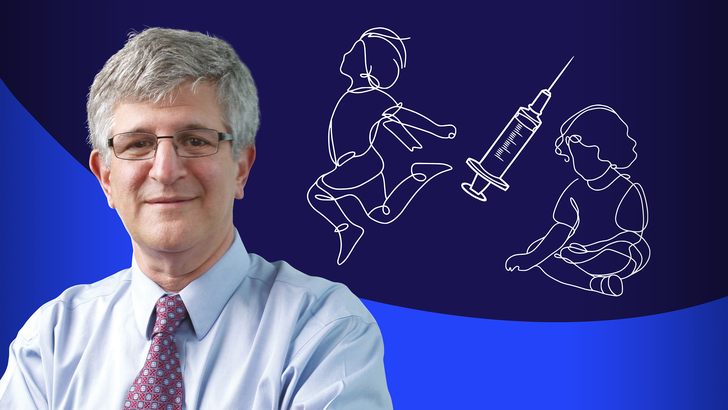
Welcome to On the Frontlines of Pediatric Vaccines on ReachMD. I'm Dr. Shelina Ramnarine, and joining me to discuss pediatric vaccine hesitancy and strategies for addressing it is Dr. Paul Offit. He's the Director of the Vaccine Education Center and a Professor of Pediatrics in the Division of Infectious Diseases at the Children's Hospital of Philadelphia. Dr. Offit, thanks so much for being here today.
Dr. Offit:
Thanks for asking me.
Dr. Ramnarine:
So to start us off, Dr. Offit, what's changed most in how patients and caregivers think about vaccination in recent years?
Dr. Offit:
I think people don't fear the diseases. My parents were children of the 1920s. Whooping cough and diphtheria would kill tens of thousands of children every year. I was a child of the early 1950s. I was actually born before the polio vaccine. I was five when the polio vaccine was invented, and polio would paralyze upwards of 30,000 children every year and would kill 1,800 children.
I had measles. I had mumps. I had German measles. I had chickenpox. At that time, measles would cause 48,000 hospitalizations, primarily from pneumonia and dehydration, and 500 deaths a year. Mumps was the most common cause of acquired deafness. Rubella, when a woman was infected in the first trimester, would cause 20,000 cases of congenital rubella syndrome with blindness, deafness, and permanent heart defects.
I trained in pediatrics in the late 1970s at Children's Hospital in Pittsburgh, and we had these 12 hour on, 12 hour off emergency department rotations. I would do two to three spinal taps a night. I trained between 1977 and 1980. We didn't have a Haemophilus influenzae b vaccine. We didn't have a pneumococcal vaccine for children. We didn't have a meningococcal vaccine. Today, pediatric residents at our hospital don't know how to do spinal taps. It's often the interventional radiologist that does them.
But my children are children of the 1990s, so not only do they not see these diseases, they didn't grow up with them, so they're a lot less compelled by them, and that's also true with young doctors. So I think, really, we lack the fear of infectious diseases. You didn't have to convince me to vaccinate my children. You didn’t have to convince my parents to vaccinate me, my brother, and sister. That's the biggest difference, is that we don't fear the diseases.
Dr. Ramnarine:
And with that context in mind, what are the most common factors driving vaccine hesitancy?
Dr. Offit:
So I think that as well as the lack of fear of the disease—in other words, the vaccines have been a victim of their own success. But I think there’s also this unrealistic view of vaccine safety. There's a lot of misinformation and disinformation out there about vaccine safety that's just wrong, and it's readily available on the internet or on social media.
And I think the combination of 1) not fearing the diseases, and 2) having a really unfounded fear of vaccine safety, those two things I think have contributed to an erosion of vaccine rates. So much so that last year, 2025, we had more cases of measles than we'd had in three decades. We had whooping cough deaths in states that hadn't experienced whooping cough deaths in years. We had more children die of influenza last year—children die of influenza last year, 2025—than we'd seen since the 2009 swine flu pandemic, and probably about 150 children this year.
So you're seeing the effect of not fearing the diseases, having an unrealistic fear of vaccine safety, and thus an erosion in vaccine rates among kindergartners that's leaving our children vulnerable to diseases that are perfectly preventable by vaccines.
Dr. Ramnarine:
Now building off of that, why is vaccine misinformation so effective and difficult to counter?
Dr. Offit:
Well, first of all, the misinformation business is extremely well-funded. If you look at groups like the Informed Consent Action Network or Children's Health Defense—Robert F. Kennedy Jr.'s former group—they have tens of millions of dollars in funding to get misinformation out there. The misinformation business is a much better business than the information business, and they're very good at gaining attention.
Plus, I think it's much easier to scare people than it is to un-scare them. It's hard to un-ring the bell. Once you've heard the notion, for example—and it was born in the late 1990s—that the measles, mumps, and rubella vaccine caused autism… Now, that was false, and more than two dozen studies have now shown that was false, but it's hard to un-ring the bell. You've put that notion into people's heads, and it's hard to get rid of it.
Dr. Ramnarine:
For those just tuning in, you're listening to On the Frontlines of Pediatric Vaccines on ReachMD. I'm Dr. Shelina Ramnarine, and I'm speaking with Dr. Paul Offit about building vaccine confidence in families.
So, Dr. Offit, we've talked about what drives hesitancy. Now let's shift to how clinicians can respond in real-world conversations. From your perspective, what strategies consistently help build vaccine confidence?
Dr. Offit:
Well, first of all, I think one should have an enormous amount of sympathy for where parents are today. What do we ask of parents of young children in this country? We ask them to, in the first few years of their child's life, give vaccines to prevent 14 different diseases. That can mean as many as 25 shots during that period of time. It can mean as many as five shots at one time to prevent diseases most people don't see, using biological fluids most people don't understand. So I can understand why people are pushing back on vaccines.
So you have to come from that initially—that what they feel is perfectly reasonable. And then I think our job is to explain that a choice not to get a vaccine is not a risk-free choice. This is what that risk looks like and what's going on right now with regard to measles or whooping cough or influenza. So that's number one.
And number two is that when they have issues with vaccine safety, to try and explain how you would address that issue. For example, if you're worried that aluminum adjuvants in vaccines may cause disorders or diseases, that's an answerable question. These are scientific questions that can be answered in a scientific venue and have been. So, for example, there was a large study published in the Annals of Internal Medicine that involved more than two million children studied over 23 years, looking at children who got anywhere from zero milligrams to 4.5 milligrams of aluminum, and then looked at 50—five zero—different disorders or diseases to show that there was no association.
So it's okay to have the fear, but I think that when you hear that fear has been addressed with, often, millions of dollars worth of studies, you should believe those studies. Because if you don't, then you sort of move into the different category, which is that you believe there's a conspiracy to hide information from you, to hurt you.
And that's what the anti-vaccine activists do. They try and convince you that there's this dark group working behind the scenes that are funded by big pharma to mislead you, and it's just not true. Doctors, healthcare professionals, and public health people care deeply about children in this country and have for decades. And their efforts have shown up in the fact that vaccines have saved millions of lives in this country and have made us live longer, better lives.
Dr. Ramnarine:
Now, more specifically, are there any communication techniques you've used to counter misinformation or myths about pediatric vaccination that you found particularly helpful?
Dr. Offit:
I think that when I give you all those numbers about the instance of diseases or disorders, it's a little numbing. I think it would help to feel this. What does it feel like to see a child suffer and worse, die of a vaccine-preventable disease?
I think of a woman like Alyssa Kanowitz, who's the head of the Amanda Kanowitz Foundation. I've seen her speak to groups, and what she does is she shows a series of videos of her beautiful little four-year-old daughter interacting with friends and family and relatives. And then she tells the story of what it was like to watch her daughter die of influenza—falling off a cliff in slow motion. And there is no one who was sitting in that audience that wasn't crying.
And I think that's what you need to feel. So we hear, for example, that two healthy little girls—a six-year-old girl and an eight-year-old girl—died last year, 2025, in West Texas. What did that feel like? What did it look like to watch a child come into the hospital, get put on, maybe initially, face mask oxygen, and then a ventilator, and essentially suffocate from drowning in your own fluids with measles?
There's no treatment for measles other than prevention. You can do supportive treatment, but that only gets you so far. What does it feel like? And I think that's what we need to do a better job at.
Dr. Ramnarine:
Yeah, storytelling is such a powerful tool. As we come to the end of our program, Dr. Offit, do you have any key takeaways you'd like to leave our audience with?
Dr. Offit:
I think it's an important time right now. Now, more than ever, we have to be able to stand up for the science. And science is a powerful thing to have on your side. So know that that's behind you. Good science is behind you. We just need to be able to, without fear, stand up for that science, because otherwise children are being put at risk unnecessarily.
Dr. Ramnarine:
Those are great comments as we come to the end of our program. I want to thank my guest, Dr. Paul Offit, for sharing his insights on how to strengthen trust in pediatric vaccines. Dr. Offit, it was great having you on the program.
Dr. Offit:
Thanks for asking me.
Announcer:
You’ve been listening to On the Frontlines of Pediatric Vaccines on ReachMD. To access this and other episodes in our series, visit On the Frontlines of Pediatric Vaccines on ReachMD.com, where you can Be Part of the Knowledge. Thanks for listening.

