
Transcript
Announcer:
You’re listening to On the Frontlines of Dry Eye Disease on ReachMD. And now, here’s your host, Dr. Steve Jackson.
Dr. Jackson:
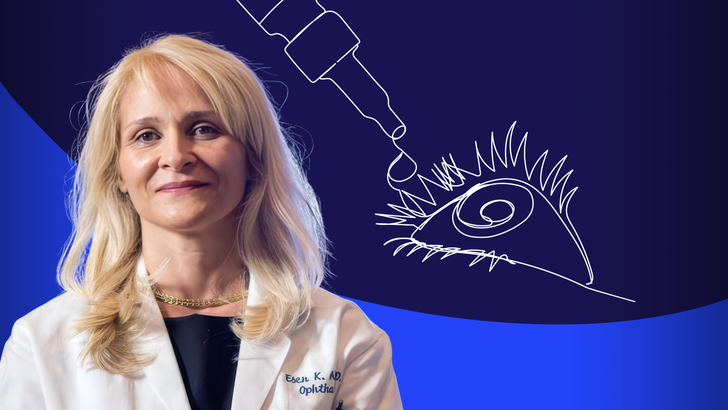
This is On the Frontlines of Dry Eye Disease on ReachMD. I'm Dr. Steve Jackson, and joining me to explore how dry eye care is evolving is Dr. Esen Akpek. She's the Director of the Frances and C. Stephen Foster Center for Ocular Immunology and Inflammation and the Chief for the Division of Ocular Immunology at the Duke University School of Medicine.
Dr. Akpek, thanks for being here.
Dr. Akpek:
Well, thank you for the kind invite.
Dr. Jackson:
For some background, Dr. Akpek, how has our approach to managing patients with dry eye disease evolved over the last few years?
Dr. Akpek:
Our approach has evolved and is still evolving. The first prescription treatment for dry eye was approved by US regulators in 2002. And shortly after that, it started being available commercially. Since then, the amount of research has exploded, and that obviously changed a lot of the thinking and approach about dry eye.
We now realize dry eye is a lot more common than we thought that it was, and it is beyond just the dryness of the eye surface. There is inflammation, dryness, and neurosensory impairment. We now know that a lot of systemic diseases can have an impact on the ocular surface. So I think a lot has evolved, and it is still evolving, and I'm very pleased to see this happening.
Dr. Jackson:
And how has that evolving understanding of the disease influenced the way you evaluate patients and identify causal or contributing factors to their dry eye?
Dr. Akpek:
A while ago, dry eye was considered a nuisance and an annoyance, if you will. Patients would complain bitterly, but we didn't know and we didn't have the tools to evaluate the severity of the situation, probably because we didn't have any therapeutics to actually address it either. So I think that now, dry eye is a consideration in every patient who presents ophthalmology or optometry. It's not something the patient has to bring up. We are actively evaluating for the presence of dry eye, whether we are cataract surgeons or, for example, glaucoma specialists or even retina specialists treating macular degeneration.
First of all, ocular surface and dry eye have been incorporated into comprehensive ocular evaluation. Second, we now know that dry eye is not just dryness, and it's not just lack of tears or moisture; it's beyond that, and it involves the entire ocular surface. I like the term that was coined by Michael Stern and Steve Pflugfelder, “lacrimal functional unit,” because it incorporates everything—blinking, eyelids, eyelashes, meibomian glands, conjunctiva, corneal epithelium, fornices, et cetera. So we’ve now started looking at everything on the ocular surface.
We have newer therapeutics that we can prescribe for our patients or even in-office treatments. But we also understand there is an interplay of inflammation, sicca, innervation, and physiological changes, so it's beyond just lack of moisture on the ocular surface.
Another more recent development in the field is that environmental effects—for example, humidity in the environment, blinking reflex, decrease of blinking associated with certain diseases such as Parkinson's or Alzheimer's or while doing certain tasks such as reading, driving, etc., or sustained gazing. These also play a huge role in the impact of dry eye in each individual person. Now we know more about the visual impact, for example, of dry eye, with regards to decrease of blinking and reading speed and impairment with nighttime driving. So these are some of the newer things we have figured out within the past 10 years or so.
Dr. Jackson:
And with the evolution of our understanding comes the evolution of treatments. So with more treatment options now available, how do you decide which management approach makes the most sense for an individual patient?
Dr. Akpek:
I myself follow the Tear Film and Ocular Surface Dry Eye Workshop III. It was published in the American Journal of Ophthalmology. It took about a couple years to put it together. It's an extensive guidance document with regards to published evidence related to treatment options.
We no longer classify dry eye according to evaporative or aqueous deficient. We also no longer classify the disease assuming patients’ symptoms and signs correlate and classify as mild, moderate, severe. We basically have now started looking at all of the ocular surface and tear film parameters from tear stability to corneal staining to osmolarity to everything, or tear production using Schirmer test. So we measure every measurable aspect of tear film and ocular surface, and then we try and address each finding separately irrespective of patient symptoms.
I am not saying that we don't care about patients’ symptoms; obviously, we do, but we start treatment and escalate according to findings. Even if the patient does not complain, we start treatment and escalate it according to findings. For example, there are medications that have been shown to improve corneal staining symptoms regarding meibomian gland dysfunction. There are also in-office treatments for Demodex, or medical treatment for it. I think the field is evolving at a very fast pace, and everything is now geared towards what the physician identifies on the ocular surface.
Dr. Jackson:
For those just tuning in, you're listening to On the Frontlines of Dry Eye Disease on ReachMD. I'm Dr. Steve Jackson, and I'm speaking with Dr. Esen Akpek about current and emerging approaches to managing dry eye disease.
Despite the progress we've seen in dry eye care, what challenges and unmet needs remain for these patients?
Dr. Akpek:
I have the impression based on published evidence that dry eye is still being trivialized, underrecognized, and undertreated, so that is still a problem. It's getting better, but that's still a problem. The second issue is that not very many providers are actually doing detailed evaluations. Still, the treatment is dictated by the patient's symptoms. So unfortunately, because of the discordance between patients’ symptoms and signs, particularly in patients with more severe signs, such as underlying diseases like graft-versus-host disease or Sjögren's disease, these patients don't necessarily complain much. And if they don't complain much, then they don't get appropriate treatment. So diagnosing, treating, and escalating the treatment should be according to physical signs, and that means that we actually have to examine the ocular surface and tear film parameters, which is also, I think, underperformed.
Another very important issue, which is one of my research projects, is a lack of agreed-upon endpoints or outcomes measures and the standardized tools to measure them. Some of us are looking at the corneal staining, and some of us are looking at Schirmer tear production. Some medications are being approved according to, for example, increase Schirmer or according to Schirmer respondents. There are many different ways of looking at dry eye diagnosis and improvement or worsening, and there's no universally agreed upon outcome measures that correlate with patient symptoms. So I think this is an important aspect of dry eye that needs to be solved very soon. and this might have an impact on how we practice dry eye and also how medications are approved.
Dr. Jackson:
And looking ahead, what areas of ongoing or emerging research do you think have the greatest potential to address those gaps?
Dr. Akpek:
Yeah, that's a very important aspect of dry eye as well. Currently, we don't actively look at dry eye when we evaluate a patient in the clinic. I think that tear film and ocular surface parameters should be a part of a comprehensive ophthalmic evaluation. It's just like how we check, for example, eye pressure or do a dilated exam to check to see if there are, for example, findings related to diabetes or high blood pressure, et cetera, or cataract or corneal findings. We have to actively examine ocular surface and tear film, and I think that can perhaps enable us to recognize dry eye and initiate treatment sooner rather than later. It should not be always patients complaining of dry eye; we should be looking for it. And I believe that with current science progress in the field, dry eye soon will be a curable disease as long as we can recognize and initiate treatment soon enough.
Research should go towards basically addressing the underlying loss of homeostasis of the tear film and ocular surface and addressing the issue with different types of medications rather than just anti-inflammatories, which are abundant in our armamentarium currently. I think biologics may have a role in improving the surface and addressing the innervation in the cornea to improve blinking and basal tear secretion, et cetera. And there are many different mechanisms that we can tackle to improve dry eye. But we also, as physicians, need to diagnose dry eye at a stage when it is still salvageable and when we can change the ultimate or the natural outcome of the disease.
Dr. Jackson:
And as we're wrapping up this conversation, Dr. Akpek, what do you see as the most important next steps toward improving care for these patients?
Dr. Akpek:
I think that we all have to work together. I think we need to get together as physicians, scientists, payers, and policymakers. All stakeholders will need to get together and make some rules and regulations, and we need to increase awareness about dry eye because it is very common and it has a huge impact on quality of life.
There's a huge disconnect between what patients need, what we as physicians need to address their issues, and what the payers are willing to accept. We run into this problem all the time. I think that the payers are still disregarding the impact of this disease on quality of life and basically health-related expenditure, et cetera. A lot of the patients’ decrease or reduction in work productivity alone should be able to increase the importance of this disease. But for some reason there's still a disconnect.
Dr. Jackson:
And with that in mind, I want to thank my guest, Dr. Esen Akpek, for joining me to share her perspective on our evolving approach to dry eye care.
Dr. Akpek, it was great speaking with you today.
Dr. Akpek:
Oh, thank you so much for the opportunity.
Announcer:
You’ve been listening to On the Frontlines of Dry Eye Disease on ReachMD. To access this and other episodes in our series, visit On the Frontlines of Dry Eye Disease on ReachMD.com, where you can Be Part of the Knowledge. Thanks for listening!
