
Transcript
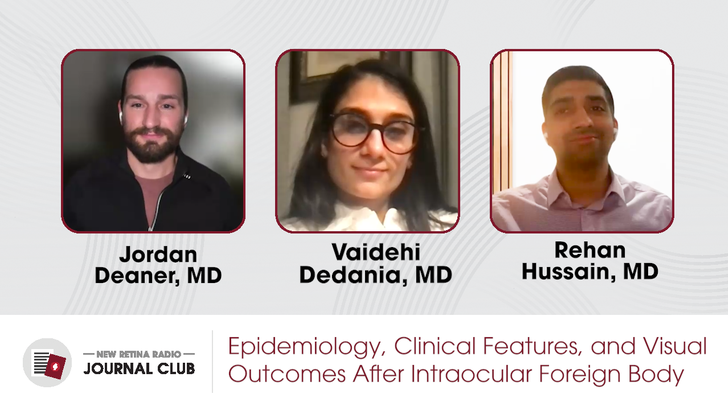
Jordan Deaner:Welcome to the New Retina Radio Journal Club with VBS. My name is Jordan Deaner from Mid Atlantic Retina and Wills Eye Hospital in Philadelphia, Pennsylvania. I'm joined today by two of my outstanding colleagues.
Vaidehi Dedania:Hi, I'm Vaidehi Dedania from NYU Langone Health. Thank you for having me here.
Rehan Hussain:And I'm Rehan Hussain with Midwest Retina Consultants in Chicago. It's a pleasure to be here.
Jordan Deaner:Thank you both for joining [00:00:30] me. Today, we're discussing a paper, Epidemiology, Clinical Features and Visual Outcomes after Intraocular Foreign Body Removal by Ong et al. It was first published online in the American Journal of Ophthalmology in November of 2025. Rehan, would you please take us through the paper?
Rehan Hussain:This was a large analysis analyzing the IRIS Registry, and they looked at around 4,800 eyes that had intraocular foreign body removal in the United States between 2016 and 2024. [00:01:00] Now, we know that these injuries are rare, about 2.3 cases per 100,000 patient-years, but they disproportionately affect working age men and are more common in rural settings. About half of these foreign bodies were present in the posterior segment and a significant number of those patients had serious complications, like 12% had retinal detachment, cataract was present in 10%, and a small but significant amount of patients had endophthalmitis and vitreous hemorrhage. [00:01:30] And these visual outcomes were generally poor at onset with a median of about 20 over 400. And there was a delayed recovery of vision, meaningful vision gained at around two months, which, in my opinion, may be related to use of gas tamponade, but many factors probably play a role in that given the uniqueness of these injuries.
Now, in terms of predictors, some of the strongest predictors were worse baseline vision, which could be seen with such things as retinal detachment and ophthalmitis, [00:02:00] posterior segment involvement, and poor pre-injury visual acuity, and sort of tying into another episode we recorded, African American patients generally had worse visual outcomes. So there may be some sort of a social aspect at play as well. Overall, these large database studies provide a useful real world benchmark that can show how patients present and recover and can help inform us with prognosis and counseling after these serious traumatic events.
Jordan Deaner:Rehan, thank you for that excellent summary [00:02:30] of a kind of complex large database paper with a lot of data to digest there. I will turn it over to Vaidehi here and ask her for her quick reaction to the paper.
Vaidehi Dedania:Yeah, a couple of points, rather maybe a few. So first, it's really interesting that visual acuity did not significantly improve until approximately two months. Dr. Hussain touched upon maybe there was gas, it could be oil. There are a number of other factors there, but the fact that we didn't see it [00:03:00] even in patients who may not have had posterior involvement is interesting. And then also that it plateaued at 18 months. So that may be longer than many of us think, but also shorter than we would've thought. So this really kind of just changes how we're going to counsel patients about it. Another interesting factor was that retinal detachments were present in about 13% of patients at baseline, but it developed in another 14% of patients during follow-up. So this is also [00:03:30] something that should help us inform our surgical planning and our surveillance intervals for these patients. And finally, about 30% of these patients needed two or more procedures. And so understanding that and gaining that from this data will again, allow us to prognosticate and educate our patients better on what their course may look like.
Jordan Deaner:Vaidehi, I think excellent points, really excellent analysis. I was really [00:04:00] awestruck by the visual acuity timeline as well. I think the paper really stands to remind us that early postoperative visual acuity after a foreign body in the eye can be quite misleading. That being said, I think when I encounter these patients, I always try to temper expectations in these traumatic cases, especially we saw that there's risk for things like endophthalmitis and retinal detachment, and so that can lead to even worse vision. And so always, I think, a good mantra is underpromise and overdeliver. Rehan, [00:04:30] what are your thoughts? What are your reactions to the analysis?
Rehan Hussain:I totally agree about underpromise, overdeliver. I always take that approach. I think you want to strike a balance, of course. I don't want to make it all doom and gloom. You kind of want to keep some hope so patients don't go into despair, but you also don't want to create falsely elevated expectations. I can personally think of a case I had where somebody had an IOFB, I took it out, case went great. They didn't even have a detached retina. [00:05:00] It was embedded in the retina and I lasered it, but I was like, "Oh, this guy could do really well." And then just like this paper said and Vaidehi brought up, it just detached later on and I did a surgery and it seemed fine, then he developed PVR. And there's so many things at play that make it different from just a regular RD.
The tissue could just be distorted. There can be incarceration of tissue and more inflammation. So it must take a long time to really feel like you're in the clear in some [00:05:30] of these cases, even if it seemed like a straightforward case. So that was what I learned from my personal experience and seeing the data in this paper validated what I saw, at least on that one case.
Jordan Deaner:Rehan, also great points. I think we have to follow these patients very closely afterwards, look for these late complications, and make sure that we're educating the patient on the late complications and look for warning signs. We talked about poor visual acuity immediately after for a couple months, then the visual acuity [00:06:00] seems to improve. What do you think is or could be some of the reasons for this delayed recovery in visual acuity?
Rehan Hussain:So a lot of things could be at play. It could be depending of course on what kind of problems they had at baseline. If it was even just something like a vitreous hemorrhage, you might do a vitrectomy and clear it up, or there could just be kind of a re-bleed afterwards. It could be a little bit of oozing from the trauma. And so sometimes that can be a surprise. I mentioned earlier on [00:06:30] about probably having a low threshold to put gas in these cases because they may have an obvious break or they might not have an obvious break, but they can have a break develop later. You might miss things because there could be a poor view. So I would probably likely use gas in a lot of these cases, which could contribute to the delayed recovery and just so many other things at play.
I mean, you could have oil in the eye, there could be sutures on the cornea, sutures anywhere causing astigmatism. Hyphemas don't necessarily [00:07:00] could completely evacuate it all the time. It's not a very controlled situation and so you just got to roll with it. You do what you can in these cases. And it doesn't surprise me that even if everything goes according to plan, it could just be a slow recovery as the eye heals and there's just so much inflammation. And a lot is at play in these complex cases.
Jordan Deaner:Lots of good points made there. I think one of the things that we don't have any information about in this study is how [00:07:30] large is the entry wound? Do they have large corneal lacerations? Do they have traumatic cataracts? All of these things that may be readily addressed or addressed in the near postoperative period but do take time to recover from and have a known delayed visual acuity recovery. Vaidehi, we'll send you the next question. Was there anything that was surprising to you about the patient population in this cohort?
Vaidehi Dedania:Yeah, what's really interesting here is the mean age was around 55 [00:08:00] years old, which I was quite surprised at how old many of these patients were because we tend to hear about this happening in younger patients. And when we think about not just anecdotally, other studies, they really report that IOFBs tend to happen in younger men. And so it was very interesting that we see this patient population in this study. Now, what could be some reasons that we saw this? Again, it's a limitation of the [00:08:30] study using the IRIS registry. We're not privy to the information on how IOFB is coded. There are variations in what an IOFB may or may not be. Was it coded with any other diagnoses and how that played into this? And so I am quite surprised that the patient population is older at 55. And where this also is important is when we think about the outcomes when we talk about Dr. Hussain mentioned [00:09:00] PVR risk. These things change over time and with age. And so if you're having an older patient population, how is that affecting the outcomes that they're reporting as well?
Jordan Deaner:Rehan, any additional thoughts on why the median age in this cohort was so old at 55?
Rehan Hussain:I was also surprised just like how Vaidehi had mentioned earlier, and I think it just goes back to the limitations of some of these large database studies. We're relying on CPT codes, which may not always be accurate. Some people might view [00:09:30] an IOL that's dislocated as an IOFB, and we would see that a lot more in an elderly population, people who have had cataract surgery. So there could definitely be some bias from people who are removing IOLs and that's getting counted as an IOFB.
Jordan Deaner:Also very good points. Let's move on to the discussion regarding some of the complications. There were some known highlighted complications like endophthalmitis, hyphema, retinal detachment, that really were shown to have [00:10:00] a significantly worse visual acuity outcome. You have a patient that presents with one or more of these complications, how are you going to guide them? How are you going to prognosticate them? And are you going to prognosticate them right off the bat or do you think this is something we should follow for a little bit? We'll start with you, Rehan.
Rehan Hussain:So how I would handle it is I would try not to say too much upfront. I would just say, "This is a very serious injury. My first goal [00:10:30] is to save the eye, close the wounds, remove the object. Obviously, I'm invested in you getting the maximum return of vision as possible, but it's just too early to know. There's so many things at play depending on how the surgery goes and how the recovery goes." So I would just frame it like that, just harping on what you said. Don't over promise anything, but just tell them your plan and just say, "We're going to do our best [00:11:00] and pray for the best." And hope it works out.
Jordan Deaner:Vaidehi, do you think there's a unique combination of a patient that presents to you maybe with a large corneal laceration with a hyphema and a retinal detachment, poor view? Do you think there's a combination of a presentation that you think the eye is maybe unsalvageable?
Vaidehi Dedania:I think there are a lot of factors that come into play here. So one scenario where I can potentially [00:11:30] see that happening is you have a really elderly patient who is just not able to get to the OR for anesthesia. That might be a scenario. It's really tough to make that decision across the board because there are so many factors at play here. Pain is one of them, but also mechanism of injury. And so some of this is a touch and feel type of situation. I do think that in many of these scenarios when these [00:12:00] patients are presenting emergently, they're not prepared to have an enucleation, nor should they be because sometimes not everything needs to be done at once. Sometimes it might be sufficient to go close that large corneal laceration and inject some intravitreal antibiotics and then go from there. You don't need to go in and close a corneal laceration or do a temporary KP and all of these measures to then fix visual detachment.
You can just sometimes achieve some stability before going on with the next steps. [00:12:30] And that comes with the conversation that you have with the patients from the beginning, especially when you talk about staging it. What are the goals of what you're doing? Is it just globe preservation or is it what level of visual recovery? Because if it's globe preservation, patients may understand to a degree a little bit more, well, this is why you're leaving the retinal detachment unfixed at this point.
Jordan Deaner:I think a lot of wisdom was just said there. Sometimes we always want a slam dunk. We always want to go in and have the hat trick and fix all the [00:13:00] problems all at once. But I oftentimes look back at cases where I'm like, "Maybe I should have done that stage. Maybe that would've been a little easier. Maybe that would've been a little better for the patient in the end." And I think you said some really nice things that come from a lot of experience there. Rehan, any final comments?
Rehan Hussain:I really appreciate that statement that Vaidehi just made also. I want to echo that. I think we put a lot of pressure on ourselves [00:13:30] as retina surgeons to try to be superheroes. And maybe if you did it in a staged way, like she had said, you just have time to process things too. A lot of these IOFB cases, they come at really inconvenient times. You might be waking up in the middle of the night and going in for it. And I appreciated that because just let things heal a little bit, see what happens. You can always live to fight another day, as the saying goes. And you could definitely, I [00:14:00] think, run into trouble trying to get too aggressive, trying to do too much. And also just reemphasizing about the expectations being set upfront.
Jordan Deaner:Awesome. Well, thank you both so much for a wonderful discussion.
Vaidehi Dedania:Thank you for having me. This was a great opportunity.
Rehan Hussain:Thank you so much. It's been a pleasure.
Jordan Deaner:Thank you to the audience for listening to the New Retina Radio Journal Club with VBS. Please stay tuned for some further episodes.