
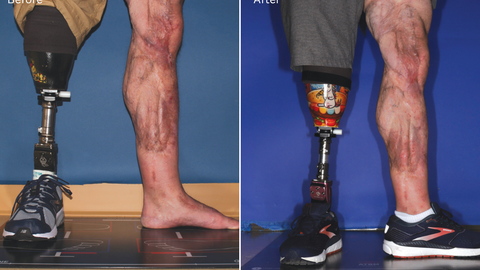
This case report describes how fractional CO₂ laser therapy significantly improved pain, scar pliability, vascularity, and functional mobility in a severely injured soldier with chronic, non-healing lower-extremity wounds.
CO2 Laser Therapy to Improve Pain, Pliability, and Scar Coloration for a Wounded Soldier
03/23/2026
Choose a format
Media formats available:
KEY TAKEAWAYS
- Fractional CO₂ laser therapy improved pain, scar pliability, vascularity, and functional mobility in a patient with severe combat-related injuries.
- Serial treatments promoted collagen remodeling and wound healing, resulting in durable improvements without the need for adjunctive therapies.
- This case highlights the role of laser-based scar rehabilitation in restoring function and quality of life in patients with complex, non-healing wounds.
Army Staff Sergeant Daniel Burgess sustained catastrophic injuries while deployed in southern Afghanistan after stepping on an improvised explosive device (IED). The blast resulted in the loss of his right leg and a complete degloving of his left. He also suffered from chronic pain and immobility in the remaining leg, along with open, non-healing wounds with poor vascularization.
Despite his resilience and rehabilitation efforts, the condition of Sgt. Burgess’ remaining leg, marked by extreme scarring, pain, and poor blood flow, threatened his mobility and quality of life. At one point, he even considered amputation, saying: “It was so bad, that I considered my prosthetic as my good leg.”
For years following his return, Sgt. Burgess visited multiple Veterans Affairs (VA) hospitals up and down the East Coast searching for relief, but nothing brought meaningful results. It was not until his move to Florida, and a visit to my practice for treatment with CO2 laser technology, that he was able to see real change.
CASE PRESENTATION
At his initial consultation, the patient presented with hypertrophic scars that were tight and tethered, with localized breakdown in areas lacking normal skin mobility.
CO₂ laser therapy was suggested due to its 2-decade track record for reducing pain and pruritus while promoting collagen remodeling, improved elasticity, normalized color, and enhanced functional recovery.
TREATMENT
In the initial phase, the patient was treated every 2 to 3 months for a total of 4 sessions with a fractional CO2 laser (ULTRApulse Alpha®, Lumenis). Each session involved full-field fractional CO₂ resurfacing of all affected regions on the residual limb, covering approximately 10% to 15% of total body surface area (≈1,900–2,800 cm²).
Treatment parameters were customized to scar thickness and tissue response. Despite the large surface area, sessions were well tolerated, with predictable healing supported by standardized wound care and follow-up. Improved perfusion was apparent at the bedside through enhanced capillary refill and normalized tissue coloration.
While ongoing maintenance was not strictly necessary, the patient’s increased physical activity led to periodic 6- to 12-month re-evaluations for spot treatments as needed.
By the conclusion of the treatment series, nearly 100% of the treated skin showed marked gains in texture, pliability, and reduced scar thickness. No regression of prior gains was observed, and his results have remained stable and durable.
Post-treatment care included gentle cleansing with soap and water multiple times daily followed by a thin layer of white petrolatum ointment for epidermal protection and moisture retention.
DISCUSSION
From the first session, Sgt. Burgess experienced noticeable improvement in pain, pliability, and scar coloration.
While wound closure required several treatments to achieve full epithelialization, each session progressively improved local vascularity and stimulated collagen remodeling. The most striking improvements were the reduction in tightness and the steady softening and mobility of the residual limb after each treatment.
Sgt. Burgess can now rely on his healed leg and is able to enjoy more active time with his wife and daughters. He required no adjunct therapies beyond self-directed exercise.
Clinically, this case exemplifies how modern scar rehabilitation within the Veterans Health Administration can restore not only skin function but also motion, independence, and dignity. Sgt. Burgess’ journey represents the best of what our system strives for—ensuring that the sacrifices of our veterans are met with the same commitment to healing and restoration through advanced, evidence-based care.
Disclosures: The author listed no relevant financial disclosures.
Details