
Transcript
Announcer:
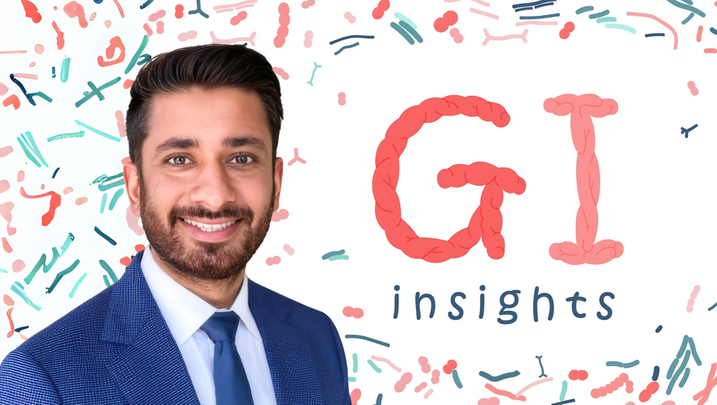
You’re listening to GI Insights on ReachMD. On this episode, we’ll hear from Dr. Hersh Shroff, who’s an Associate Professor of Medicine and the Director of the Integrated Healthcare for Alcohol Use and Liver Disease Clinic at University of North Carolina at Chapel Hill. He’ll be discussing the practical applications of AI tools in everyday patient care. Here’s Dr. Shroff now.
Dr. Shroff:
Providers like myself are using AI in a lot of different ways in clinical practice. The most common uses for me, and I think for many others, are to reduce the electronic health record-based burdens of care delivery.
So examples include using ambient AI scribes, which can help draft the visit notes and summarize an encounter with a patient. And then there are chart summarization tools, which are now being integrated into electronic health record systems. These can quickly search through the entire electronic health record, summarize a patient's clinical information, and bring it to your fingertips. I also use widely available large language models, specifically the ones that are trained to access medical literature. There's one in particular called OpenEvidence, which allows us to much more easily and quickly retrieve medical evidence at the point of care
In large part, this is buying back my time and attention. I think we're living in an age of information overload, not just in healthcare, but in all aspects of our life. And in healthcare specifically, the unfortunate truth is that clinicians are now spending hours and hours of extra time on documentation and other administrative tasks, oftentimes after hours, outside of a typical day of seeing patients. This is known as pajama time in our literature, and this type of after-hours work is leading to massively high levels of burnout. It's actually leading to providers leaving the workforce. So I think this is an unsustainable trajectory that we're on. And thankfully, AI offers just one way to offload that cognitive burden that our providers are experiencing.
As a tangible example, I can now look at my patients for the entire visit and actually have an eye-to-eye conversation with them, rather than feeling the pressure to take the time to type or make notes during the visit. I can also easily summarize their history in five minutes of searching the chart using the new AI tools before seeing a patient, rather than spending sometimes 10 or 15 minutes reading through 90 to 100 pages of PDF files that are scanned in from their referral and buried in their chart.
I think a lot of these tasks go unrecognized by the individuals who are receiving care, understandably, but these are things that we do behind the scenes that, again, dramatically lead to our cognitive burden and burnout.
Announcer:
That was Dr. Hersh Shroff talking about how AI is being used in clinical practice today. To access this and other episodes in our series, visit GI Insights on ReachMD.com, where you can Be Part of the Knowledge. Thanks for listening!