Transcript
Announcer:
You’re listening to Eye on Ocular Health on ReachMD, and this episode is sponsored by Biogen. Here’s your host, Dr. Charles Turck.
Dr. Turck:
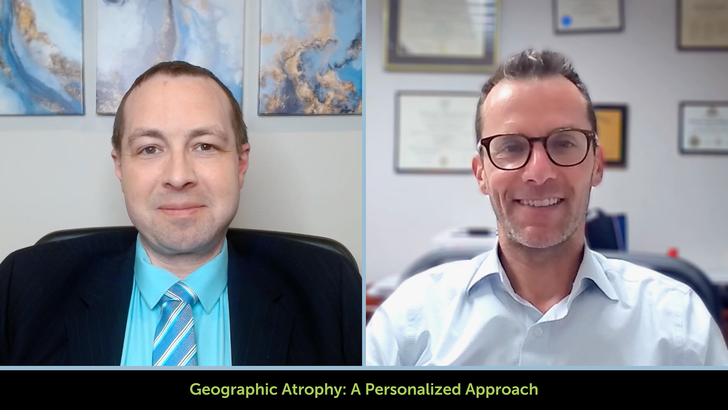
This is Eye on Ocular Health on ReachMD, and I'm Dr. Charles Turck. Today, I'm joined by Dr. Jonathan Jonisch to explore how we can personalize care for patients with geographic atrophy. Dr. Jonisch is a board-certified ophthalmologist and an Assistant Clinical Professor of Ophthalmology at the Hofstra Northwell School of Medicine in New York.
Dr. Jonisch, welcome to the program.
Dr. Jonisch:
Thanks for having me.
Dr. Turck:
Well, let's start with the big picture, Dr. Jonisch. What does the current treatment landscape look like for geographic atrophy, and what role does care personalization play in your clinical decision-making?
Dr. Jonisch:
So really, the treatment of geographic atrophy secondary to age-related macular degeneration has dramatically shifted over the last three years. Over the last twenty or thirty years, retina specialists were treating patients with dry macular degeneration and geographic atrophy with watchful waiting, monitoring, AREDS-style vitamins, dietary changes, and smoking cessation, and following them once or twice a year.
That was until about three years ago, when we had our first FDA-approved medication for GA, and we've been treating, and there's been a second medication that's been approved. And both of those have been incorporated into retinal practices, dramatically changing the watchful waiting versus actively treating these patients.
As far as personalization, not everyone is an ideal candidate. So personalization, for me, really begins by assessing baseline vision, assessing the lesion characteristics, the location of the lesion, and, ideally, having a bit of a history with the patient to know their line of progression—where they were and trying to predict where they're going to go to try to determine who's an ideal candidate for these treatments.
Dr. Turck:
Now, if we dig into some clinical trial findings, we've now seen phase III data showing that complement inhibition can slow geographic atrophy lesion growth, even though these therapies don't restore vision.
What stands out to you as most clinically meaningful when evaluating those results, and how do you balance efficacy with the safety profiles of different treatments, including neovascular conversion risk?
Dr. Jonisch:
Yeah, it’s super important with all our therapies to weigh the risks and benefits. Amongst the FDA-approved complement inhibitors, both of those trials really focused at primary endpoints on lesion growth as opposed to improvement in visual acuity. Visual acuity, actually, was not a primary endpoint in either study.
As far as safety, inflammation obviously is of a paramount concern, and conversion to neovascular macular degeneration is kind of a new adverse event in our field. But it does appear to be a class-wide effect, that complement inhibition does slightly increase the risk of wet macular degeneration in patients that begin with geographic atrophy who are otherwise already at increased risk for conversion to wet macular degeneration.
So patients have to understand that, and physicians have to understand that going in and really communicate that well to the patient.
Dr. Turck:
For those just tuning in, you're listening to Eye on Ocular Health on ReachMD. I'm Dr. Charles Turck, and I'm speaking with Dr. Jonathan Jonisch about the personalization of geographic atrophy care.
So, Dr. Jonisch, let's zero in now on the disease-level factors that guide decision-making. How do elements like lesion size, location, rate of progression, and disease stage influence your approach to treatment initiation?
Dr. Jonisch:
So lesion location and history of progression are super important for me when identifying ideal candidates for complement inhibition in geographic atrophy. Earlier-stage disease really offers more of an opportunity to try to preserve retinal tissue and potentially preserve function over time.
Some subfoveal lesions may be severe, where they're not really ideal candidates, though for some subfoveal lesions, we do have a discussion about trying to reduce the encroachment of their scotoma, or of their blind spot enlarging to some degrees. Though, really, the efficacy in those patients has to be understood to be more muted.
In addition, those lesions tend to grow slightly slower than the extrafoveal lesion. Progression rate helps identify patients who may need earlier or more proactive intervention.
Dr. Turck:
And on the patient side, what roles do factors like comorbidities, treatment burden, or lifestyle play in tailoring therapy, and how do you weigh those against the clinical evidence when making treatment decisions?
Dr. Jonisch:
So really, as far as ocular history, we’re weighing whether they have a prior history of wet macular degeneration. We do have patients—a fair amount—who have comorbidities such as wet macular as well as geographic atrophy, and some of those patients are considered to be beneficial in terms of starting treatment.
Treatment burden—including frequent intravitreal injections having labels to have monthly or every other month—those discussions are had with patients weighing the benefits of both. And then lifestyle factors factor in as well: the ability for them, to come into the office for these treatments, caregiver support, and visit frequency. All those things factor in, as this is an indefinite treatment. I explain to patients, we're going to be using these treatments until something better comes around. So this is not a one-year or a two-year fix.
Dr. Turck:
Now, with all this in mind, how do you approach conversations with patients when discussing the benefits and limitations of available treatments, particularly around the distinction between slowing progression and restoring vision?
Dr. Jonisch:
Yeah, it's a super important point to really get out in front of this topic with the patients. Many patients may expect vision improvement. They're being treated for a condition, and they expect their vision to improve. So reframing goals towards slowing decline is key. And oftentimes I'll tell the patient, the vision you have today is really the best vision you're going to have, outside of things such as cataracts and other things that could be comorbidities.
So a clear explanation of disease trajectory helps patients understand the value of early intervention. We do know from some of the data that patients that are treated earlier do benefit more over those five years than patients who had a delayed start. And then shared decision-making ensures treatment aligns with patients’ priority and tolerance for burden.
Dr. Turck:
Now, before we wrap up, Dr. Jonisch, do you have any final thoughts you'd like to leave with our audience?
Dr. Jonisch:
GA treatment, obviously, has changed for us retina specialists, though there are still not clear guidelines. We're missing a lot of information as to who are the ideal candidates for these treatments—who really shouldn't be missed.
But what I've found in studying the data and interacting with patients is that the medications that we have are not perfect treatments for macular degeneration.
We wish they were better, but they're the best that we have, and I explain that to patients. And many of them really appreciate the idea of trying to change the trajectory of their disease. As we know, geographic atrophy is both irreversible and progressive, so empowering both the physician and the patient to try to change that trajectory I have found useful in my practice.
Dr. Turck:
Fantastic thoughts for us to consider as we come to the end of today's program. And I want to thank my guest, Dr. Jonathan Jonisch, for joining me to discuss how we can incorporate clinical evidence and other key factors into personalized treatment decisions for geographic atrophy. Dr. Jonisch, it was great having you on the program.
Dr. Jonisch:
Thanks for having me. I enjoyed it.
Announcer:
This episode of Eye on Ocular Health was sponsored by Biogen. To access this and other episodes in our series, visit Eye on Ocular Health on ReachMD.com, where you can Be Part of the Knowledge. Thanks for listening!