Transcript
Announcer:
You’re listening to DermConsult on ReachMD, and this episode is sponsored by Leo Pharma Inc. Here’s your host, Dr. Charles Turck.
Dr. Turck:
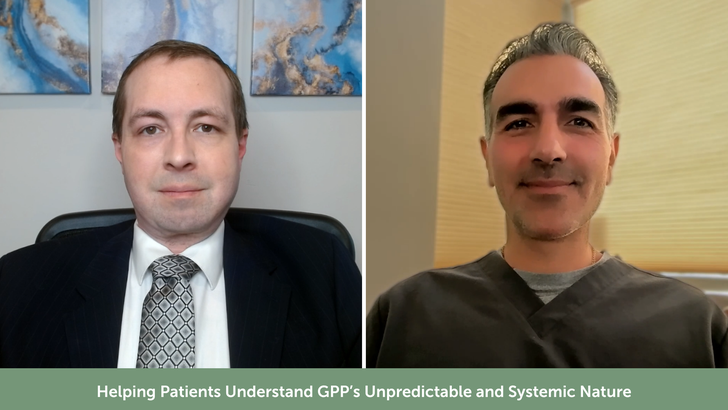
This is DermConsult on ReachMD, and I'm Dr. Charles Turck. Joining me today is Dr. Andrew Dorizas, who's a double board-certified dermatologist and Mohs surgeon affiliated with the University of Miami Health System and Advanced Dermatology of Alaska. We'll be talking about how we can help our patients better understand the systemic and unpredictable burden of generalized pustular psoriasis. Dr. Dorizas, welcome to the program.
Dr. Dorizas:
Thank you for having me, Dr. Turck. I'm excited to have this discussion.
Dr. Turck:
Well, let's start, Dr. Dorizas, at the beginning of the patient journey. When you're diagnosing someone with generalized pustular psoriasis, how do you help them understand that it's more than just a skin disease?
Dr. Dorizas:
It's a great question. And I think the overall term “psoriasis” has now evolved from an understanding that even though we see it on the skin as an early and dominant manifestation, we no longer consider it a skin disease. It is, in fact, a systemic disease with a skin manifestation.
And I tell my patients that the pustules in generalized pustular psoriasis are what we see with our eyes, but the inflammation is happening within and throughout the entire body. And for the patients that come in and they think that they just have psoriasis, I explain to them that this is not the same as plaque psoriasis. It is clinically, genetically, and immunologically different at many levels, although it may share some similarities with some of the symptoms.
I also always tell them that even though today you might be experiencing the skin manifestations that you see, this condition is an evolving one. It can change very rapidly, and it can involve systemic manifestations, such as fevers, chills, malaise, joint pains, and severe risks that can occur systemically that can lead to hospitalization and sometimes death.
Dr. Turck:
Now, one of the biggest challenges with generalized pustular psoriasis is its unpredictability. So how do you explain to patients that periods of stability can still be interrupted by rapid and severe flares?
Dr. Dorizas:
That's a great question, and I want to start by saying that a patient who has experienced a flare will undoubtedly always remember what that felt like. It would remain with them, and that fear will be the constant driver of our treatment discussion.
However, there are many patients who have generalized pustular psoriasis who may not have been through that flare yet, or perhaps it was even a mild version of it. And I think for those patients, it is very important to differentiate that this is not regular plaque psoriasis. GPP escalates very quickly, and it can happen over days and even hours in some cases, and I think that is the most dangerous aspect of it.
The issue is that there are these periods where the patient can feel that they're in this remission state, but they don't have clear skin. Clear skin equates to complete disease control. We don't use the words cured, controlled, or remission. What's happening is we are in a period of low immunologic activity. And so because that can change on a whim, the goal is not to treat the flare that is in front of us in the future. The goal is to teach you how to recognize it early and to treat it if we have to go down that road. But more importantly, the goal is to find a treatment option that we can put you on today in this lower immunologic activity period that will hopefully prevent you from ever getting to that next point of flare.
And the most important thing is to have the patient understand what the course of the disease can look like by telling them experiences from other patients that we've had because not all of them have lived that same experience.
Dr. Turck:
Now, another challenge that we alluded to earlier is that generalized pustular psoriasis affects the entire body. During clinic visits, what systemic symptoms should we ask patients about even when their skin findings appear controlled?
Dr. Dorizas:
Right. This is a great question, and I go through this in detail with all my patients because I think they have to understand that any one of these symptoms that we're going to talk about may be of importance. So even when they think it's nothing, I always tell them to make sure they annotate that they're experiencing this and let me or my office know as soon as possible.
So we're talking about things like fever, chills, generalized fatigue, malaise, or overall weakness. The real red flags would be things like skin pain, burning of the skin, and joint pains but also things that are not very specific, like overall poor intake of food, feelings of dehydration, and not sleeping properly.
And I think apart from just the symptoms that they feel, it's also important to annotate and make note of any changes that they're having in their overall health—for example, new medications that they were prescribed by other providers or any kind of recent infection, as unimportant as they might think it is. Of course, we always go over the big ones, like any recent steroid use and prescriptions of steroids from any of their other providers or urgent care. And then of course, for my female population, we talk about the associations of GPP with pregnancy. And so if they do end up finding out that they have become pregnant, which is an amazing thing, we make sure that myself or my office is aware of that as well.
Dr. Turck:
For those just tuning in, you're listening to DermConsult on ReachMD. I'm Dr. Charles Turck, and I'm speaking with Dr. Andrew Dorizas about communication strategies that can help patients better understand generalized pustular psoriasis.
Now, looking beyond the physical symptoms, Dr. Dorizas, would you tell us how the unpredictability of generalized pustular psoriasis can affect patients' daily functioning and emotional well-being?
Dr. Dorizas:
I feel like the patients have a profound emotional connection to their disease, and this can interfere with many things. I have patients, for example, who avoid traveling long distances because of the fear that it might happen in an area that does not have an academic or hospital system that can treat a severe flare. They avoid certain types of work because they believe that the exposures can trigger that. A lot of times, it leads to a social interaction change where the patients just don't connect emotionally with other people because they're so overly focused on their condition.
It is overwhelming, and I think the main reason it is so is because it's like driving a car down a highway. Imagine you're on that highway and you're going 80 miles an hour, and now the car has no brakes. And you know it has no brakes and you're in control of the car, but you really don't know what's ahead of you. At any given point, there's traffic or a sharp curve. That's how it is living with this condition.
Dr. Turck:
And because flare progression can be rapid, what practical strategies have you found to be most helpful in teaching patients to monitor symptoms and proactively communicate related changes?
Dr. Dorizas:
So there are maybe a handful of conditions in dermatology where I give my personal cell phone to my patients, and this absolutely is one of them. I think a direct line of communication with providers—the dermatologist, an urgent care doctor who's familiar with this condition, and a hospitalist who's treated a patient before in the hospital setting—is important because the single determining factor in the outcome of a flare is how quickly we can initiate treatments.
And so for patients, we have what I call the ‘flare action plan.’ So they have a knowledge of the systemic symptoms they should be aware of. They obviously know their skin manifestations. And so in today's era of medicine where we have amazing technologies, I have them use their smartphone to take notes of what they feel and the progression of that symptom. We use EMRs now that have portals where patients can directly message myself or my staff, who I also have trained on these indications that are of the utmost severity so that they know when they see the patient who mentions GPP to reach out immediately.
And so when using a simple zero to 10 scale, if you see a trend upwards or an increase in the level or amount of systemic symptoms, at that point, the urgent contact is initiated, and we begin what we would call rescue therapies. In my population of patients with GPP, we have a discussion about initiating maintenance therapy, and the vast majority of them are already on maintenance therapy. So when we have a flare, we talk about rescue therapy. And we have all of our offices directly set up for that rescue therapy implementation when it is needed.
Dr. Turck:
And finally, Dr. Dorizas, when it comes to long-term disease management, what perspective or expectations do you want patients to carry with them?
Dr. Dorizas:
We are in a new era of treatment for generalized pustular psoriasis. And the era is not focused anymore on flare control, which has historically been how we diagnosed and considered GPP overall as a disease state. I think now the goal has become: what can we do to have an on-treatment remission state for our patients? And so the expectation is for me and the patient to come to the agreement after education, discussions, and assessments that we can implement a targeted maintenance therapy that can hopefully be the agent that we need to minimize or completely eliminate the amount of flares that they have.
And so a lot of times, it had always been about flare treatment, but now it's about disease control. And remember: this is truly a chronic autoinflammatory neutrophilic systemic disease. And so by using a therapy that is geared towards that—and I always talk about the interleukin-36 receptor inhibitor spesolimab; it is a simple treatment that the patients can do in the convenience of their homes—and once we have the patient on that treatment, the goal is monitoring their symptoms. And then, of course, hopefully, we are all prepared, educated, and know what to do in any case of a flare.
Dr. Turck:
Great comment for us to reflect on as we come to the end of today's program. And I want to thank my guest, Dr. Andrew Dorizas, for joining me to share these strategies for improving patient communication around the chronic, systemic, and unpredictable nature of generalized pustular psoriasis. Dr. Dorizas, it was great having you on the program.
Dr. Dorizas:
Thank you so much for having me.
Announcer:
This episode of DermConsult was sponsored by Leo Pharma Inc. To access this and other episodes in our series, visit DermConsult on ReachMD.com, where you can Be Part of the Knowledge. Thanks for listening!