
Transcript
Dr. Turck:
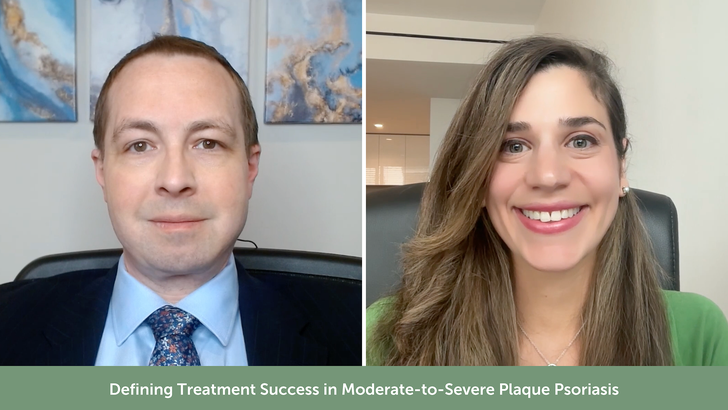
Welcome to DermConsult on ReachMD. I'm Dr. Charles Turck, and joining me to discuss how treatment goals are evolving in moderate-to-severe plaque psoriasis is Dr. Emily Nadelmann, a board-certified dermatologist. She's an Assistant Professor of Dermatology at the George Washington School of Medicine and Health Sciences and at the University of Maryland School of Medicine.
Dr. Nadelmann, thanks for being here today.
Dr. Nadelmann:
Thank you so much for having me. Very happy to be here.
Dr. Turck:
Well, for some background, Dr. Nadelmann, how have expectations for treatment success in moderate-to-severe plaque psoriasis changed in recent years?
Dr. Nadelmann:
The bar has moved, and it's moved a great deal. Not long ago, the benchmark we used that anchored our trials in our conversations was PASI 75, so a 75 percent improvement in the composite score that grades how red, how thick, and how scaly the plaques are and how much of the body they cover. So a 75 percent reduction was once an excellent result, but today, it actually reads as a floor, not a ceiling.
What's changed is the biology we can target. As therapies moved deeper into the IL-23 and IL-17 pathways, the conversation shifted from much better to clear or almost clear and now toward completely clear skin. The goalposts moved from PASI 75 toward PASI 90 and 100 and toward absolute measures, so a residual PASI at or below one or two rather than the percentage change alone.
Dr. Turck:
Now, high levels of skin clearance are not achievable for many patients. So when you assess treatment success in practice, what factors do you consider alongside measures like PASI or BSA?
Dr. Nadelmann:
Yeah, exactly. PASI and BSA are indispensable, but they help us to remember that they're actually just whole-body averages. They just tell us how much skin is involved and how inflamed it is. What they do not tell us is where the disease sits or what it is costing the person that's living with it. That distinction matters. A person can have a body surface area of one or two percent and still be profoundly affected because that small amount happens to involve the scalp, the palms and soles, the face, or the genital skin. And these are high-impact sites, and the number simply does not carry their weight. So the first thing I consider alongside this score is location.
The second is symptom burden, and the itch is central. Itch is consistently among the symptoms patients rank as the most disruptive, and it does not always track with how the plaques look. There can be pain, cracking, bleeding, and disrupted sleep, and so I also consider these as well.
And then third, I screen for psoriatic arthritis at essentially every visit.
Joint disease can progress quietly, even though the skin looks well controlled, and if we miss it, it can carry a lasting consequence.
And finally, I weigh the psychological and systemic dimension, like mood, daily function, and comorbidity burden, because a treatment that clears skin but leaves the person struggling has not fully succeeded. So the objective score is one input, not the verdict.
Dr. Turck:
Now, as you touched on, Dr. Nadelmann, even when a patient experiences substantial improvement, there may still be residual disease burden. I was wondering if you could help us understand what that looks like in practice and how we can better recognize it, perhaps with an example or two of how you've seen that residual burden present in practice.
Dr. Nadelmann:
Definitely. So residual burden is easy to underappreciate precisely because it hides behind a good-looking chart. So say a patient has gone from severe disease to PASI 90. On paper, that is an excellent response, but 10 percent of a once severe disease can still mean stubborn scalp involvement, a few resistant plaques on the elbows, or persistent disease in an intimate area that never comes up unless we ask.
There is human dimension too. Patients who've lived with visible disease often carry what has been described as cumulative life course impairment, so years of covering up, of avoidance, and of anticipating other people's reactions. So that does not resolve the moment the plaques fade. The skin often looks and improves faster than the confidence does.
And then there also appears to be a biological form of residual burden. We are learning that the skin can look completely clear but can still carry a molecular signature of disease, a kind of molecular scar, which may help explain why lesions so often recur in the same spot after treatment stops. And there's still a lot more research finding that clinical measurement and where it fits.
And so real-world patients who reach completely clear skin report meaningfully greater gains in quality of life than those who are almost clear. But the last increment getting that last bit is not trivial to the person living in it.
Dr. Turck:
For those just joining us, this is DermConsult on ReachMD. I'm Dr. Charles Turck, and I'm speaking with Dr. Emily Nadelmann about our changing definition of treatment success in moderate to severe plaque psoriasis.
If we look beyond clinical factors, Dr. Nadelmann, how do patient priorities change the way you define treatment success, even when objective measures suggest the disease is well controlled?
Dr. Nadelmann:
So this is where I have learned to hold my own assessment a little more loosely. There is a well-documented gap between what clinicians prioritize and what patients do. We tend to anchor on the extent and severity of the plaques. Patients often anchor on the itch, where the disease is, how the treatment fits into their lives, and the freedom from thinking about the disease at all. So success from the patient's chair can look different from success from mine.
So I picture a patient whose skin I would call well-controlled, but for whom one residual patch in a visible or intimate spot is the entire problem. So by my metric, the treatment is working, but by theirs, it's not finished, and theirs is the definition that ultimately matters and what governs whether they feel well.
So some patients strongly also prefer an oral therapy and weigh that heavily. Others value the durability and dosing interval of an injectable and are entirely content with that. Neither preference is wrong, and neither shows up in the PASI score. That same goes for tolerability. A minor side effect for one person is a deal breaker to another.
The practical consequence is that patients report outcomes. These deserve a real seat at the table, not a ceremonial one. When we build what patients actually report—the symptoms, convenience, satisfaction—we tend to see better adherence and better outcomes. And objectively, getting them under control tells us the disease is quiet, but only the actual patient can tell us whether their life is quiet, and that outcome is what we're working toward.
Dr. Turck:
Now, as treatment options and expectations continue to evolve, how should we approach shared decision making to ensure that treatment goals still reflect what matters most to each patient?
Dr. Nadelmann:
Shared decision-making matters more now precisely because we have more genuinely amazing options, and the choice among them is increasingly value-laden rather than purely clinical. So when several therapies can plausibly get a patient to clear or almost clear, the deciding factors are often the ones only the patient can supply, how they feel about injections versus tablets, how a monitoring schedule fits into their life, and day-to-day convenience.
So my approach when a patient comes in is to start with the goal that they have before mentioning the options. I try to establish what success looks like for this particular person—the scalp, the hands, the itch, the freedom from flares—and only then bring the options to that goal. The sequence keeps the patient tethered to what matters, not to whatever is on the top of my mind.
And comorbidities and life stage also are very important to consider. So psoriatic arthritis, plans around family and pregnancy, if they're going to be trying to conceive, other medical conditions, and the practical realities of access and coverage all shape the choice, and patients deserve to see how each option meets their situation.
And also, our role is to frame the real trade-offs honestly, including where the evidence is strong and where it's still maturing, and then decide together. And if we do this well, it improves the satisfaction and adherence, and the goal is to plan with the patient in mind.
Dr. Turck:
And finally, Dr. Nandelmann, when a patient returns for follow-up, what questions should we be asking to understand whether they've truly reached their treatment goals?
Dr. Nadelmann:
So I try to start off with, "How's your skin doing?" Because that question invites a reflexively polite answer. The more useful questions are specific, and several are not about the plaques at all. So I always ask about the high impact sites; “How's the scalp? The hands and feet? Any trouble in the intimate areas?” These are the places patients rarely volunteer and the score rarely captures. And then also ask about itch. How much are they itching? Is it affecting their sleep? Itch is often the symptom that lingers in a sensitive barometer of incomplete control. I ask about the joints—any new joint pain, stiffness, or swelling, especially morning stiffness. And this is a recurring screen that I do for psoriatic arthritis, and I ask it regardless of how the skin looks. And then lastly, daily life; is psoriasis still shaping what they wear, what they do, and how they interact with people? And also, are they tolerating the regimen and the dosing? Are they having side effects that are making it hard to stay on schedule? And then also asking about if they're actually able to access the medication and if there's any insurance issues.
But at the end of the day, it's their own verdict. I ask, "Are you satisfied with where we are?" So even if a patient's not completely clear, they may be completely content. And so at the end of the day, it's their goal and their happiness that matters.
Dr. Turck:
Well, with those insights in mind, I want to thank my guest, Dr. Emily Nadelmann, for joining me to discuss her perspective on treatment success in moderate-to-severe plaque psoriasis.
Dr. Nadelmann, it was great having you on the program.
Dr. Nadelmann:
Thank you so much for having me. It was great to be here as well.
Dr. Turck:
You've been listening to DermConsult. To access this and other episodes in our series, visit DermConsult on ReachMD.com, where you can Be Part of the Knowledge. Thanks for listening.

