
Transcript
Announcer:
Welcome to CME on ReachMD. This episode is part of our MinuteCE curriculum. Prior to beginning the activity, please be sure to review the faculty and commercial support disclosure statements as well as the learning objectives.
Dr. Lopes:
Hello, this is CME on ReachMD, and I’m Dr. Renato Lopes. Here with me today is Dr. Valeria Caso. Valeria, welcome, and I understand you have a patient case to present to us today. Right?
Dr. Caso:
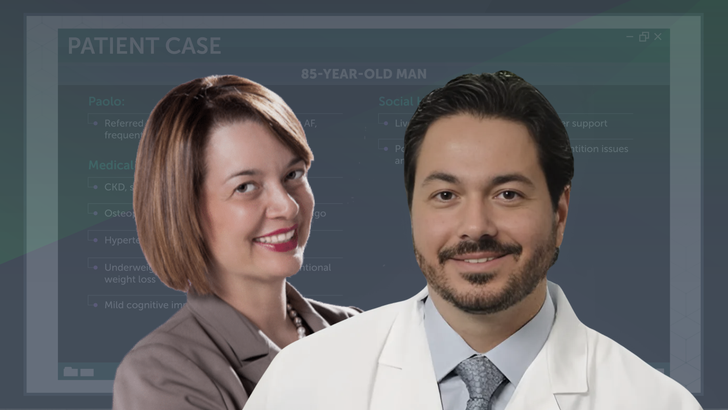
Thank you, Renato. We’re living in difficult times, and we want to give the best treatment to our patients. And I met Mr. Paolo. He is 85 and he was referred to me by a cardiologist for the new onset of AF. And why they referred it to me, it was for the fact that he tends to fall frequently.
He had a history of fatigue, and probably more than fatigue, it was also some mild cognitive impairment, so they wanted to be on the safe side by starting anticoagulation. He has CKD of stage 3B, hypertension. He has also a history of osteoporosis, because we never forget – we always have to think that these patients have sarcopenia, and he had already history of hip fracture. So he lives alone, which is also a big issue because it's the real world brings you this kind of patient here, sometimes a caregiver mostly coming to clean. He is also not very motivated to eat, and his BMI considered was 17.9.
So considering everything, his CHA2DS-VASc score was 3. And I think the most important point here, and this is why I want to show you and share with you the case, is to manage AF when frailty is involved. And also, nutritional deficiency, because this will lead to more sarcopenia, more risk of a fall, and also, we have also the polypharmacy because this is a patient older than 85.
So what should we do in this case? What kind of treatment should we give? Lower dose? So this is something that I would like to put to discussion for you and for the audience.
Dr. Lopes:
So that's a very nice case and a very common patient population that we see every day. And the question is that, in the warfarin era, this was a patient that we were very concerned to treat because, first of all, we need to remember that those highest-risk patients are actually the patients who benefit the most from oral anticoagulation and stroke prevention. However, those are the patients who are also at the highest risk for bleeding, and that’s what makes those type of patients challenging in clinical practice. And in the warfarin era, I think we are very concerned about the risk for intracranial hemorrhage, the risk of bad, severe bleeds, the risk of multiple falls in this patient population. But I think that now, in the last 15 years, that we are leaving the DOAC era. We have now very interesting data in comorbidities, in patients with renal impairment, in the very elderly patients, in patients who are at high risk for falls, in patients who actually had a fall in the last 12 months. And overall, I would say that the performance of the NOACs are much better than warfarin.
Of course, I'll point out that there might difference among the NOACs in which of the NOACs might be more appropriate for these patients with multiple comorbidities and risk for falls or had a fall in the last year. So there are differences among the NOACs. I think one needs to understand well the data. For example, we have a specific subgroup analysis on apixaban on patients who had falls in the last year, on edoxaban in patients at risk for falls, showing really tremendous benefit of those NOACs when compared to warfarin.
But I think the good news is that also, looking at intracranial hemorrhage, particularly the traumatic intracranial hemorrhage that we are so afraid of, I think the NOACs have an extremely good performance in minimizing the risk tremendously. So I think that’s the key message, right, Valeria? In this patient population, when we are afraid of intracranial hemorrhage, I think if you use a NOAC in the appropriate dose, following the label, I think if we stop the unnecessary aspirin, which a lot of those patients might be taking aspirin concomitantly, and I think that this has been proven to only increase the risk of bleeding and no treatment effect in terms of stroke prevention. And if you put a patient on blood pressure, so if you also make sure that the blood pressure is controlled, I think that bleeding will be minimized, particularly the intracranial hemorrhage risk will be minimized in this very challenging group of patients.
Dr. Caso:
Thank you, Renato. I think you made the point. Again, it’s about tailoring treatment to difficult patients. We have the basis from randomized trials, we have more and more data from real-world evidence, and again, choosing the right dose and the right drug for the right patient will clearly make the difference.
Dr. Lopes:
That's great. Thank you so much, Valeria, and thanks everybody for listening.
Announcer:
You have been listening to CME on ReachMD. This activity is provided by TotalCME and is part of our MinuteCE curriculum. To receive your free CME credit, or to download this activity, go to ReachMD.com/CME. Thank you for listening.

