
Transcript
Dr. Sabbagh:
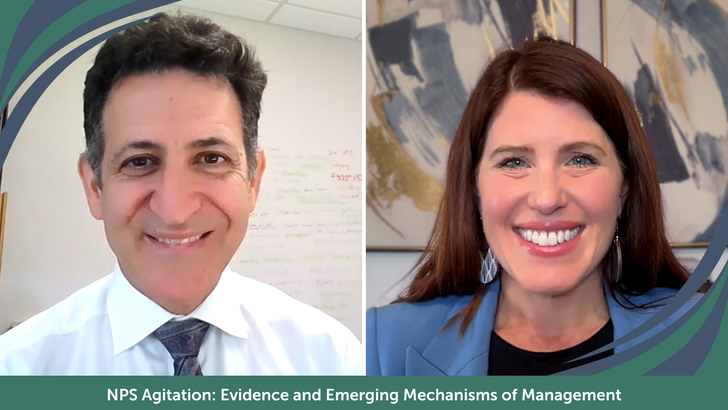
This is CE on ReachMD, and I'm Dr. Marwan Noel Sabbagh. Joining me today is Dr. Dani Cabral.
Dani, how should we treat agitation in Alzheimer's disease today? And what approaches are on the horizon?
Dr. Cabral:
Well, agitation in Alzheimer's is one of the most difficult symptoms we manage, because it is common, distressing, and sometimes dangerous. And we now have a definition of agitation, which is defined as having 1 of 3 components, or at least 1 excessive motor activity, verbal aggression, or physical aggression, and that has to be going on for ≥2 weeks, along with cognitive impairment, say, in Alzheimer's disease, and it's causing disability in the person's life. And so it's really helpful to have that definition as a starting point.
And all medications have been off label for agitation until our first FDA-approved medication for agitation in Alzheimer's, brexpiprazole, was recently approved. And so we've been seeing benefits with that and more uptake. And we found that with 2-3 mg daily, that can be effective, and that has to be titrated gradually. Like all antipsychotics, that does still carry the boxed warning of increased mortality, so we need to be aware of that and counsel our patients and families, and so there is shared decision-making on that.
Now, there are a lot of exciting things on the horizon for agitation treatments, and this is being studied more and more understanding of the neurobiology. So one example is xanomeline-trospium.
Now, that's already been approved and is being used for schizophrenia. And what makes it interesting in neurodegeneration is that it targets the M1 and M4 cholinergic pathways, which are highly relevant for cognition, salience, and behavioral regulation. And so in Alzheimer's disease, phase 3 studies are underway using this medication for both agitation and psychosis.
And then another promising treatment that we’re seeing under investigation is dextromethorphan-bupropion. So it’s exciting. Mechanistically, this is not a traditional antipsychotic. Dextromethorphan acts on NMDA receptors and sigma-1 receptors in the monoaminergic systems, while bupropion helps increase its bioavailability. Now, clinically, phase 2 and phase 3 data for dextromethorphan-bupropion suggest improvements in agitation, and it's received FDA breakthrough designation.
So, otherwise, another still under investigation but exciting emerging area is the FAAH/MAGL inhibition, which modulates the endocannabinoid system. So just rather than just sedating behavior, this interestingly intersects with stress signaling, neuroinflammation, and synaptic plasticity, and that helps with emotional regulation. So there's a phase 2 study going on of this dual FAAH/MAGL inhibitor designed to increase the endocannabinoid tone. And this study is called the BALANCE-AAD phase 2 trial. And we’re always hoping our studies end up positive and so we’ll find out soon enough.
And so the way I think about treatment today for agitation is layered and nuanced. We start with environmental and medical optimization. We use evidence-based pharmacologic options when needed, like brexpiprazole, and increasingly we're looking toward these emerging therapies that are actually targeting the neurocircuitry of what’s going on and restoring stability rather than just suppressing symptoms. And this broader shift is for treating agitation as a behavioral endpoint to understanding it as a biologically-driven network disorder, not just, again, a reaction to cognitive changes related to Alzheimer's disease.
Dr. Sabbagh:
That's a lot. Wow. Thank you, Dani. I tell you that because I know as a practicing behavioral neurologist, I see the limitations of the drugs we have had traditionally. I see the need. I see the driver and the urgency that families want solutions, and they want them pretty quickly. And we see the limitations of what our drugs can do. So having new options, new targets, new mechanisms of action is very, very exciting.
But at the end of the day, I know that I'm going to be ultimately often reaching for pharmacologic treatments, so it's better to have more in my toolbox than I have now.
I believe that really brings everything together. And thank you for listening.
 In support of improving patient care, Global Learning Collaborative is jointly accredited by the Accreditation Council for Continuing Medical Education (ACCME), the Accreditation Council for Pharmacy Education (ACPE), and the American Nurses Credentialing Center (ANCC) to provide continuing education for the healthcare team.
  Global Learning Collaborative designates this activity for
  Global Learning Collaborative has been authorized by the American Academy of PAs (AAPA) to award AAPA Category 1 CME credit(s) for activities planned in accordance with AAPA CME Criteria. This activity is designated for
