
Transcript
Dr. Sabbagh:
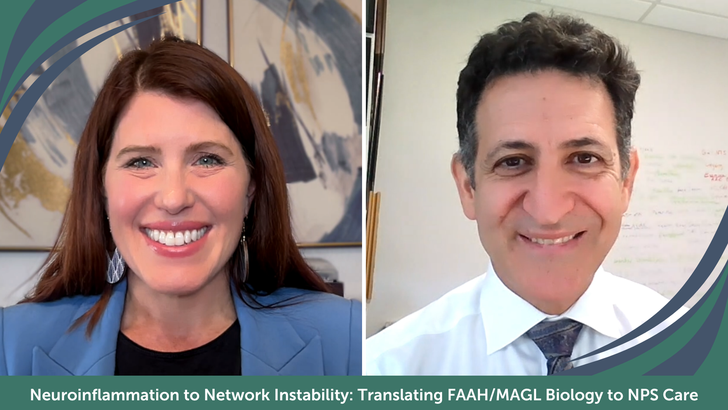
This is CE on ReachMD, and I'm Dr. Marwan Noel Sabbagh. Joining me today is Dr. Dani Cabral.
Dani, how does Alzheimer's disease pathology drive behavioral and psychiatric symptoms?
Dr. Cabral:
I love this question, because for so long, behavioral and psychiatric symptoms in Alzheimer's, as you know, were just viewed as reactions to memory loss and stress from that. But actually, we now know they're part of the biology of the disease. So as Alzheimer's pathology spreads, it disrupts fronto-limbic, and salience networks, and those regulate emotion, threat detection, impulse control, sleep, and social behavior. And then at the same time, the amyloid, tau, and glial activation create a state of chronic neuroinflammation and synaptic dysfunction. And so all of that together can explain why most people with Alzheimer's develop agitation, anxiety, apathy, irritability, sleep disturbance, psychosis as a core part of the disease itself.
And so this is where the endocannabinoid system, interestingly, becomes clinically relevant. So endocannabinoids normally act as a kind of braking system in the brain helping to regulate neurotransmission and to dampen excessive excitatory signaling. And within that, 2 key enzymes are really at work, which is, there's a lot of syllables coming up here, Marwan. So fatty acid amide hydrolase, or FAAH, and monoacylglycerol lipase, or MAGL. So we're going to call those all those letters together, FAAH/MAGL, just to make it easy.
So those break down the major endocannabinoids, including anandamide and 2-AG. And so when this activity is high, the endocannabinoid tone falls, and the result is less control over glutamatergic activity, and then greater network instability, and less buffering against inflammation. And then all of this hyperexcitability and inflammatory signaling can increase those neuropsychiatric symptoms. And so mechanistically, these 2 pathways have somewhat different emphases, but in any event, they're involved in modulating the neural and stabilizing neural signaling and then reducing this neuroinflammatory tone.
So in terms of the potential clinical relevance is that this approach can target a biological bridge between the inflammation, the hyperexcitability, and the behavior. And as we know, these clinical symptoms, these behaviors, neuropsychiatric symptoms, are the most distressing for the patients and the families and can really be the key factor in decline and challenges and impact on our healthcare system.
So it's especially appealing in Alzheimer's disease where we’re to target these things where so much of that is present. Preclinical and early clinical literature suggests that this endocannabinoid–modulating approaches could have promise for things like agitation and anxiety, but this is all still under investigation. And so there is a dual FAAH/MAGL inhibitor that's currently being tested for agitation associated with Alzheimer's disease. So I'm so excited about that, because we really need better treatments for this.
And so basically, the take-home message is that these symptoms, us neurologists, really, we need to take these psychiatric symptoms more seriously. And now that there's neurobiologic substrates being identified with these fronto-limbic pathways and other neuroinflammatory pathways, network-level dysfunction, so we have these treatments that are being studied, including these endocannabinoid–modulating therapies like FAAH/MAGL, and these are promising. And so what they're going to do, hopefully, is restore that inhibitory balance and then reduce inflammatory stress. And we think these are, again, the keys underlying the agitation that’s going on.
So this is real promising and exciting work that's happening.
Dr. Sabbagh:
I think we all know that neuropsychiatric symptoms are a huge driver of morbidity and mortality, and we're going to dig deeper into both the FAAH/MAGL and the neuropsychiatric symptoms in other episodes.
But it's important to understand that there are new mechanisms of action, new targets, new therapeutic approaches that are being considered more than the traditional approaches. So this is a very exciting time, and that's knowledge that you can now put into clinical practice. Thank you so much, and we'll see you next time.
 In support of improving patient care, Global Learning Collaborative is jointly accredited by the Accreditation Council for Continuing Medical Education (ACCME), the Accreditation Council for Pharmacy Education (ACPE), and the American Nurses Credentialing Center (ANCC) to provide continuing education for the healthcare team.
  Global Learning Collaborative designates this activity for
  Global Learning Collaborative has been authorized by the American Academy of PAs (AAPA) to award AAPA Category 1 CME credit(s) for activities planned in accordance with AAPA CME Criteria. This activity is designated for
