
Transcript
Announcer:
You’re listening to GLC on ReachMD. This activity, titled ‘Don't Miss the Shot on Goal: Closing Meningococcal Vaccination Gaps in Adolescents,’ is provided by Global Learning Collaborative.
Prior to beginning the activity, please be sure to review the faculty and commercial support disclosure statements, as well as the learning objectives.
Dr. Alexander:
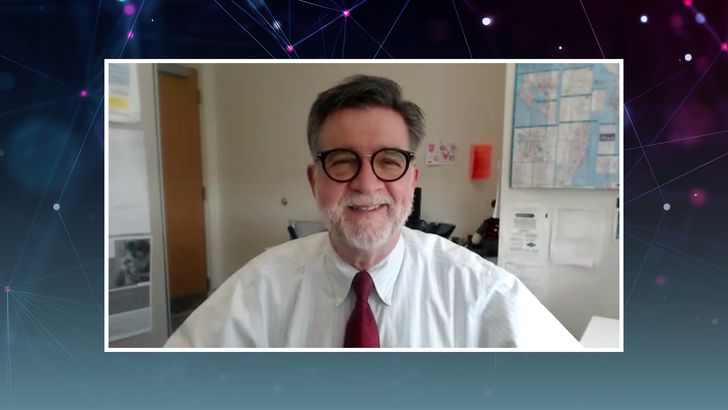
Hello, I'm Dr. Kenneth Alexander, chief of Pediatric Infectious Diseases at Nemours Children's Hospital in Orlando, Florida. I'm taking a break from my clinic.
I'd like to welcome you to our Patient-Clinician Connection focused on closing meningococcal vaccination gaps in adolescents.
Meningococcal disease can progress rapidly and lead to devastating consequences, including meningitis, bloodstream infection, permanent disability, limb loss, and death, sometimes within hours of the first symptoms. Adolescents and young adults are an important population for prevention, yet gaps in meningococcal vaccination remain, especially for MenB vaccination. As physicians, we have an important opportunity to review immunization status and discuss meningococcal vaccination with patients and their families. A clear, confident recommendation from a healthcare provider can be a powerful driver for vaccination, making these conversations an essential part of protecting adolescents against a potentially life-threatening but vaccine-preventable disease.
Today, we will be hearing from a parent advocate. Then I'll be illustrating my approach through a series of 2 clinical vignettes where we'll explore how to communicate the importance of MenB vaccine to an adolescent patient and to a parent.
Let's get started.
Aracelly:
Hi, I'm Aracelly and I live in Santa Cruz, California. I'm an advocate for the American Society for Meningitis Prevention.
I'd like to tell you a little bit about my son, Joseph. Joseph loved playing sports. He played football. He loved surfing, playing in the ocean, hanging out with his friends. He was just a regular, happy, healthy teenager.
His career dream was to become a firefighter, and he was in the EMT program in San Luis Obispo. At the beginning of his second semester in February of 2019, Joseph woke up one morning with what he thought was the flu. He drove himself to Jamba Juice thinking that getting a smoothie would make him feel better. He decided to skip school, which was very strange for him. It was out of character, and he stayed home all day. His symptoms were pretty typical. He had a low-grade fever, he had a runny nose, but he was having a lot of leg pain, and the only thing that helped him feel better was taking hot showers. And he was also vomiting, pretty much all day long. But his girlfriend and his roommates, they didn't really think that it was that serious. They just thought he had the flu, just like what Joseph thought.
And later that evening, Joseph's girlfriend called me and asked if Joseph had ever had the chickenpox because he had a rash all over his chest. And I told her that he had had the vaccine, the chickenpox vaccine, and that she should take him to the emergency room. So they went to the emergency room. When Joseph walked in, the doctors immediately started treating him for meningitis, and within an hour, he went into cardiac arrest, and they worked on him for an hour, for 60 minutes, and they were not able to get him back. And Joseph was pronounced dead at 11:20 PM on the same day that he woke up with what he thought was the flu.
Joseph was vaccinated with meningitis ACWY but not meningitis B. Our pediatrician never informed us that there was another vaccine, even though he knew that Joseph was getting ready to go to college. I later learned that in order to be protected, Joseph needed both vaccines, meningitis ACWY and meningitis B.
Dr. Alexander:
Thank you, Aracelly, for telling your story. That's really important.
What I'd like to do now is take a minute. We'll do a vignette on how to make an effective presumptive announcement for meningitis B vaccination.
Dr. Alexander:
Mom, you've done a good job, and your doctor's done a good job. Jacob has had his HPV vaccine series. He's had the Tdap vaccine and the meningococcal conjugate vaccine. But there's some good news here. There's another vaccine that's available to protect against meningitis B that's not covered in the vaccines that he's had, and this is going to be especially important as Jacob is headed off for college.
Let's give him his vaccine today.
Alicia:
I haven't heard of this vaccine. We were just here for a sports physical, and I wasn't expecting to get him vaccinated today. He had a bunch of vaccines when he was 12. What is this meningococcal B vaccine, and does he need it?
Dr. Alexander:
So you're asking a really good question. You're asking what is this meningococcal B vaccine about and does Jacob need it? And you're right, you're here for a sports physical, you weren't expecting this. So let's talk about this for a minute. The vaccines that he's had have protected him against a lot of bad diseases, and certainly meningitis is a bad one.
The meningococcal conjugate vaccine he had was very good, but we can broaden his protection with the meningitis B vaccine. And meningitis B is a form of meningitis that is particularly common as young people take off for college. So let's do this. Let's improve his meningitis protection by giving him the meningitis B vaccine today.
Alicia:
Thank you, Dr. Alexander. I didn't know anything about this vaccine. I'm okay with it. Can you talk to Jacob about it as well?
Dr. Alexander:
I'd love to.
Dr. Alexander:
Giving a presumptive announcement vaccine recommendation is a particularly important and effective way to promote vaccination. A presumptive announcement is a structured process where you first begin by acknowledging the patient's age. Jacob is 17 today. He's headed off to college. The next thing we do is to make an announcement that we're going to protect him against a disease. We can protect Jacob against meningitis B, a really bad form of meningitis, and we can do that today. And that's the third point. Emphasize that we're going to vaccinate today.
This is a simple 10- to 15-second announcement. So to run through it again, Jacob is 17 today. He's headed off to college. We recommend, for all young people as they head off to college, a dose of meningitis B vaccine to protect them against meningitis. Let's give it today.
The idea here is we're normalizing by talking about the patient's age. We then talk about the disease, not so much the vaccine, but focus on the disease we're trying to prevent, and finally, emphasize that we're going to give it today, and then stop because you've given the parent your presumptive recommendation.
Dr. Alexander:
You know, Jacob, we've had some nice one-on-one conversation. We've talked a lot about many important things. Before we're done, though, there's one more thing I want to talk about. Let's talk about meningococcal vaccine for just a minute. As you know, I've recommended it, and when I talked to your mom, she thinks this is a really good idea.
But you're an adult, so I need to talk to you about this for a while too.
Jacob:
I've had all those other vaccines. Is this one safe? And what are the chances of me actually catching this if I don't get the shot?
Dr. Alexander:
So, Jacob, you're asking 2 really good questions. Number 1, is the vaccine safe? And 2, do you really need it?
So to the first question, is it safe, we've got lots of experience here. Many people have received this vaccine, and it's got a good safety record. Most likely, you're just going to get a sore arm out of the deal, but what you will get is protection against a really bad disease.
I would never want to see you get meningococcus B disease. It can be a terrible disease. It's life-threatening, it's limb-threatening, and it's most common in young people, often as they head off to college. So for you, as a young man headed off on a bright career, I strongly recommend that you get meningococcus B vaccine. Let's do it today.
Jacob:
I think I'd rather get the vaccine than get meningitis, so let's do it today.
Dr. Alexander:
I think that's a really smart move.
Dr. Alexander:
Meningococcal vaccination is an important thing that we can do to protect our adolescent and young adult patients. And we have to keep in mind that there are 2 kinds of vaccines. There is the meningococcal conjugate vaccine that protects against 4 types of meningococcal disease, and then there's the meningococcal B vaccine that protects against the fifth type.
And so for complete meningococcal disease prevention, we have to give both vaccines.
Voice-Over:
Let's review the recommendations for meningococcal vaccination in healthy adolescents, for which there are 6 available meningococcal vaccines: two MenACWY, two MenB, and two MenABCWY.
For the MenACWY vaccines, vaccination is recommended at age 11 to 12 years, followed by a booster at age 16. The same vaccine brand should be used for all doses.
For the MenB vaccines, vaccination is recommended at ages 16 to 18 years in a shared clinical decision-making conversation. The preferred vaccine schedule is 2 doses, 6 months apart.
For adolescents who have not received MenB vaccination and are about to enter college, a 3-dose schedule at 0, 1 to 2, and 6 months may be used, making sure to use the same MenB vaccine product for the series.
When a MenACWY and a MenB vaccine are indicated in the same visit, 1 dose should be given in the right arm and 1 in the left arm, or the combination MenABCWY vaccine can be administered as one dose.
Aracelly:
After hearing my story and from Dr. Alexander, my message to physicians is simple. Please discuss all meningitis vaccines, including meningitis ACWY and MenB, with all of your patients so they have the information they need to make an informed decision about vaccination. Don't assume they already know, and don't leave them in the dark.
I didn't have a chance to protect my son. There is no greater gift that you can give your patients than the gift of information and the opportunity to make a decision that could save their lives.
Announcer:
You have been listening to GLC on ReachMD. This activity is provided by Global Learning Collaborative.
To receive your free CE credit or to download this activity, visit ReachMD.com/CME. Thank you for listening.
 In support of improving patient care, Global Learning Collaborative (GLC) is jointly accredited by the Accreditation Council for Continuing Medical Education (ACCME), the Accreditation Council for Pharmacy Education (ACPE), and the American Nurses Credentialing Center (ANCC) to provide continuing education for the healthcare team.
 Global Learning Collaborative (GLC) has been authorized by the American Academy of Physician Associates (AAPA) to award AAPA Category 1 CME credit for activities planned in accordance with AAPA CME Criteria. This activity is designated for 0.25 AAPA Category 1 CME credit(s). PAs should claim only the credit commensurate with the extent of their participation in the activity.
 Global Learning Collaborative (GLC) designates this activity for a maximum of 0.25 contact hour(s)/0.025 CEUs of pharmacy continuing education credit.


