
Transcript
Announcer:
Welcome to CE on ReachMD. This activity is provided by Prova Educationand is part of our MinuteCE curriculum.
Prior to beginning the activity, please be sure to review the faculty and commercial support disclosure statements as well as the learning objectives.
Dr. Slomovitz:
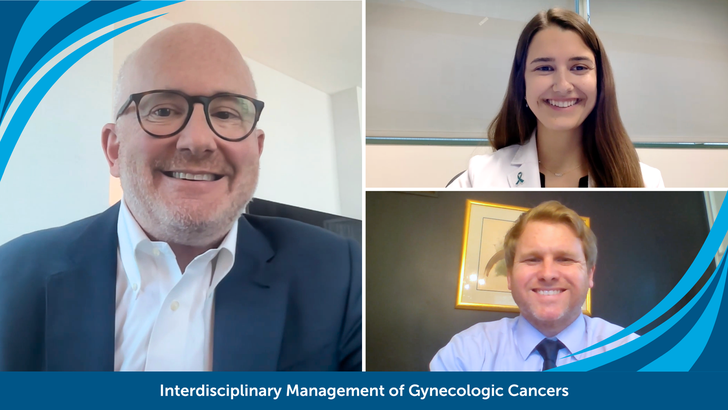
Hi. Good day. This is CE on ReachMD, I'm Dr. Brian Slomovitz. Here with me today is Michelle Flint and Casey Cosgrove.
To start today's discussion, let's talk about the interdisciplinary management of gynecologic cancers. It’s really important to come up with the best treatment options for our patients. With that, it's having a team, having different groups of individuals on our team who really are expertise in different areas, and then to use those experts to come up with the best treatment options. In cancer care, it's really according to our what we call NCCN guidelines, or sort of the best treatment practices; it's not the one best way to treat disease, but it's one of the best options to treat disease.
Michelle, Casey, starting with Michelle, can you please review your role in the interdisciplinary team for the management of our patients?
NP Michelle Flint:
Thank you, Dr. Slomovitz. So as a gynecologic oncology nurse practitioner, I often see patients at some of the lowest points of their lives. My goal is to try to make their journey with cancer a little bit easier. I try to give them autonomy with education, reduce complications through close symptom management, and coordinate their care.
A comprehensive patient assessment is really important to do this. So we look at social determinants of health, including socioeconomic status, ethnicity, insurance status, geography. All these things create disparities in cancer care, especially in reference to cervical and endometrial cancer. So these place vulnerable populations at higher risk for mortality by limiting preventative care, delays cancer diagnosis, and it limits access to advanced treatments or possibly clinical trials.
So from diagnosis through active treatment, then transitioning over to surveillance and survivorship, social workers, nutritionists, radiologists, pathologists, integrative medicine, and survivorship nurses, they all are working together to support these patients.
We also have interdisciplinary tumor boards that review patient cases, creating more individualized treatment plans, and that looks at biomarkers, comorbidities, more of a holistic view.
Dr. Slomovitz:
I think with a team, it's important to focus on people's strengths. And not only – you know, I’m not just saying this – a great, strong clinician, but you're also really one of the leading translational researchers in our field.
But I really want to hear a little bit, Casey, not only how you're doing this in the clinic, but how sometimes you go back to your lab, you scratch your head, and how do we get a better answer for those questions?
Dr. Cosgrove:
No, yeah. Thank you, Brian. And, Michelle, great points.
I think that truly, the cancer care nowadays has to be a multidisciplinary approach. And as a gynecologic oncologist, we're used to providing kind of that quarterback care for gynecologic cancers, including both surgical and medical management. But I also find myself coordinating a lot of other team members, radiation oncologists, referring medical oncologists, local radiation and medical oncologists, and kind of providing that comprehensive care.
One thing that I've really prided myself on—and it was as Brian was alluding to— we've been really integrating a lot about molecular biomarkers. And to Michelle, your point about tumor board, we're not only talking about the pathology now at our tumor boards, we're talking about all the different biomarkers that are going to help us provide the really precision medical care that our patients are expecting in contemporary oncologic care.
We're looking at the tumors and we're looking at particular markers that we can exploit and give directed patient care treatments with things like immunotherapy or antibody-drug conjugates. These are really precision medicine.
As a gynecologic oncologist and as somebody that has a translational science lab, we're looking to really identify which markers are going to have the biggest impact on patients. We're looking for markers that are going to help us give an idea about prognosis for patients so we can provide them that appropriate counseling, and then also markers that are going to provide us prediction for whether or not a treatment may or may not work.
So really, multidisciplinary care is so, so important, and as a gynecologic oncologist, making sure that I'm taking a lead and coordinating all these care plans for especially our cervical and endometrial cancer patients, which can have so many people involved in their care on a day-to-day basis.
Dr. Slomovitz:
I love it. What we're talking about today is team medicine. It's just not one person saying this is what we need to do for our patients. It's bringing together a team. The patient is the captain of the team with them or their family members, having the doctors, the surgeons, the nurse practitioners, the extenders. This is really what makes cancer care at multidisciplinary centers like ours so good, and really what's best for our patients.
So thank you both very much for those great introductions. And I look forward to the series talking about cervical and endometrial cancer. Thank you.
Announcer:
You have been listening to CE on ReachMD. This activity is provided by Prova Educationand is part of our MinuteCE curriculum.
To receive your free CE credit, or to download this activity, go to ReachMD.com/CME. Thank you for listening.
 I
I This activity was planned by and for the healthcare team, and learners will receive 1.0 Interprofessional Continuing Education (IPCE) credit(s) for learning and change.


