Transcript
Announcer:
You’re listening to Clinician’s Roundtable on ReachMD, and this episode is sponsored by Akebia Therapeutics. Here’s your host, Dr. Charles Turck.
Dr. Turck:
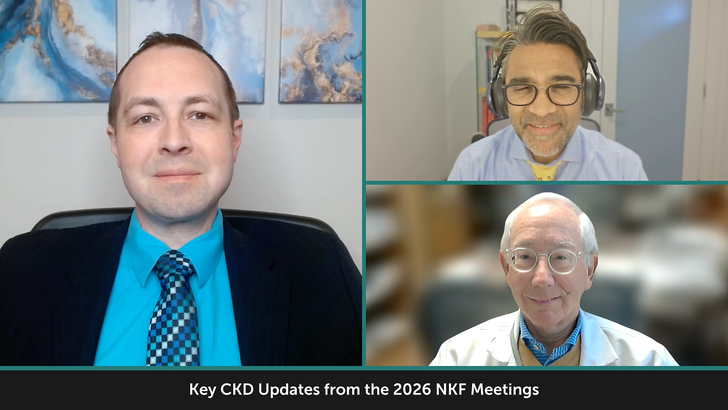
Welcome to Clinician's Roundtable on ReachMD. I'm Dr. Charles Turck, and joining me to discuss the latest clinical insights into chronic kidney disease, or CKD, from the 2026 National Kidney Foundation's Spring Clinical Meetings are Drs. Matthew Weir and Suneel Udani.
Dr. Weir is the Director of the Division of Nephrology in the Department of Medicine at the University of Maryland Hospital in Baltimore. He's also a Professor of Medicine at the University of Maryland School of Medicine. Dr. Weir, thanks for joining us today.
Dr. Weir:
It's a pleasure.
Dr. Turck:
And Dr. Udani is a consulting physician and the Medical Director of Research at Nephrology Associates of Northern Illinois and Indiana. Dr. Udani, it's great to have you with us as well.
Dr. Udani:
Thank you very much for having me.
Dr. Turck:
If we start with you, Dr. Weir, when you look across the major presentations and late-breaking data from this year's meetings, what stood out most about our evolving approach to CKD management?
Dr. Weir:
Well, there are a number of important issues. It depends on the type of cause of kidney disease. But I think some of the most exciting areas of new opportunity are in the treatment of different forms of glomerular kidney disease—particularly IgA nephropathy, where there is a whole host of new therapeutic opportunities, which, in a way, are going to provide some confusion for clinicians. But they’ll certainly open up more opportunities with regard to different treatment strategies and perhaps even combinations of therapies that will make a difference in slowing the progression of kidney disease.
Dr. Turck:
And turning to you now, Dr. Udani, as the therapeutic landscape for IgA nephropathy continues to evolve, what considerations do you think will be most important in treatment decision-making?
Dr. Udani:
Well, we're fortunate to have so many good options now, and it's rare to have win after win in clinical trials and in the therapeutic landscape. This is a great problem to have, but it does definitely complicate matters.
I think the challenges are going to be looking at sustainability of response and long-term tolerability and durability of those responses. Essentially, do people lose that response? We know that biology is a complex thing, and disease states can often find a way to evade the mechanisms that we utilize to block a pathway. The question remains, will that occur in any of the classes of medications with IgA nephropathy, whether we're talking about complement inhibition, APRIL inhibition, APRIL/BAFF inhibition, et cetera. So what we'll want to know about is sustainability, durability response, long-term tolerance and safety issues. Because again, mostly, thankfully, we've seen fairly good safety profiles or very acceptable safety profiles from the therapies that have been approved to date. But what we don't know is how that plays out in the real world and for real people not in a clinical trial setting. Do we see that sustained?
And then lastly, what we really want to see over the next few years are the effects of combination therapy. Which combinations are safe to use, and which are the most beneficial in terms of halting the disease process as best we can?
Dr. Turck:
Anemia management in CKD has also received plenty of attention this year. So with that being said, Dr. Weir, what key themes are emerging from the latest discussions and data on anemia management?
Dr. Weir:
There's been a progression in terms of our anemia management considerations. Certainly, the patients must be iron replete. There's certainly good data about the utility of intravenous iron. And once they're iron replete, we consider the use of different forms of ESAs or EPOs to facilitate better control of hemoglobin.
But in the last three or four years, there have been newer developments with the HIF-stimulating therapies to also facilitate anemia correction. And the nice thing about these drugs is they work mechanistically in an entirely different way. They're oral, and they can actually make better use of existing body iron stores, particularly if there's ongoing inflammation in the patient.
Dr. Turck:
Given these new developments, Dr. Udani, how are you approaching treatment selection today, and what factors help you identify which patients may be appropriate candidates for newer therapeutic options?
Dr. Udani:
Yeah, thankfully, again, we're having more options, and I think we've had a more liberal approach to iron replacement and supplementation as well. But the advent and approval of the oral HIF-PHI inhibitors provides another option for therapy. I think that we've all encountered patients that we know have been resistant to DSAs, whether that is ESA resistance as a whole or developed autoantibodies—DSAs.
And that's where I think this class of medication in particular has a very accessible role, because they've had experience with what is considered the standard of care and guideline-based initial choice of therapy. But having another option for those select patients that aren't responding is quite helpful, and I would like to see how that plays out, again, in that select patient population where we know we can use them safely and effectively.
Dr. Turck:
And Dr. Weir, this year's meetings also featured updated discussions about disease progression and risk stratification. So where do you think the latest data are offering more clarity for nephrologists, and what are the most important clinical questions that remain unresolved?
Dr. Weir:
Well, above and beyond the traditional therapeutic opportunities—blood pressure, cholesterol, and glucose—with, again, more intensive goals for these big three, I think there's clear evidence that we have cardiorenal disease-modifying therapies which can improve upon what we've done in the past.
And certainly, we can use renin-angiotensin system blocking therapies. There's newer data with nonsteroidal MRAs. There's exciting data with the SGLT2 inhibitors and, of course, more recent data with incretin therapies. And not only do they help facilitate some weight loss, but they also appear to have kidney protective capabilities as well.
Dr. Turck:
For those just tuning in, you're listening to Clinician's Roundtable on ReachMD. I'm Dr. Charles Turck, and I'm speaking with Drs. Matthew Weir and Suneel Udani about clinical updates in chronic kidney disease, or CKD, from the 2026 National Kidney Foundation Spring Clinical Meetings.
As we continue exploring key topics from the meetings, I'd like to zero in on the convergence of nephrology and cardiovascular medicine. So, Dr. Weir, how are newer treatment strategies for cardiovascular kidney metabolic risk changing the way clinicians think about risk reduction in CKD?
Dr. Weir:
This is a very good point, and it's an area of my own particular interest. I've long held myself out as being a cardio-nephrologist or a nephron-cardiologist, in large part because people with kidney disease die from cardiovascular disease. In fact, according to the US statistics in the Medicare population, if you have got diabetes and chronic kidney disease, you're five times as likely to die from heart failure, a heart attack, or a stroke as you are to reach end-stage kidney disease.
So really, all patients with reduced kidney function, especially if they have more albumin in the urine, require global efforts to reduce cardiovascular risk. This means more intensive control of blood pressure, more intensive reduction of LDL cholesterol, and, if they have diabetes, more intensive opportunities to improve the hemoglobin A1C.
Dr. Turck:
Since we have a growing number of disease-modifying therapies available for CKD, Dr. Udani, how are you deciding which therapies to prioritize first, and what factors influence your treatment strategies for individual patients?
Dr. Udani:
I think it is, once again, an area that we've seen some wins in, and it's really nice to see that. Again, it grows the complexity of choosing the best option. So we try to identify and really hone in on what pathophysiologic processes we think are driving the chronic kidney disease. And I think the new therapies there, or the therapies that we're using more, are SGLT2 inhibitors, GLP-1 receptor agonists, aldosterone synthase inhibitors, and mineralocorticoid receptor antagonists.
So we’re really trying to, again, hone in on which patient phenotype responds to each agent. And I think those with diabetes and more essential obesity or other complications of obesity, such as metabolic liver disease, will probably benefit from GLP-1 receptor agonists. For those that have resistant hypertension or we know have concomitant heart failure, we’re honing in on the aldosterone pathway, whether we’re talking about MRAs for patients with concomitant heart failure or diabetes or aldosterone synthase inhibitors for patients with resistant hypertension.
We're going to try to identify, again, what is the other feature, aside from their chronic kidney disease, that's adding the layer of complications to their long-term outlook and also driving the CKD progression? Naturally, this is going to be one of those things where there will be some trial and error, because we have, a priori, thoughts in terms of who will respond to what, but we know those assumptions will not always play out.
And so once we have therapeutic agents available, we'll give trials to patients, see how they respond, and then, of course, ultimately generate real-world evidence, which will help us further—hopefully—develop more clear pathways in terms of how to approach which patient, with which therapy, and when.
Dr. Turck:
Now, several discussions also highlighted the realities of implementing CKD therapies into everyday practice. From your perspective, Dr. Weir, what practical barriers are clinicians navigating here?
Dr. Weir:
Yeah, the key barriers, really, I think are threefold. First is education for the patients to understand why they need to do what they need to do. Two, obviously, is implementation based on the number of drugs that the patients already receive and obviously ensuring compliance. And three is the issue of patient access to many of these newer therapies, which unfortunately come at a premium cost. But they require extra effort to justify to the payors and pharmacy benefit managers that these drugs provide an incremental advantage over traditional therapies, which are often generic.
Dr. Turck:
And finally, Dr. Weir, what key strategies would you like to share with clinicians who are trying to translate all of this evidence and these updated recommendations into real-world treatment decisions for patients with CKD?
Dr. Weir:
We're still a ways away from what I would describe as precision-based therapeutics, rather than just saying everybody should have everything, which is completely unrealistic from a numbers standpoint. Both in terms of numbers, medication, and obviously cost, we need to be developing more important strategies to identify which patients deserve which therapies.
And whether we're talking about diabetic kidney disease, IgA nephropathy, or correction of anemia in chronic kidney disease, I think we need more information. I think for right now, the best opportunity for us is to assess the medical comorbidity that these patients have and choose therapy which solves more than one medical problem. And I think in that way, we can optimize available clinical therapeutics to our patients' best advantage. But of course, we’re reminding ourselves that we always need to educate the patients as to why they need certain therapies so that they'll be invested in their own care and will obviously be more compliant.
Dr. Turck:
Great way to round out our discussion. And I want to thank my guests, Drs. Matthew Weir and Suneel Udani, for joining me to share these insights from the 2026 National Kidney Foundation Spring Clinical Meetings and their implications for chronic kidney disease care. Dr. Weir, Dr. Udani, it was great having you both on the program.
Dr. Weir:
Thank you very much.
Dr. Udani:
Thank you very much.
Announcer:
This episode of Clinician’s Roundtable was sponsored by Akebia Therapeutics. To access this and other episodes in our series, visit Clinician’s Roundtable on ReachMD.com, where you can Be Part of the Knowledge. Thanks for listening!