Transcript
Announcer:
You’re listening to Clinician’s Roundtable on ReachMD, and this episode is supported by an independent grant from Insmed. Insmed had no editorial control over this program, and all views expressed belong to the speakers. And now, here’s your host, Dr. Alexandria May.
Dr. May:
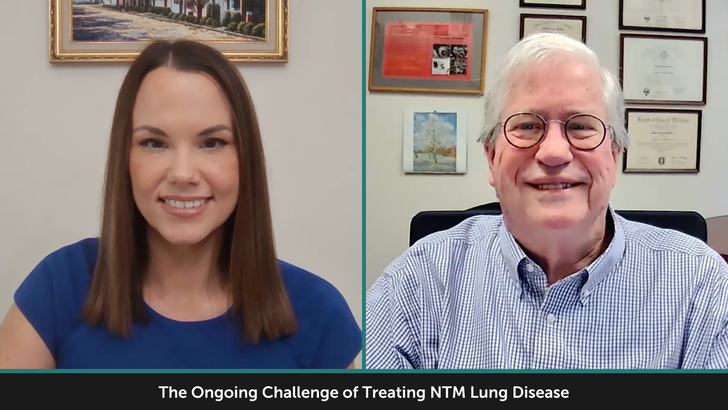
Welcome to Clinician's Roundtable on ReachMD. I'm Dr. Alexandria May, and today I'm joined by Dr. David Griffith to discuss how emerging evidence in nontuberculous mycobacterial, or NTM, lung disease could influence our approach to patient care. Dr. Griffith is a Professor of Medicine in the Division of Mycobacterial and Respiratory Infections within the Department of Medicine at National Jewish Health in Denver, Colorado.
Dr. Griffith, thanks for being here today.
Dr. Griffith:
Thank you very much for that kind introduction.
Dr. May:
Let's start with the big picture, Dr. Griffith. With a growing body of evidence in NTM lung disease, what's changed most in how we think about treatment success for our patients?
Dr. Griffith:
The definition of treatment success has generally been from a microbiological perspective. In other words, patients who have positive sputum cultures for nontuberculous mycobacteria, and specifically Mycobacterium avium complex, or MAC, are judged to be responding to therapy with conversion of their sputum from culture positive to culture negative. Now, of course, there are other metrics. Symptoms are very important to patients, of course. Radiographic to some degree. But most often, we look to conversion of sputum mycobacterial cultures from positive to negative.
Dr. May:
Why has that become such an important treatment goal, and what does it tell us about treatment success?
Dr. Griffith:
It's evolved out of tuberculosis care. That, of course, is the gold standard for treatment success in tuberculosis patients. The problem is NTM are not quite so neat and don't respond quite so favorably as TB patients. So it gets a little messy.
There was a recent study with ALIS, or amikacin liposome inhalation suspension, that showed patients did have improvement in symptoms with regimens that included ALIS compared to regimens that did not. So ALIS, in recent trials, has shown both microbiologic improvement as well as improvement in patient symptoms.
Dr. May:
Along those lines, studies like CONVERT along with subsequent real-world analyses have given us a much clearer picture of amikacin liposome inhalation suspension and its role in treatment-refractory Mycobacterium avium complex lung disease. So can you walk us through our current understanding of achieving culture conversion and identifying patients who are most likely to benefit?
Dr. Griffith:
Well, so far we have rather crude criteria or metrics for initiating treatment and deciding who to treat. There's still a lot of subjectivity in that decision. There are some patients who have advanced disease where it's very clear they need therapy; there are others who have very indolent disease. And unfortunately, we don't have good biomarkers to predict who is going to be in one of those baskets. Now, there is some good news in that realm in that there are a number of tests that are being developed to help us make that decision more objectively. So for instance, somebody with cavitary mycobacterial disease needs treatment without question. Someone maybe a little older with minimal symptoms and with management of their bronchiectasis might not need therapy, at least initially or aggressively.
Dr. May:
For those just joining us, this is Clinician's Roundtable on ReachMD. I'm Dr. Alexandria May, and I'm speaking with Dr. David Griffith about how emerging evidence is shaping the future care of patients with nontuberculous mycobacterial, or NTM, lung disease.
So, Dr. Griffith, despite the progress we've made, treatment outcomes can still vary substantially across NTM species. Where do you see the biggest unmet needs today, particularly for patients with resistant Mycobacterium avium complex disease or Mycobacterium abscessus infection?
Dr. Griffith:
Over the years of my career, we have been challenged by the treatment-refractory nature or drug-resistant nature of mycobacterium. Mycobacterium abscessus is the poster child. It's something that is difficult for many clinicians to understand. The in vitro susceptibility to antibiotics of a particular NTM, be it abscessus or MAC, frequently doesn't correlate with response by the patient to the antibiotic, and so the development of new antibiotics has been extremely slow. And particularly for Mycobacterium abscessus, there's a little bit of data that suggests a drug like omadacycline may have activity. But again, there's very little clinical data to support that impression. So the biggest need is we have to find ways to get around the innate resistance of these organisms, because the medicines that we have now are particularly for abscessus. But you could name half a dozen others, like Mycobacterium simiae, that are extraordinarily hard to treat, and they're no easier to treat now than they were twenty years ago.
Dr. May:
As you look across the current pipeline, where do you see the greatest opportunity for emerging therapies to make a meaningful difference in our patients?
Dr. Griffith:
If we might use epetraborole as an example, it has good in vitro activity against MAC. It has a good safety profile against MAC. And there's animal data that it should be effective. But in the one large trial that that has been conducted, it was no better than a regimen without epetraborole for treating MAC patients. And that's the frustration with trying to find agents to treat MAC or abscessus.
So frankly, in terms of new medications, I hesitate to say that we've got something promising on the horizon because it can look great right up until the time you give it to a person, and then it falls flat. And that's happened half a dozen times in my career in trying to treat NTM disease. I know there's a lot of interest—more interest now than there's ever been. That's the encouraging part. People are more aware of these diseases and the pathogens, and they're more interested in finding answers. So it's not that people aren't looking; it's just that we haven't cracked the code yet on how to go from the laboratory to an effective drug in a patient.
Dr. May:
We're also seeing investigators explore the use of therapies earlier in the disease course, while other approaches like inhaled clofazimine and host-directed therapies continue to move through development. Which of these strategies are you watching most closely, and what should clinicians look for in the coming years?
Dr. Griffith:
Clofazimine is another drug that has been around for a long time, and good evidence that it's effective is still elusive, and that's given its normal route of administration, which is the oral route. So if you combine that uncertainty about efficacy and a different route of administration, in this case, inhalation—I was skeptical about that from the get-go, and of course it didn't pan out. Clofazimine is a great example of why this is so hard to study because clofazimine MICs are universally low. But do people need loading doses? What’s the optimal maintenance dose? How long should they be treated? All of those are open questions for NTM and, frankly, even for MTB. So clofazimine is a good example of how hard this has been. Now, clofazimine is firmly entrenched in the armamentarium for fighting NTM disease. But it's sort of like intravenous amikacin in the sense that we just don't have a lot of data to show that it's effective.
Dr. May:
Before we wrap up, Dr. Griffith, as molecular testing and sequencing become more widely available, how are these tools helping guide treatment decisions, and where do you think we still need stronger evidence?
Dr. Griffith:
Molecular testing is a whole Pandora's box. It's a window into the complexity of this process. We talk about the microbiome in bronchiectasis patients for bacteria; it looks like there may be a microbiome for mycobacteria as well. More and more, we see multiple species of NTM from individual patients.
And then there is the question about microbiologic recurrence after successful treatment. Is it true recurrence, or is it what we term “relapse infection?” Now, that can be studied with sequencing of the different isolates. And I think what that tells me at this stage is that bronchiectasis patients have this interplay with the environment, and they pick up some and get rid of some of these mycobacteria. They kind of come and go. And what the circumstances are that create the environment for progressive or invasive disease like that is another area where we lack understanding. But those are the tools of the future. There's no doubt.
Dr. May:
That's a great comment for us to think on as we come to the end of today's program. I want to thank my guest, Dr. David Griffith, for joining me to discuss how our approach to managing nontuberculous mycobacterial lung disease is evolving. Dr. Griffith, it was great having you on the program.
Dr. Griffith:
Well, thank you very much.
Announcer:
This episode of Clinician’s Roundtable was supported by an independent grant from Insmed. Insmed had no editorial control over this program, and all views expressed belong to the speakers. To access this and other episodes in our series, visit Clinician’s Roundtable on ReachMD.com, where you can Be Part of the Knowledge. Thanks for listening!