
WHO Reporting System for Lung FNA: Diagnostic Accuracy Review
Key Takeaways
- A systematic review and meta-analysis evaluated the WHO lung cytopathology reporting system for fine-needle aspiration biopsy (FNAB) in terms of diagnostic performance.
- The review assessed risk of malignancy across WHO reporting categories and compared diagnostic accuracy using different thresholds for a positive result.
- The findings support the WHO reporting system as a standardized framework for lung cytopathology reporting and interpretation, with the "suspicious for malignancy or higher" threshold providing the best balance of sensitivity and specificity.
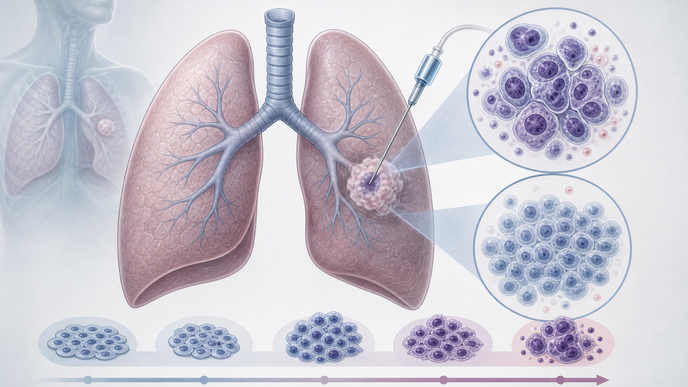
The investigators reviewed studies applying the WHO reporting system to lung FNAB specimens, using histopathology or clinical follow-up as reference standards. Diagnostic accuracy was evaluated at three thresholds for a positive cytology result: malignant only, suspicious for malignancy or higher, and atypical or higher. The meta-analysis also examined pooled diagnostic odds ratios and summary receiver operating characteristic analyses while assessing how the risk of malignancy changed across WHO reporting categories. This approach allowed the investigators to evaluate both overall test performance and the clinical interpretation associated with individual reporting categories.
Four studies met the inclusion criteria. Risk of malignancy increased progressively across the WHO reporting categories, ranging from 27% in the benign category to 92% in the malignant category. Diagnostic performance varied according to the threshold used to define a positive result. A malignant-only threshold yielded a sensitivity of 33% and specificity of 100%, whereas a threshold of suspicious for malignancy or higher achieved a sensitivity of 73% and specificity of 96%, representing the best overall balance between sensitivity and specificity. Expanding the threshold to atypical or higher increased sensitivity to 83% while reducing specificity to 84%. Aggregate diagnostic odds ratios and summary receiver operating characteristic analyses further supported the diagnostic robustness of the WHO reporting system.
Overall, the systematic review and meta-analysis supports the WHO lung cytopathology reporting system as an effective framework for standardized reporting of lung FNAB specimens. The findings indicate that reporting categories provide clinically meaningful estimates of malignancy risk while demonstrating strong overall diagnostic performance. As presented by the investigators, defining a positive result as suspicious for malignancy or higher offers the most balanced diagnostic accuracy, whereas including atypical results further improves sensitivity at the expense of specificity, supporting the system's utility in lung cytopathology interpretation.