
Virtual Reality Linked to School Participation Improvements in Children With ADHD
Key Takeaways
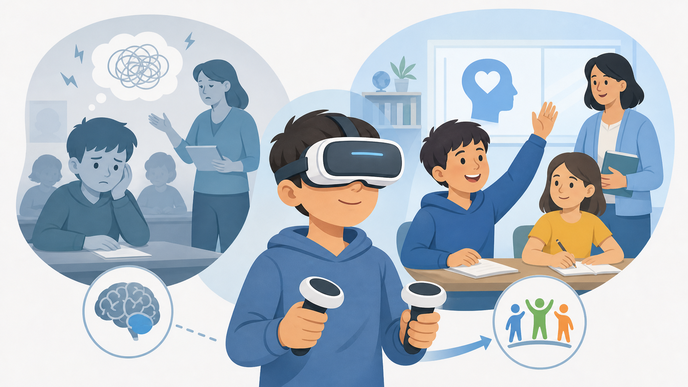
- In a randomized 8-week immersive virtual reality program in a university pediatric occupational therapy unit, children with ADHD were evaluated with teacher-rated school participation-related constructs.
- The immersive virtual reality group showed significant improvement in total School Participation Questionnaire score and all questionnaire domains. Post-intervention comparisons favored immersive virtual reality over waiting-list control across the total School Participation Questionnaire score and every domain.
- The School Participation Questionnaire reflects environmental and child determinants of school participation rather than direct participation outcomes, such as attendance frequency or involvement quality.
In a randomized trial of immersive virtual reality for school participation-related constructs, investigators enrolled 92 children aged 7 to 12 years with ADHD diagnosed by a child psychiatrist according to DSM-5 criteria. Participants were randomized 1:1 to IVR or waiting-list control, 46 per group, and teachers working in public primary schools were blinded to allocation.
IVR was delivered in a university pediatric occupational therapy unit with an Oculus Quest 2 headset and Job Simulator for 45-minute sessions twice weekly for 8 weeks, while controls received no additional therapy during the study period. Teachers completed the School Participation Questionnaire (SPQ) at baseline and after 8 weeks, and the Bruininks-Oseretsky Test of Motor Proficiency Test 2 Brief Form (BOT-2 BF) characterized motor proficiency at baseline.
Baseline SPQ scores were similar between groups, and Fine Motor Integration was the only baseline motor difference. The IVR group's SPQ total score increased from 136.6 ± 21.01 to 150.0 ± 14.45 (p < 0.001; d = 0.978). Post-intervention comparisons favored IVR across total SPQ score and all SPQ domains with p < 0.001, with large effect sizes ranging from d = 0.878 to d = 1.165. The waiting-list group showed no overall improvement as well as declines in several domains.
The SPQ captures environmental and child determinants related to school participation rather than direct participation outcomes such as attendance frequency or involvement quality. The authors also described practical constraints, including intermittent device overheating, two session-ending shutdowns, and transient simulation sickness in a small number of participants.
The trial showed greater gains in teacher-rated school participation-related constructs with IVR than with no additional therapy during the study period. The authors interpreted the program as feasible and as having potential as an adjunctive approach, while noting that the measured outcomes were participation-related constructs rather than direct participation outcomes.
Clinician Questions
What did the School Participation Questionnaire measure in children with ADHD receiving immersive virtual reality?
The SPQ captured teacher-rated environmental and child determinants of school participation, organized into doing or competence, symptoms or mind-and-body experience, being or identity, and environment. These domains reflect participation-related constructs rather than direct participation outcomes such as attendance frequency or involvement quality.
How was immersive virtual reality delivered in the ADHD school-participation trial?
The program used an Oculus Quest 2 headset with the Job Simulator application in a university pediatric occupational therapy unit for 45-minute sessions twice weekly for 8 weeks. Children completed office worker, gourmet chef, store clerk, and auto mechanic scenarios after a brief orientation, and the protocol did not include performance prompting during the tasks.
What limits how far the immersive virtual reality findings in children with ADHD can be generalized to routine school settings?
Generalizability is limited because delivery occurred in a university-based pediatric occupational therapy unit rather than in routine classrooms, the comparator was a waiting-list group that received no additional therapy, and outcomes came from teacher-completed SPQ ratings without repeated classroom observation or broader multi-informant triangulation. Those design features bound how directly the findings extend to everyday school implementation.