
US Radiology Pipeline Grows, But Workforce Strain Persists
Key Takeaways
- In the US radiology workforce, residency positions increased over time, indicating a larger training pipeline.
- Resident counts also rose, but more slowly than the growth in available positions.
- The practicing radiologist workforce increased more modestly than training-pipeline measures.
- Population-adjusted radiologist supply changed only marginally, and the authors concluded that workforce strain persists relative to population needs.
In a retrospective descriptive analysis of US radiology workforce trends, investigators used data from the National Resident Matching Program, the Accreditation Council for Graduate Medical Education (ACGME), Robert Graham Center graduate medical education tables, and the Area Health Resource File. Dataset spans were 2007-2025 for the National Resident Matching Program, 2008-2024 for ACGME, 2000-2023 for the Robert Graham Center tables, and 2010-2022 for the Area Health Resource File. The analysis assessed trends in radiology residency positions, national resident counts, practicing radiologists, and active radiologists per 100,000 population.
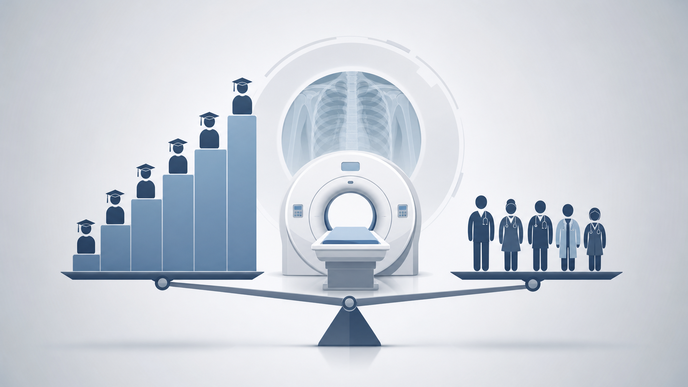
Radiology residency positions increased from 1,090 to 1,449 between 2010 and 2025, a 33% increase; total radiology residents increased from 4,584 to 5,630 between 2010 and 2024, a 23% increase; and practicing radiologists increased from 34,328 to 38,306 between 2010 and 2022, a 12% increase. Radiologists per 100,000 population changed from 11.1 to 11.5, which the authors characterized as a marginal shift.
The authors concluded that the radiologist pipeline has grown but still lags overall residency expansion and population needs. They linked limited growth in the practicing workforce, despite expanded training positions, to ongoing workforce strain. The authors also stated that expanding residency slots and mitigating workforce attrition will be necessary to address widening workforce gaps.
Clinician Questions
What part of the US radiology workforce did this analysis actually measure?
Investigators tracked US radiology residency positions, national radiology resident counts, practicing radiologists, and active radiologists per 100,000 population using four national datasets. The analysis reflects national workforce trends rather than imaging utilization, patient outcomes, or any single radiology subspecialty.
How should the near-flat radiologist-per-capita finding be interpreted in this US workforce analysis?
Within this descriptive national trend analysis, the finding suggests that growth in the training pipeline outpaced growth in the practicing workforce, leaving population-adjusted radiologist supply largely unchanged.