
Urinary LIF Predicts Recovery in Acute Interstitial Nephritis
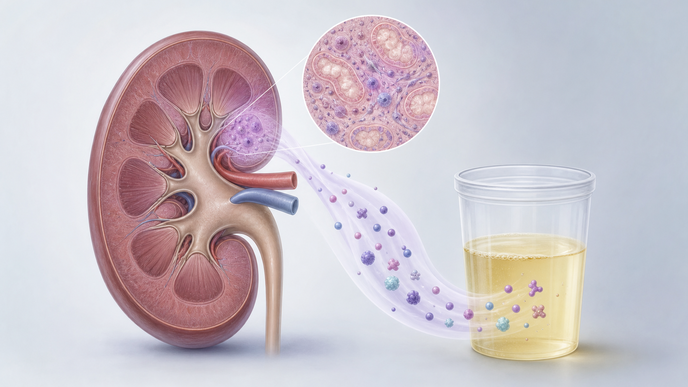
Key Takeaways
- In biopsy-proven AIN, higher LIF in urine collected at biopsy was associated with kidney recovery at 3 months.
- In the independent AIN validation cohort, adding urinary LIF increased the reported AUC from 0.88 to 0.97; the likelihood-ratio test yielded P = 0.01.
- The association between urinary LIF and AIN recovery did not differ significantly by corticosteroid exposure.
- Urinary LIF was not associated with recovery after acute tubular injury in the cohorts examined.
Investigators analyzed urine taken at kidney biopsy from 55 people with biopsy-proven AIN, measuring 5,416 proteins, including leukemia inhibitory factor (LIF). They assessed kidney recovery 3 months later and evaluated LIF in an independent AIN validation cohort. Models containing age, sex, and baseline estimated glomerular filtration rate were compared with models that also included LIF; investigators separately examined its recovery association in acute tubular injury. They measured LIF with a sandwich immunoassay and used Xenium spatial transcriptomics to compare AIN and healthy kidney biopsies, followed by tissue immunofluorescence.
Biopsy-time urinary LIF was higher among AIN participants who recovered; 40 of the 55 discovery participants had recovered by 3 months. Urinary LIF discriminated recovery with an area under the receiver operating characteristic curve (AUC) of 0.86 (95% confidence interval [CI] 0.76–0.96). Each doubling of urinary LIF was associated with 4.8-fold higher odds of recovery after full adjustment. Higher LIF was also associated with less interstitial fibrosis and tubular atrophy, while its recovery association did not significantly differ between corticosteroid-treatment groups.
Urinary LIF discriminated recovery in the independent AIN validation cohort, with an AUC of 0.84 (95% CI 0.65–1.00). Adding LIF increased the validation clinical-variable model's AUC from 0.88 to 0.97 (likelihood-ratio P = 0.01). Sandwich immunoassay measurements agreed with proteomic findings and remained associated with recovery. By contrast, urinary LIF was not associated with recovery after acute tubular injury in either cohort. In AIN tissue, mast cells and distal tubular cells expressed LIF, and expression of the downstream signaling factor suppressor of cytokine signaling 3 (SOCS3) was higher near LIF-expressing cells. These spatial observations suggest a pathway for investigation rather than demonstrating a mechanism of recovery.
The authors noted the small sample, geographic homogeneity, subjective recovery classification addressed through sensitivity analyses, lack of serial biomarker measurements, and focus on one of several proteomic candidates. Enrollment in the independent AIN validation cohort was not specified, limiting assessment of the precision of its discrimination estimates. Urinary LIF remains a candidate prognostic marker in AIN, not an established test for treatment selection; observed discrimination does not demonstrate that acting on a result improves outcomes. The absence of a recovery association in acute tubular injury does not establish diagnostic separation from AIN.
According to the investigators, urinary LIF has potential prognostic relevance for recovery after AIN across discovery and validation cohorts. They identified LIF-related kidney tissue signaling as a question for further investigation, without establishing that LIF causes repair.
Clinician Questions
Can a urinary LIF measurement distinguish acute interstitial nephritis from acute tubular injury?
Urinary leukemia inhibitory factor (LIF) concentrations did not differ between acute interstitial nephritis (AIN) and acute tubular injury in either cohort. Its association with recovery in AIN but not acute tubular injury does not mean LIF distinguishes the two diagnoses.
What protein-level kidney biopsy findings accompanied high urinary LIF and recovery in acute interstitial nephritis?
In acute interstitial nephritis, immunofluorescence showed greater SOCS3 expression and phospho-STAT3 nuclear translocation in biopsies from patients with high urinary LIF and recovery than in low-LIF/nonrecovery biopsies or healthy control tissue. These protein-level findings are distinct from spatial transcriptomic observations and do not establish that LIF causes kidney repair.